

 Phoenix 24
Speed is becoming the product itself.
Seattle, March 2026
Amazon has expanded its ultra-fast delivery model in the United States by offering one-hour and three-hour delivery options for more than 90,000 products, reinforcing a strategy that places logistics speed at the center of competition in online retail. The rollout extends across major metropolitan areas and a wider network of cities and towns, giving the company a broader platform to compete in the increasingly aggressive battle over convenience, everyday essentials and last-mile efficiency.
The new offering allows customers to order a wide range of items, from household goods and personal care products to toys and consumer basics, with delivery windows far shorter than the same-day standard that had already become one of Amazon’s main advantages. The one-hour option is being introduced in hundreds of U.S. cities, while the three-hour model has expanded into more than 2,000 locations, showing that the company is not treating the service as a premium urban experiment alone.

What matters here is not only the number of products or the faster timing, but the strategic shift behind the move. Amazon is turning rapid delivery from a membership perk into a stronger competitive weapon at a moment when retailers are under pressure to defend customer loyalty through speed, reliability and frequency of purchase. In practical terms, the company is betting that the shorter the wait, the more categories of goods consumers will be willing to buy through its platform, including items once reserved for nearby stores.
The pricing structure also underlines that this is a paid convenience layer rather than a universal free upgrade. Prime members can access one-hour and three-hour delivery for lower fees than non-members, which gives Amazon another way to strengthen the value proposition of its subscription ecosystem. That matters because delivery speed is no longer just an operational issue. It has become part of the company’s retention model, linking logistics performance directly to membership value.
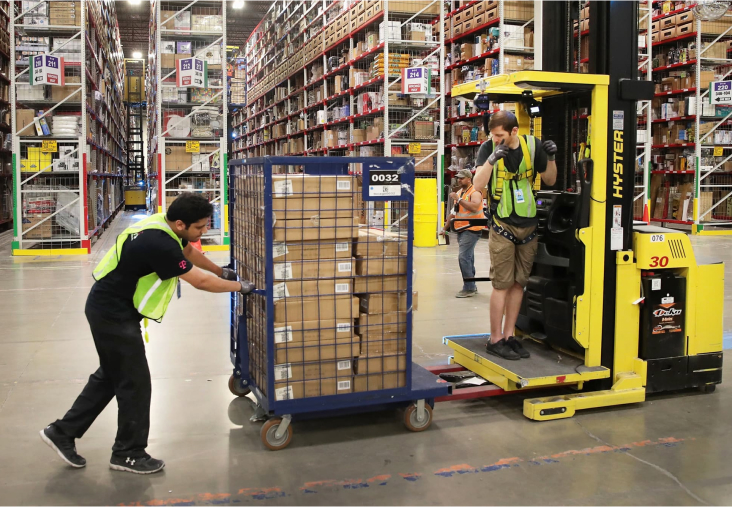
To make the system work, Amazon is relying on its existing same-day delivery network while introducing operational changes inside fulfillment sites. The company has created dedicated workstations for these accelerated orders, new package identification systems and updated internal routing to move high-priority items faster through the network. That suggests the service is not simply a marketing announcement, but a deeper adjustment in how Amazon wants parts of its retail machine to function.
The competitive backdrop is crucial. Walmart and other retailers have spent the past few years trying to narrow the convenience gap that once made Amazon’s logistics look nearly untouchable. By expanding one-hour and three-hour delivery, Amazon is trying to reassert leadership in a market where speed increasingly shapes not just customer satisfaction, but shopping behavior itself. The company has already argued that faster delivery changes what people buy, pushing them to order more frequent, more practical and more routine items online.
That behavioral shift may be the real story. Faster delivery does not only shorten waiting time. It changes the categories that consumers consider suitable for e-commerce. Essentials such as toiletries, paper goods and urgent household replacements become more viable online purchases when fulfillment starts approaching the convenience of local physical retail. In that sense, Amazon is not just accelerating parcels. It is trying to redraw the boundary between digital ordering and immediate consumption.
For now, the expansion signals a clear direction. Amazon is using delivery speed as a direct instrument of market power, customer retention and category expansion in the United States. As retail competition tightens, the company’s latest move suggests that the next stage of e-commerce will be shaped less by whether a product is available online and more by how quickly it can reach the customer’s door.
Phoenix24: clarity in the grey zone. / Phoenix24: clarity in the grey zone.