

 Phoenix 24
His latest reflection confronts censorship, passivity and intellectual obedience.
Buenos Aires, June 2026
Alberto Manguel has returned to the subject that has defined much of his intellectual career: the transformative power of reading. In a new book inspired by his long reflection on readers, libraries and written memory, the Argentine-Canadian author presents reading as a form of resistance against authoritarianism, prejudice and the simplification of public debate. His argument moves beyond the idea of books as entertainment or cultural decoration. For Manguel, attentive reading is a civic practice capable of protecting individual judgment.
The project develops ideas that have appeared throughout his essays, particularly his conviction that readers do not receive meaning passively. Every act of reading requires interpretation, comparison and a willingness to question what appears on the page. Those same faculties are essential in societies exposed to propaganda, ideological manipulation and overwhelming quantities of information. A citizen trained to read critically is more difficult to deceive because language is no longer accepted without examination.
Manguel has spent decades studying the relationship between books and human experience. His influential work A History of Reading explored how societies have read aloud and silently, privately and collectively, under freedom and persecution. Later essays examined libraries, curiosity, literary imagination and the metaphors through which readers understand themselves. The new publication places those concerns within a political and technological environment increasingly shaped by rapid consumption.
The author’s concept of resistance does not depend on a specific ideology. It begins with the reader’s refusal to accept that only one interpretation is possible. Literature introduces contradictory voices, unfamiliar experiences and characters whose motivations cannot be reduced to a slogan. By entering those worlds, readers practice the difficult task of understanding complexity without immediately eliminating disagreement.
That capacity becomes especially important when governments or political movements attempt to impose uniform narratives. Authoritarian systems have repeatedly controlled libraries, prohibited books and rewritten historical memory because they understand that reading creates alternatives. A forbidden text can preserve a version of reality that official discourse seeks to erase. Even when a book does not contain an explicit political message, the freedom to interpret it independently challenges intellectual obedience.
Manguel has previously described reading as an instrument of defense against totalitarianism, racism, antisemitism, misogyny and other forms of exclusion. His position does not suggest that every reader automatically becomes democratic or morally responsible. History includes educated tyrants and sophisticated defenders of oppression. Reading offers tools for judgment, but individuals and communities must decide how to use them.
The distinction between reading and consuming text is central to his thought. Modern users encounter thousands of headlines, notifications, posts and fragments each day, yet constant exposure to words does not necessarily produce deeper understanding. Digital platforms reward speed, emotional reaction and immediate certainty. Literature requires a different rhythm built around concentration, doubt and the possibility of returning to a passage.
For Manguel, rereading can be as important as discovering a new book. A text changes because the reader returns with additional experiences, memories and questions. The words may remain identical, but their meaning is reconstructed through a different consciousness. This dynamic relationship prevents literature from becoming a fixed monument and turns the library into a living record of personal and collective transformation.
His own biography is inseparable from that idea. As a teenager in Buenos Aires, Manguel read aloud to Jorge Luis Borges, whose declining eyesight required the assistance of others. Those encounters exposed him to a reader who moved freely across centuries, languages and literary traditions. Borges demonstrated that books communicate not only with their authors’ historical moment but also with every text that readers carry in their memories.
Manguel later became an editor, translator, novelist, essayist and director of Argentina’s National Library. His life has unfolded across several countries, including Argentina, Canada, France, the United Kingdom and Portugal. This geographical movement reinforced his understanding of the library as a portable homeland. Books allowed him to establish continuity even when languages, institutions and physical surroundings changed.
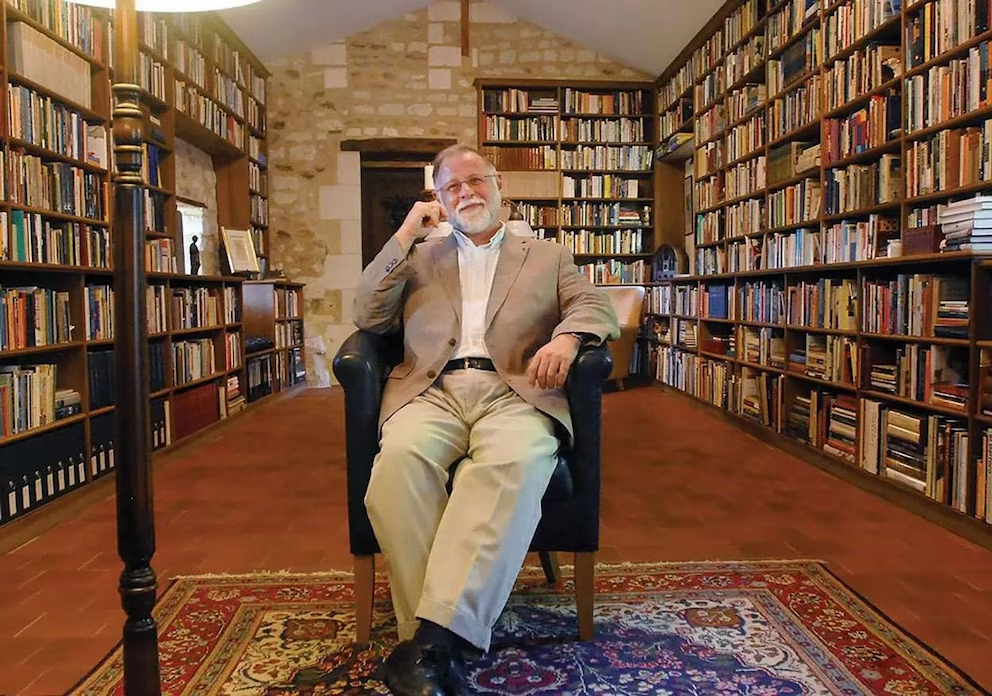
That personal library eventually grew to approximately 40,000 volumes. Manguel donated the collection to Lisbon, where it became the foundation for a center dedicated to the history of reading. The project, known as Espaço Atlântida, seeks to make the collection available to researchers and the public rather than preserve it as a private monument. The decision transformed personal memory into shared cultural infrastructure.
Libraries occupy a crucial place in his defense of reading because they represent more than storage. They organize encounters between generations, protect fragile documents and allow readers to discover works they were not originally seeking. Their public character also challenges the idea that knowledge should belong exclusively to those able to purchase it. A functioning library is therefore both an intellectual institution and an expression of democratic access.
The new book arrives during renewed disputes over censorship, educational curricula and the removal of controversial titles from libraries. Around the world, books addressing race, sexuality, religion, colonialism and political violence have become targets of organized campaigns. Supporters of restrictions often claim to protect children or community values. Critics argue that eliminating difficult texts prevents readers from confronting the realities those books describe.
Manguel’s perspective rejects the assumption that protection requires intellectual isolation. Readers, including young readers, need guidance and context, but they also need opportunities to encounter uncertainty. A society that removes every disturbing idea does not create stronger citizens. It produces individuals less prepared to recognize manipulation when it appears outside the controlled environment of a classroom or library.
Artificial intelligence introduces another dimension to this debate. Automated systems can summarize books, generate interpretations and answer questions within seconds. These tools may expand access to information, but they can also encourage users to substitute generated conclusions for direct engagement with a text. Manguel’s philosophy suggests that the value of reading lies partly in the effort that cannot be delegated.
The struggle with ambiguity, the pause before understanding and the disagreement with an author all contribute to the reader’s intellectual formation. A summary can transmit a plot or argument, but it cannot reproduce the private process through which a person discovers meaning. Technology may assist reading, yet it cannot assume the moral and imaginative responsibility of the reader.
Manguel’s resistance is therefore quiet but demanding. It takes place when someone opens a book, gives sustained attention to another voice and refuses to let algorithms, authorities or social pressure determine the only permissible conclusion. The act may appear solitary, but its consequences are public. Independent readers form communities capable of questioning inherited narratives and imagining alternatives.
The book does not promise that literature will defeat intolerance or prevent political violence by itself. Its claim is more precise: without readers capable of interpreting language critically, democratic life becomes easier to manipulate. Reading preserves the space between a statement and its acceptance. Inside that space, judgment, memory and freedom remain possible.
Leer también es negarse a obedecer sin pensar. / Reading also means refusing to obey without thinking.