

 Phoenix 24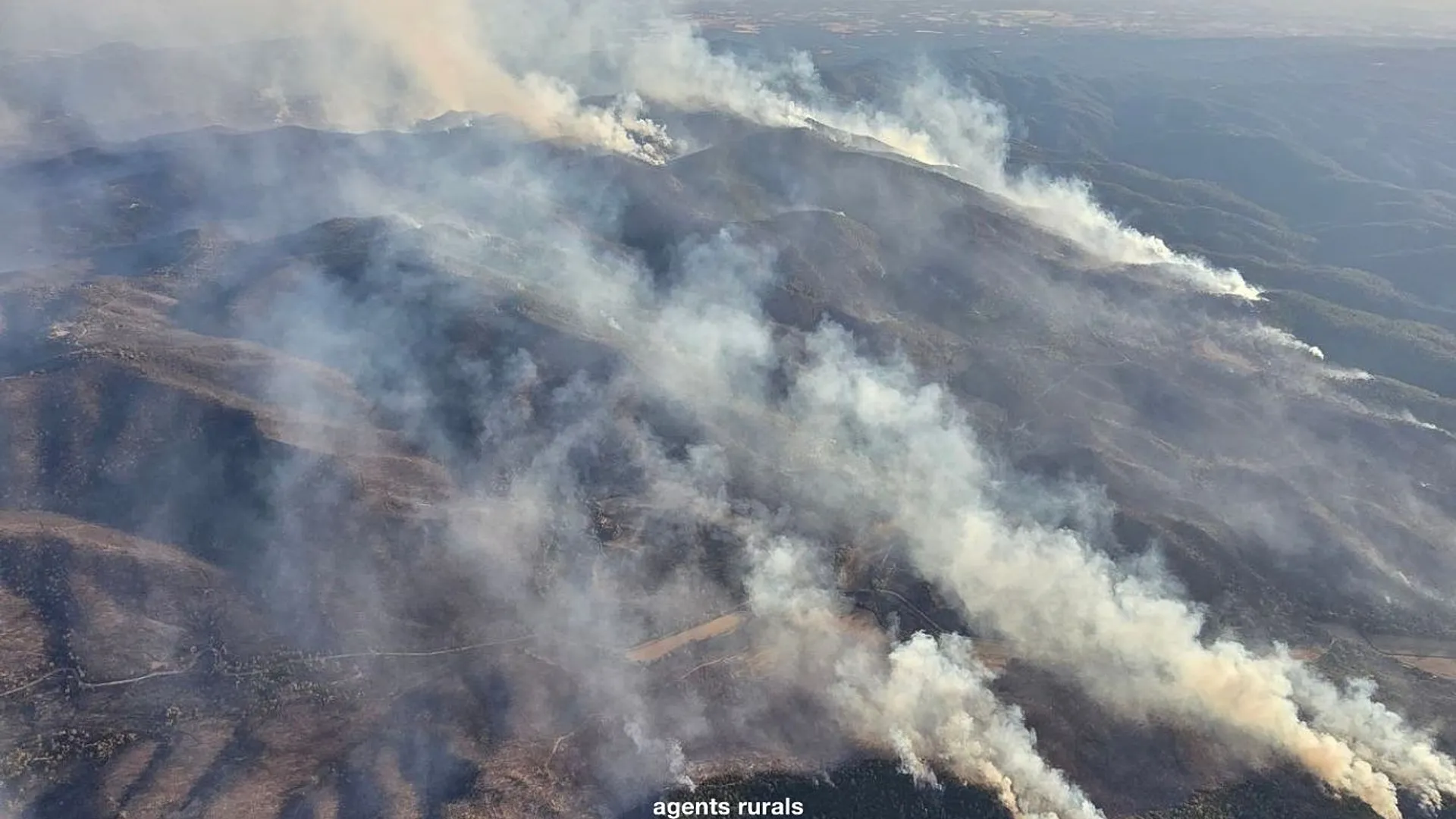
Thousands confined as flames challenge firefighters.
GIRONA, SPAIN — July 2026.
A major wildfire in Spain’s Costa Brava has burned around 2,200 hectares and forced approximately 12,000 people to remain indoors across several municipalities. Authorities warned that the blaze could eventually affect the entire 30,000-hectare Les Gavarres natural area if weather and terrain allow it to expand. Catalan President Salvador Illa ordered the closure of the massif as emergency teams worked to contain the most dangerous fronts. No serious injuries had been reported, although buildings, gardens and fences were damaged as flames moved through forested and residential zones.
Roughly 500 personnel worked through the night, including one hundred members of Spain’s Emergency Military Unit, while ten aerial resources joined the operation after daylight. Firefighters concentrated on securing ground gained overnight before the arrival of the coastal sea breeze, which was expected to increase fire activity around midday. Officials said about seventy percent of the right flank had been stabilized, but the opposite side remained active and continued climbing toward Puig d’Arques. The steep slopes and two-sided advance complicated containment efforts between Cruïlles, Romanyà de la Selva and Sant Sadurní de l’Heura.
Emergency authorities maintained partial confinement orders in seven municipalities, including La Bisbal d’Empordà, Calonge i Sant Antoni, Platja d’Aro and several nearby communities. Residents were repeatedly asked to remain inside because officials considered travel more dangerous than sheltering in homes while the fire front remained unpredictable. Children staying at a camp facility in Romanyà de la Selva spent the night in a municipal sports hall under Red Cross supervision. Two regional roads remained closed, while another route near Palafrugell was reopened after authorities reviewed conditions.
A towering smoke plume reached an estimated height of 4.2 kilometers and was visible far beyond the immediate fire zone before dispersing overnight. Smoke from the blaze reportedly travelled as far as Mallorca, illustrating the scale of the atmospheric impact created by the fire. Fire officials urged residents and visitors not to approach affected areas, warning that unnecessary movement could obstruct emergency operations. The instructions also reflected lessons from previous European wildfire disasters in which people were trapped while attempting to flee by road.
The fire has already destroyed an unoccupied house near Cabanyes de Calonge and a traditional rural property, while damaging outdoor areas surrounding other homes. Monells was identified as one of the most severely affected locations, although some patches of vegetation remained untouched inside the burned perimeter. Four firefighters suffered minor injuries but were able to return to duty, according to the Catalan government. The absence of major casualties offered limited relief as officials continued preparing for the possibility of a much larger emergency.
Investigators detained a worker suspected of accidentally starting the fire while using an angle grinder, and authorities said the case would be referred to judicial officials. Illa stated that investigators would examine not only the individual’s actions but also whether the employer carried any responsibility for the incident. The investigation adds a legal and workplace-safety dimension to an emergency already shaped by extreme heat, dry vegetation and difficult terrain. Another fire in Fontcoberta, linked to agricultural work, was brought under control after burning roughly 35 hectares.
The emergency comes as Catalonia prepares for another heatwave expected to begin immediately and continue until midweek. Authorities warned that the weather could force the closure of additional natural areas as temperatures rise and vegetation becomes more combustible. Official risk assessments placed 132 Catalan municipalities under very high wildfire danger and another 491 under high danger. Those figures show that the Costa Brava blaze is not an isolated event but part of a broader regional exposure to severe fire conditions.
The Costa Brava is one of Spain’s most important tourism regions, combining coastal resorts, historic towns, forested hills and protected natural landscapes. A prolonged fire could therefore carry consequences beyond the immediate destruction of vegetation and property, affecting transport, tourism, local businesses and public health. The closure of Les Gavarres also restricts access to an ecologically valuable area that connects inland forests with densely visited coastal zones. Authorities must balance suppression efforts with public communication in a region where summer population levels can increase rapidly.
The coming hours will be decisive because containment depends on wind, temperature, humidity and the ability of crews to secure unstable terrain before conditions deteriorate. Officials have avoided declaring the fire controlled, emphasizing instead that one flank remains capable of advancing through the massif. The possibility of 30,000 hectares burning represents a worst-case scenario rather than a confirmed outcome, but it explains the scale of the preventive measures. For communities across the Costa Brava, the immediate priority remains disciplined confinement, unrestricted access for emergency teams and vigilance as the new heatwave approaches.
Phoenix24 — Global news with clarity and perspective.