

 Phoenix 24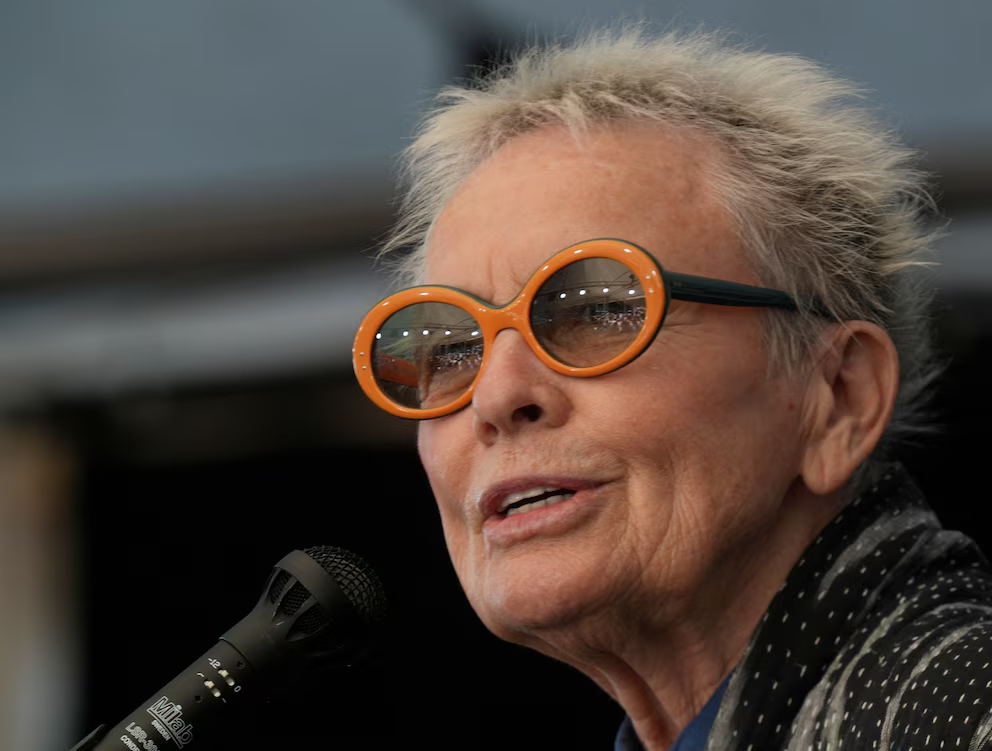
Her new performance in Central Park transformed American history, poetry and political unease into an open-air meditation on love and liberty.
New York, June 2026
Laurie Anderson brought Republic of Love to New York as a free outdoor performance that combined experimental music, spoken word, political reflection and literary memory. Presented at Central Park’s SummerStage with the jazz quartet Sexmob, the work examined the condition of the United States through stories, songs and fragments drawn from some of the country’s most influential artistic voices. Anderson described the project as a celebration of freedom, although its tone moved continually between humor, warning, tenderness and uncertainty. Rather than offering a conventional concert, she constructed a shifting conversation about what freedom means when democratic ideals coexist with fear, inequality and social division.
The performance originated from an invitation Anderson received to speak for two hours about the relationship between government and love. That unusual premise developed into a larger multimedia work exploring whether affection, empathy and civic responsibility can occupy a meaningful place within political life. Anderson avoided reducing the theme to a simple declaration of patriotism or protest, instead presenting freedom as a fragile practice that must be repeatedly examined and defended. Her approach treated the United States not as a fixed national idea but as an unfinished narrative shaped by contradictory voices.
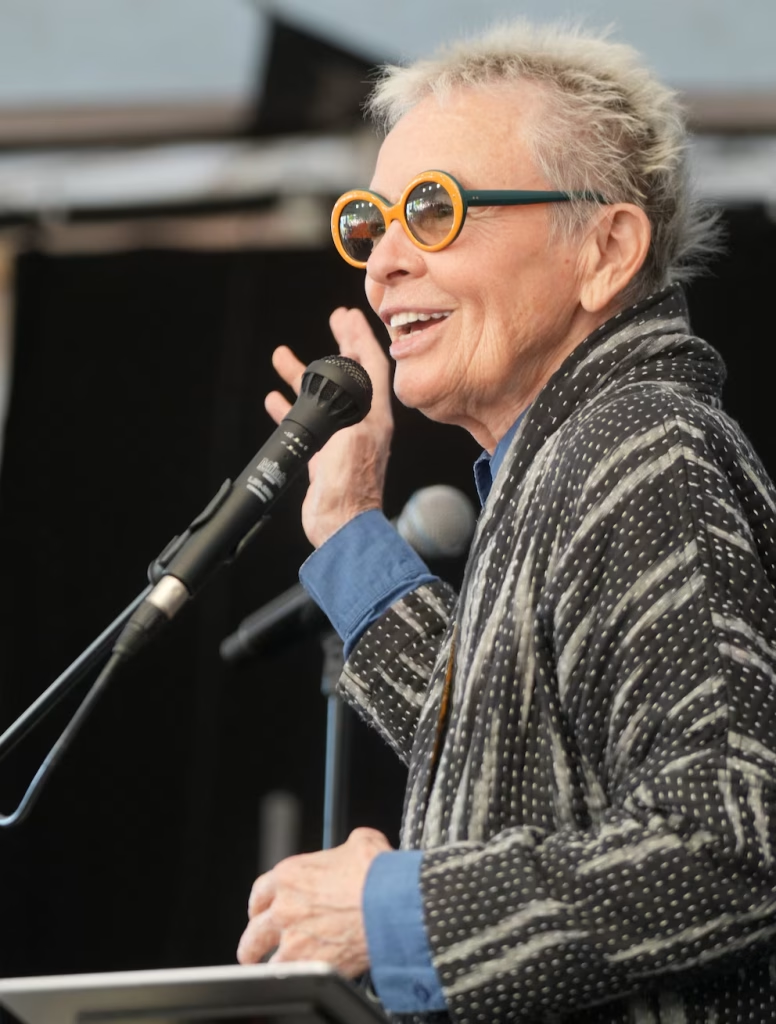
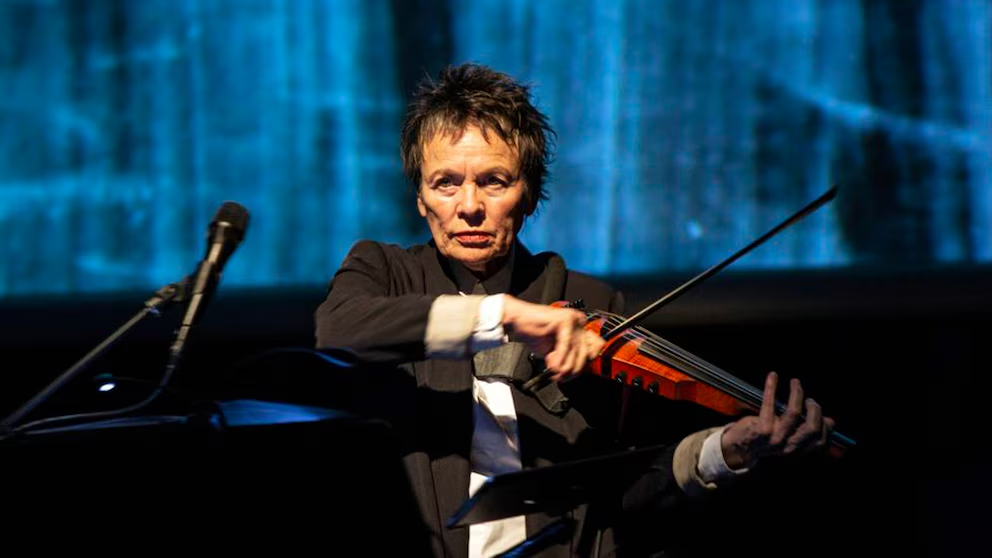
Sexmob provided the musical architecture for the evening through its combination of trumpet, saxophone, bass and percussion. The ensemble, known for improvisation and unconventional reinterpretations, supported Anderson without converting the performance into a traditional jazz concert. Its musicians responded to her speech patterns, violin passages and electronic textures, creating an atmosphere in which language and sound appeared to evolve together. The result allowed familiar material to become unpredictable, reflecting Anderson’s longstanding belief that performance should remain open to accident and discovery.
Several of Anderson’s earlier works were reconsidered within this new context, including material associated with Big Science and “Language Is a Virus.” Those pieces originally emerged from her exploration of technology, communication and American power, but their meanings have continued to change as society has become more dependent on screens, algorithms and automated language. By returning to them decades later, Anderson demonstrated how experimental art can preserve its relevance when the anxieties it identified become part of ordinary life. The older material did not function as nostalgia, but as evidence that many of her questions about authority and communication remain unresolved.
The performance also incorporated words and ideas connected with Bob Dylan, Gertrude Stein, John Cage, William S. Burroughs, Allen Ginsberg and Lou Reed. These references were not presented as formal tributes or historical lectures, but as voices entering a larger American conversation. Each artist challenged conventional language in a different way, whether through Dylan’s reinvention of song, Stein’s repetition, Cage’s attention to silence, Burroughs’s fragmentation or Ginsberg’s expansive poetic dissent. Anderson placed herself within that lineage while allowing the borrowed ideas to interact with the present moment.
Bob Dylan’s influence was particularly appropriate because his career has repeatedly connected artistic freedom with resistance to expectation. His songs have moved through folk, rock, gospel, blues and other traditions without accepting a stable identity, making reinvention itself part of his creative method. Anderson’s performance echoed that refusal to remain confined within one genre, combining concert, lecture, theatre and political meditation. The connection was less about reproducing Dylan’s music than about sharing his insistence that language can be reshaped whenever familiar forms become insufficient.
Gertrude Stein offered a different model of freedom through her radical treatment of syntax, rhythm and repetition. Her writing disrupted ordinary patterns of comprehension and invited readers to experience words as sounds, shapes and movements rather than as transparent carriers of information. Anderson has long worked from a similar understanding, using repeated phrases and altered vocal techniques to reveal how language can influence perception. Stein’s presence in Republic of Love therefore reinforced the idea that freedom also involves escaping inherited structures of expression.
The references to Lou Reed carried a more personal dimension. Anderson and Reed shared a long artistic and personal partnership before his death in 2013, and his work continues to appear within her performances as memory, dialogue and emotional presence. Rather than treating grief as a closed chapter, Anderson often allows it to coexist with humor and curiosity. In this performance, Reed’s words became part of a broader examination of how the voices of absent people continue shaping the living.
The political dimension of Republic of Love remained unmistakable, but Anderson avoided the language of a campaign speech. She approached the condition of the country through images, anecdotes and philosophical questions rather than partisan instructions. This indirect method allowed the performance to acknowledge national anxiety without telling the audience exactly what conclusion to reach. Freedom emerged not as a slogan belonging to one political group, but as a contested principle whose meaning depends on who is permitted to speak, move and participate.
Anderson’s humor prevented the evening from becoming solemn or doctrinaire. Her performances frequently move from absurd observations to profound emotional territory without announcing the transition, creating an atmosphere in which laughter and discomfort can occupy the same moment. That tonal flexibility is central to her art because it resists the idea that serious political reflection must always appear severe. Humor becomes another form of freedom by interrupting certainty and exposing the strange assumptions hidden inside ordinary behavior.
The Central Park setting strengthened the work’s democratic character. SummerStage presented the performance without an admission charge, allowing people with different backgrounds and levels of familiarity with experimental art to share the same public space. An outdoor concert cannot control every sound or movement, so traffic, weather and audience reactions become part of the experience. For an artist interested in chance and environmental awareness, those interruptions did not necessarily weaken the work; they extended its conversation with the city.
The show also arrived during the fortieth anniversary season of SummerStage, a program created to bring music and performance into parks across New York’s five boroughs. Its public format reflected the central themes of Anderson’s work by connecting artistic freedom with access to shared cultural spaces. A meditation on democracy carries a different significance when performed in a park rather than inside an exclusive institution. The audience was not simply consuming a production but participating in a temporary civic gathering.
Anderson’s career has consistently crossed boundaries between visual art, electronic music, film, literature and technological experimentation. She became internationally known through “O Superman,” but her larger body of work has resisted the commercial categories that usually define musicians. She has served as NASA’s first artist-in-residence, created performances about surveillance and disaster, and developed works involving virtual reality and artificial intelligence. Republic of Love continued that trajectory while returning to some of the most enduring instruments available to an artist: voice, memory and collective listening.
At the center of the performance was a question about whether love can function as a political force without becoming sentimental. Anderson did not propose that affection alone can solve institutional crises or erase conflict, but she suggested that public life becomes dangerous when empathy disappears completely. Government may operate through laws, budgets and authority, yet its consequences are experienced by individual bodies and families. By placing love beside power, she exposed the moral distance that political language often creates.
Freedom in Anderson’s performance was therefore neither absolute nor comfortable. It required attention to history, willingness to hear unfamiliar voices and recognition that language can liberate or manipulate. The presence of Dylan, Stein and other artistic figures illustrated how creative freedom often begins by violating rules that previously appeared permanent. Their echoes gave the evening a historical depth while Anderson’s own observations kept it firmly connected to contemporary America.
Republic of Love ultimately offered no final definition of the nation it examined. Instead, it assembled fragments of music, literature and personal experience into a space where contradiction could remain visible. Anderson celebrated freedom not by declaring that it had already been achieved, but by demonstrating the artistic imagination required to keep questioning its limits. The performance became both a tribute to American creativity and a reminder that liberty loses meaning when it is reduced to repetition without reflection.
La libertad permanece viva cuando el arte se atreve a cuestionar quién puede definirla. / Freedom remains alive when art dares to question who is allowed to define it.
e