

 Phoenix 24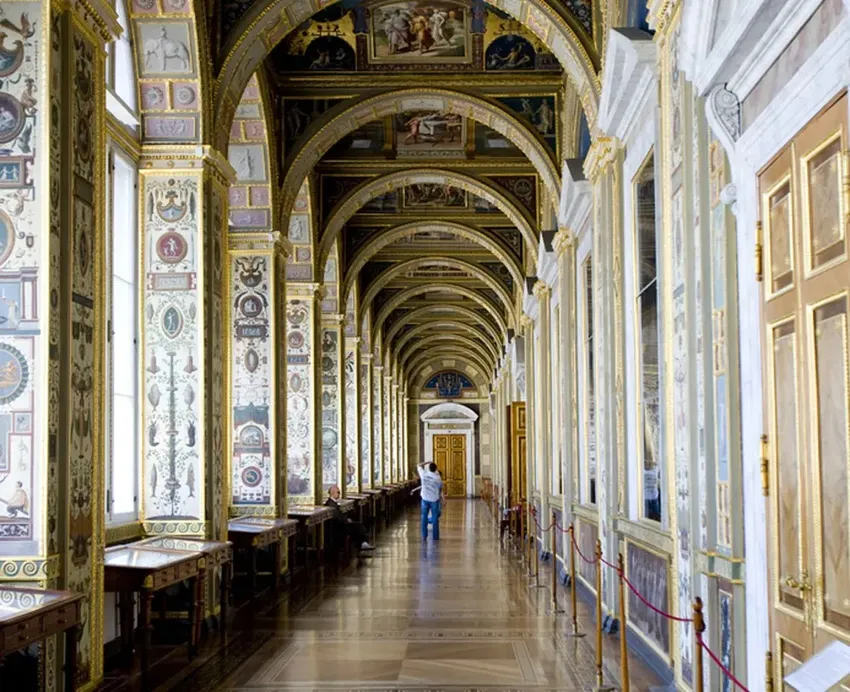
Lasers, digital imaging and protective glass will safeguard a Renaissance treasure.
Vatican City, June 2026
The Vatican has launched an ambitious five-year restoration of the Raphael Loggia, one of the most extraordinary yet least accessible artistic spaces inside the Apostolic Palace. The project will clean and stabilize a 65-meter corridor decorated with biblical scenes, botanical motifs and elaborate stucco conceived by Raphael during the final years of his life. The intervention is the first comprehensive restoration of the loggia in more than five centuries. Its objective is to recover the brilliance of the original decoration while protecting an exceptionally fragile ensemble from light, humidity and environmental deterioration.
Unlike the Sistine Chapel or the Raphael Rooms, the loggia is not included in the Vatican Museums’ regular public itinerary. It occupies the second floor of the Apostolic Palace and overlooks the Courtyard of San Damaso. Popes, presidents, diplomats and other official visitors frequently pass through it on their way to audiences or meetings with the Secretariat of State. Its restricted location has helped preserve an atmosphere of exclusivity, but it has also kept one of Raphael’s most influential creations largely hidden from millions of visitors.
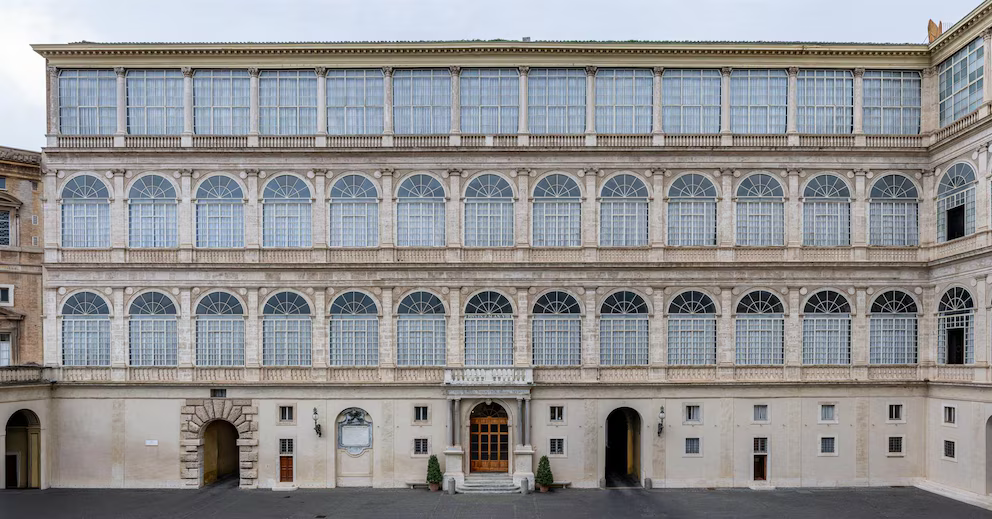
The corridor was conceived between 1517 and 1519 for Pope Leo X, a member of the Medici family and one of the Renaissance’s most important artistic patrons. Raphael designed the decorative program shortly before his death in 1520, while a large workshop of assistants carried out much of the painting and stucco work under his direction. Among the artists involved was Giovanni da Udine, celebrated for his skill in ornamental decoration and naturalistic motifs. Their collaboration transformed an architectural passageway into a unified visual universe.
The loggia consists of 13 arched bays filled with 52 biblical episodes drawn from the Old and New Testaments. The scenes include the Creation, Noah’s Ark, the stories of Abraham, Moses, David and Solomon, as well as events from the life of Christ. Because of their scale and arrangement, the compositions became known as “Raphael’s Bible.” Religious narratives are surrounded by animals, flowers, mythological figures, architectural fantasies and decorative forms inspired by ancient Roman art.
That ornamental language was strongly influenced by the rediscovery of the Domus Aurea, Emperor Nero’s ancient palace in Rome. Renaissance artists entered its buried chambers and studied the delicate designs covering the walls and ceilings. Those decorations became known as grotesques, a term derived from the cave-like spaces in which they were found. Raphael and his collaborators adapted the style with extraordinary freedom, combining antiquity, Christian imagery and observations of the natural world.
The loggia’s fame spread rapidly throughout Europe. Artists, architects and rulers copied its visual vocabulary in palaces, villas and decorative arts. Its influence became so extensive that a full-scale replica was created for the Hermitage in Saint Petersburg during the late 18th century. The Russian version allowed imperial visitors to experience Raphael’s design far from Rome. The Vatican original, however, remained vulnerable to the particular environmental conditions of the Apostolic Palace.
Until 1813, the corridor was open to the exterior. Rain, wind, dust and changes in temperature gradually damaged the paintings and stucco. Windows installed during the 19th century protected the loggia from direct exposure but created new conservation problems by trapping heat and humidity. Sunlight entering through the glass also contributed to fading and deterioration. The combination left many sections in an extremely delicate condition.
Restorers must now work with materials that cannot tolerate conventional cleaning. Many of the pigments are water-soluble, meaning that moisture could remove or permanently alter the original paint. Chemical solvents present similar risks. Specialists will therefore use controlled dry-cleaning methods and handheld laser equipment to remove dirt from painted surfaces and stucco without disturbing the underlying decoration.
Laser technology allows conservators to target deposits with exceptional precision. Energy can be adjusted according to the material, condition and thickness of the contamination being removed. The method has already been used successfully in the restoration of sculpture, architectural surfaces and Renaissance art. In the Raphael Loggia, it will be combined with detailed visual examination, scientific analysis and manual treatment.
The windows will also be replaced with a new protective system. Special glass will filter ultraviolet radiation responsible for damaging pigments and organic materials. Improved environmental control is intended to limit temperature fluctuations and reduce the accumulation of humidity. These measures are essential because restoring the paintings without correcting the conditions that harmed them would only postpone future deterioration.
The physical restoration has been valued at approximately $5.5 million and is being carried out in partnership with the World Monuments Fund. Financing comes from the Stephen A. Schwarzman Foundation, whose broader contribution exceeds $14 million. The additional resources will support digital documentation, public access initiatives, a documentary film and professional training in conservation. The project therefore extends beyond repairing the corridor itself.
High-resolution digital images will allow researchers and the wider public to examine details that are normally inaccessible. The technology can record color, texture and damage before, during and after the intervention. It will also create a permanent archive for future conservation work. For a place closed to ordinary visitors, digitization offers a way to share the loggia without exposing it to the risks generated by heavy tourism.
The restoration follows the completion of a decade-long project in the Vatican’s Room of Constantine, where specialists uncovered new evidence about Raphael’s experimental techniques. That intervention confirmed that the artist used oil directly on prepared wall surfaces in parts of the room. Discoveries of this kind demonstrate how conservation can change art history as well as improve appearance. The Raphael Loggia may also reveal information about workshop organization, materials and the division of labor among the master’s assistants.
The project carries special importance because the corridor remains part of the Vatican’s ceremonial life. It is not a preserved ruin separated from its original function, but an active passage inside the papal residence. Conservation work must therefore respect security, official schedules and the daily operations of the Holy See. Teams are expected to proceed bay by bay so that the intervention can continue without completely disrupting the surrounding palace.
When the five-year program concludes, the loggia will not necessarily become part of the standard museum route. Its architectural position and ceremonial use make unrestricted access difficult. The digital component will therefore be crucial in making the restored decoration available beyond the small number of people who physically enter the corridor. The project seeks to preserve both its institutional role and its universal cultural value.
Raphael conceived the loggia during one of the most productive periods of the High Renaissance. Five centuries later, science and technology are being used to protect the imagination he placed across its walls and ceilings. The restoration will recover colors and forms obscured by time, but its deeper purpose is continuity. A hidden masterpiece will remain alive inside the Vatican while becoming more visible to the world.
Preservar también significa volver a mirar. / Preservation also means learning to look again.