

 Phoenix 24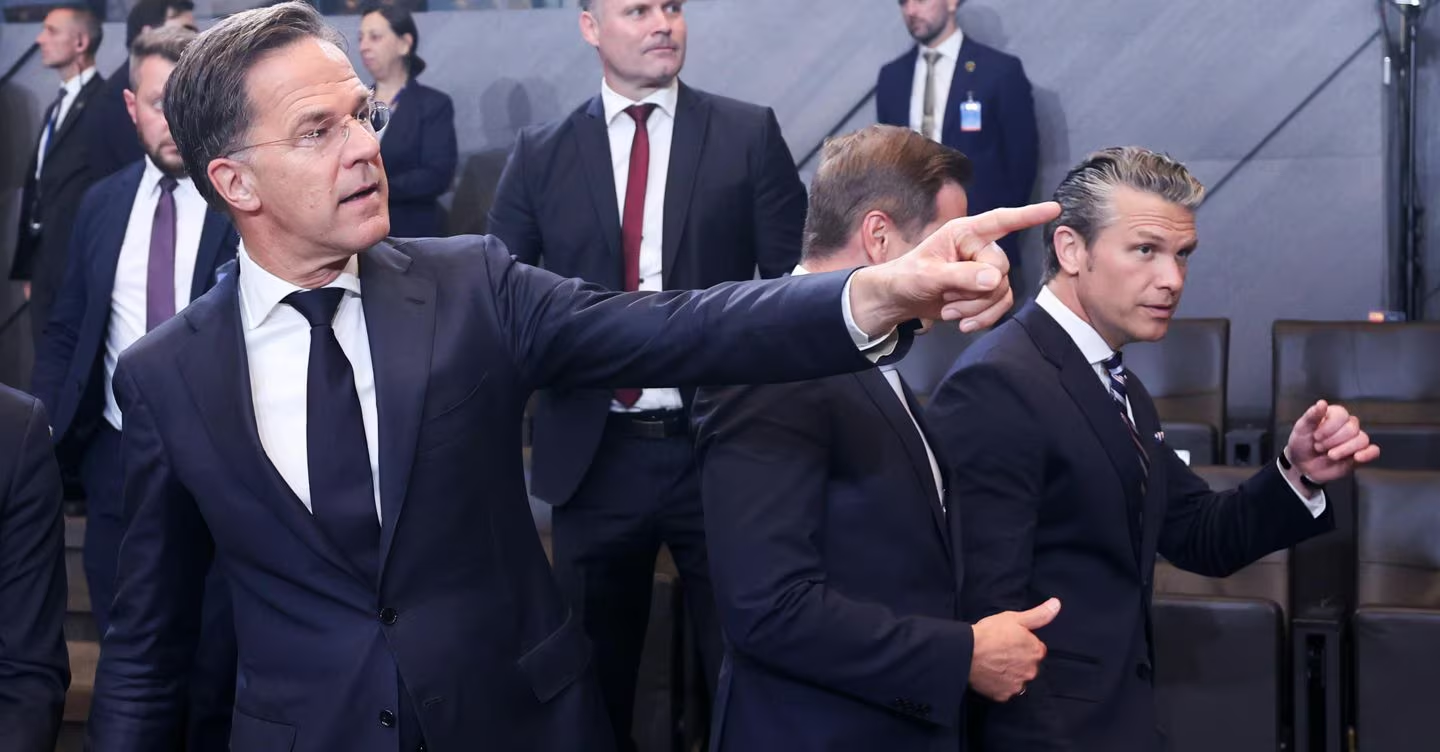
A disputed number exposed Europe’s hidden role in the Iran war.
Rome, June 2026
NATO Secretary General Mark Rutte has ignited a political controversy in Italy after claiming that 500 United States military aircraft took off from American bases on Italian territory to support Operation Epic Fury, the US-Israeli campaign against Iran. The statement appeared intended to demonstrate that European allies had contributed substantially despite criticism from President Donald Trump. Instead, it provoked an immediate rebuttal from the Italian government, which insisted that it had authorized only technical and logistical activities. The dispute now centers on whether Rutte described routine support operations accurately or created the misleading impression that Italy participated directly in combat.
Rutte made the assertion during an interview ahead of his meeting with Trump at the White House. He defended European allies against accusations that they had abandoned Washington during the conflict and presented the continent as a vital platform for American military power. According to the NATO chief, thousands of US aircraft had operated from European bases, including approximately 500 departures from facilities in Italy. He cited the figure as evidence that allied cooperation had been more extensive than governments publicly acknowledged.
The reference immediately placed Prime Minister Giorgia Meloni’s administration under pressure. Her government had repeatedly maintained that Italy had not authorized its territory to be used for direct attacks against Iran. Opposition politicians demanded an explanation, arguing that either Rutte’s account contradicted the government’s statements or the secretary general had confused noncombat operations with participation in the bombing campaign. The controversy became especially sensitive because Italian military involvement abroad is constrained by constitutional rules and parliamentary oversight.
Defence Minister Guido Crosetto firmly rejected any suggestion that Italy had permitted combat missions. He stated that the country acted in accordance with its Constitution, international treaties and bilateral agreements governing American military installations. Rome had authorized support of a technical, defensive and logistical nature, but requests associated with direct offensive action had not received approval. Crosetto also argued that Rutte had no operational role in the campaign and was therefore not positioned to characterize individual flights definitively.
NATO later attempted to clarify the secretary general’s remarks. Alliance officials indicated that the flights referenced by Rutte included routine movements, logistics and support activities conducted through existing arrangements between Italy and the United States. The explanation sought to separate aircraft departing from Italian territory from aircraft conducting attacks directly against Iranian targets. That distinction is central because the phrase “supporting the operation” can include transportation, refueling, maintenance, intelligence and defensive missions without necessarily involving weapons delivery.
Italy hosts an extensive network of American military facilities, making it one of Washington’s most strategically important European partners. Aviano Air Base in the north and Naval Air Station Sigonella in Sicily provide access to the Mediterranean, North Africa and the Middle East. Other installations support communications, logistics, naval operations and intelligence. Their location allows the United States to move personnel and equipment rapidly toward several regions without relying exclusively on bases closer to an active conflict.
The presence of American forces does not mean Washington can use every facility without restrictions. Bilateral agreements and Italian law govern the activities permitted from each installation, while politically sensitive operations may require specific national authorization. Governments often avoid publishing complete operational details because doing so could expose military capabilities or diplomatic arrangements. That secrecy can create uncertainty when foreign officials offer public descriptions that differ from the host government’s language.
The number of flights also requires careful interpretation. Five hundred aircraft departures do not necessarily represent 500 bombing missions or even 500 separate planes. A single aircraft may take off multiple times during a prolonged operation, and support missions can include tankers, cargo planes, surveillance platforms and aircraft transporting personnel. Without a detailed breakdown, the figure cannot independently establish whether Italian territory was used to launch direct attacks.
Rutte’s broader estimate suggested that between 4,000 and 5,000 American aircraft movements occurred from European bases during the campaign. He used the figure to challenge Trump’s assertion that major European allies had provided little meaningful assistance. The NATO chief described Europe as a platform for American power projection into the Middle East and Africa. His argument emphasized that the Alliance’s value extends beyond formal collective-defence operations.
Trump nevertheless continued criticizing Italy, Spain, Germany, France and the United Kingdom for failing to provide the level of support he expected. He praised Poland and Turkey as more reliable partners and framed cooperation with Washington as a test of political loyalty. That interpretation goes beyond NATO’s treaty obligations because the Alliance had not collectively approved the campaign against Iran. Individual countries therefore retained the legal authority to decide whether and how they would participate.
Rutte’s intervention placed him in a difficult institutional position. As NATO secretary general, he must preserve relations with the United States while respecting the sovereignty and public statements of all 32 members. Defending allied contributions may reassure Trump, but revealing or overstating sensitive operational details can damage trust with national governments. The Italian reaction shows how easily diplomatic reassurance in Washington can generate political consequences elsewhere.
The dispute also reveals the ambiguity surrounding modern military participation. A country can oppose a war publicly while still providing airspace, refueling, communications or logistical support through existing agreements. Those activities may be essential to sustaining an operation even when they do not constitute direct combat. Governments often describe this distinction as legally and politically decisive, while critics argue that logistical support still contributes materially to warfare.
For Meloni, the issue threatens both domestic credibility and her relationship with Trump. She has cultivated close ties with the American president but resisted direct Italian participation in the Iran campaign. If Rutte’s original wording is interpreted literally, opponents may accuse her government of concealing Italy’s role. If the clarification is accepted, the controversy may instead be viewed as a significant communication failure by the NATO leadership.
The episode arrives shortly before the NATO summit in Ankara, where the Alliance must address defence spending, European responsibility and the future American military presence on the continent. Rutte hoped to demonstrate that allies had remained useful during a major crisis. His disputed statistic instead exposed how differently Washington, NATO and European capitals define support. The argument over 500 flights is therefore not merely about aircraft movements, but about sovereignty, transparency and the political meaning of alliance solidarity.
La precisión también protege la verdad. / Precision also protects the truth.