

 Phoenix 24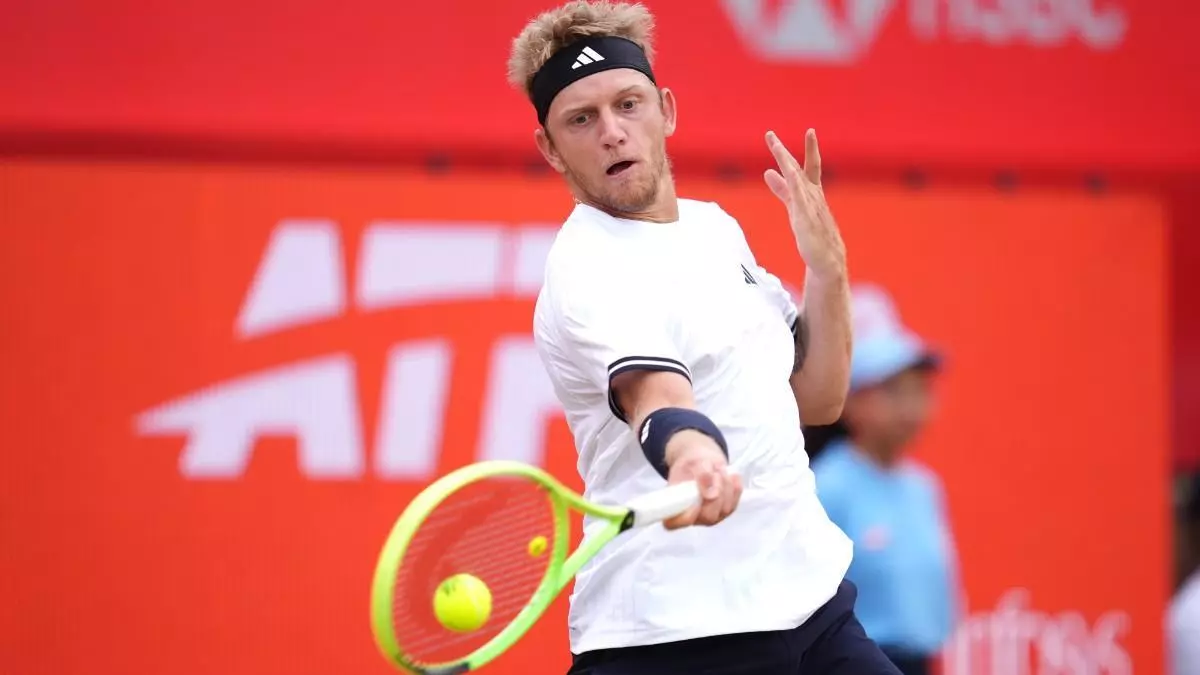
Victory on grass carried a message beyond tennis.
LONDON, England | June 2026
Alejandro Davidovich Fokina advanced to the quarterfinals of the Queen’s Club Championships after defeating France’s Corentin Moutet 6-4, 6-3 in a match that combined sporting authority with an unexpected message of support for Spain’s national football team. The Spanish player needed one hour and 40 minutes to secure his second consecutive victory on the London grass and continue building confidence before Wimbledon. After the match, he wrote a dedication on the television camera encouraging Spain in the World Cup. His gesture later became a broader defense of the players facing criticism after their difficult start to the tournament.
Davidovich entered the second-round match after overcoming British player Cameron Norrie in straight sets, a result that ended a 23-day period without a victory on the professional tour. Against Moutet, he showed greater control from the baseline and adapted more effectively to the irregular rhythm imposed by the Frenchman. The Spaniard converted four of his nine break opportunities while limiting his opponent to only one successful break from six chances. That difference in efficiency allowed him to manage the decisive moments without becoming trapped in the emotional exchanges that often characterize matches involving Moutet.
The opening set demanded patience because neither player initially established complete control. Davidovich attempted to shorten points when possible, but he also accepted longer rallies when the conditions required greater discipline. Moutet used changes of pace, angles and improvisation to prevent the Spaniard from settling into a predictable pattern. Davidovich nevertheless maintained his concentration, found the decisive break and closed the set 6-4 without allowing the French player to recover.
The second set confirmed the Spaniard’s superiority. Davidovich increased the depth of his returns and placed greater pressure on Moutet’s service games, forcing errors from uncomfortable positions. His movement on grass appeared more secure than in the previous round, while his first serve gave him opportunities to dictate play immediately. Once he built an advantage, he avoided unnecessary risks and completed the match 6-3.
Reaching the quarterfinals represents an important step in Davidovich’s preparation for Wimbledon, where the faster surface has not always rewarded his aggressive and physically demanding style. His game is naturally associated with clay and hard courts because of his defensive speed, heavy groundstrokes and willingness to construct points through extended exchanges. Grass requires quicker decisions, lower movement and greater effectiveness on serve. His performances at Queen’s suggest that he is finding a more balanced formula for competing on the surface.
The result also provides stability during a period of professional change. Davidovich recently ended his working relationship with Argentine coach Mariano Puerta and has begun collaborating with Spanish coach Pepo Clavet. Changing technical direction in the middle of the season can create uncertainty, particularly before a Grand Slam. The early victories in London indicate that the transition has not prevented him from producing competitive tennis.
His next opponent will be American Tommy Paul, a former Queen’s champion who defeated Dutch player Botic van de Zandschulp 7-6, 6-3. Paul has won seven consecutive matches at the tournament and possesses a game especially suited to grass, with compact strokes, strong court positioning and an effective first serve. Davidovich will need to improve his percentage of service points and avoid allowing the American to control the center of the court. The quarterfinal will represent his most demanding test of the week.
Beyond the result, Davidovich attracted attention for what he wrote on the camera lens after completing the match. His message encouraged Spain’s football team to continue fighting for the World Cup and expressed confidence in its ability to overcome a difficult moment. The dedication came after the national team had received criticism following its scoreless draw against Cape Verde. Davidovich used his own victory to defend the principle of supporting athletes during adversity rather than only celebrating them after success.
The tennis player later explained that when a team wins, everyone is eager to identify with Spain, but when it loses, that collective enthusiasm often disappears. His words reflected the pressure experienced by elite athletes whose public treatment can change dramatically according to a single result. By linking his performance at Queen’s with the national football team, Davidovich transformed a routine post-match message into a statement about loyalty and sporting identity. The gesture resonated because it came from another athlete competing under the Spanish flag at a major international event.
The dedication also reflected Davidovich’s own experience with fluctuating expectations. His career has included major victories, important finals and periods of inconsistency that have exposed him to criticism. He understands the difference between support based on long-term commitment and enthusiasm conditioned by immediate success. That perspective gave additional weight to his defense of the footballers.
Davidovich is currently the only Spanish representative remaining in the Queen’s singles draw after injuries and withdrawals affected other players. His progress therefore carries particular importance for Spanish tennis during the final stage of preparation for Wimbledon. Each victory provides ranking points, confidence and additional competitive experience on grass. A strong run in London could change the outlook of his season before the third Grand Slam of the year.
The Spaniard’s challenge is now to convert a promising week into a deeper tournament run. Paul will offer fewer opportunities than Moutet and will punish any decline in concentration or serving quality. Davidovich must preserve the emotional control displayed in the second round while maintaining the aggressive instincts that make him dangerous. His ability to combine those qualities will determine whether he can reach the semifinals.
The victory over Moutet demonstrated progress in both execution and temperament. Davidovich controlled a complicated opponent, handled important break points and delivered a straight-sets result without allowing the match to become chaotic. His message afterward added a broader dimension to the achievement. On a day when he advanced in one of tennis’s traditional grass tournaments, he also reminded Spanish supporters that loyalty is tested most clearly when victory is not guaranteed.
Phoenix24: inteligencia para audiencias libres. / Phoenix24: intelligence for free audiences.