

 Phoenix 24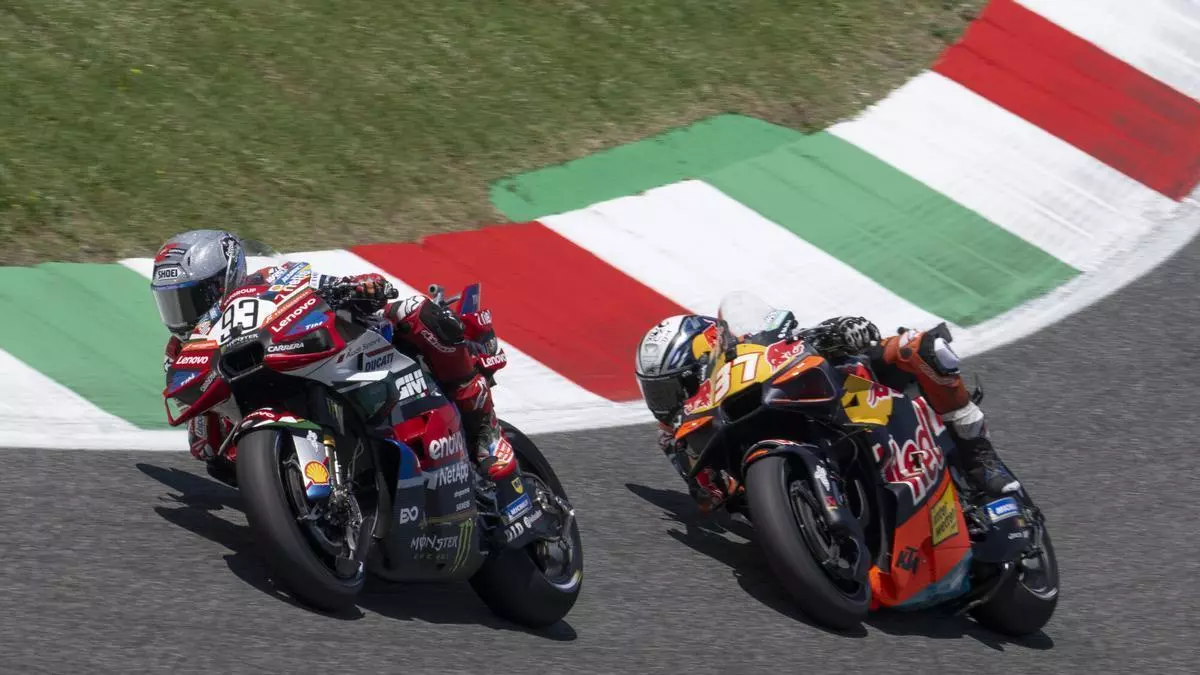
The next rivalry is learning in real time.
Mugello, June 2026. Pedro Acosta’s latest praise for Marc Márquez after their battle at Mugello revealed more than sportsmanship. It exposed one of MotoGP’s most compelling transitions: the young rider who represents the next generational rupture is still studying the champion who changed the physics, psychology and aggression of modern racing. Behind the compliments lies a deeper competitive truth: Acosta is not admiring Márquez from a distance, he is measuring him from inside the fight.
Acosta finished sixth after a demanding race in which he spent crucial laps behind Márquez, who crossed the line seventh. The result itself may appear modest, but the strategic value was much larger. For Acosta, following Márquez meant observing braking points, tire management, corner entry decisions and the invisible timing that separates a fast rider from a race architect.
The Spanish KTM rider admitted that riding behind Márquez remains an unusually valuable exercise because Marc continues to interpret races with elite instinct. That recognition matters because Acosta is not a passive admirer. He is a direct competitor, one of the few young riders capable of turning respect into pressure and pressure into overtaking attempts.
Márquez, for his part, also acknowledged the quality of the duel and the strength Acosta brings to direct combat. Their exchange created the kind of narrative MotoGP needs: technical aggression without theatrical hostility, generational tension without empty provocation. In a championship often shaped by machinery gaps, political paddock calculations and factory hierarchies, a clean fight between Acosta and Márquez restores the sport’s essential language.
The machinery imbalance remains central. Acosta continues extracting more than expected from a KTM that still struggles against the straight-line superiority of Ducati and the growing competitiveness of Aprilia. Márquez, now operating inside Ducati’s ecosystem, benefits from a package with enormous performance depth, but his value remains tied to how he interprets limits under pressure.
That is why Acosta’s words carry weight. Praising Márquez does not weaken him; it frames him as a rider conscious of what must be absorbed before it can be surpassed. Great competitors rarely learn from comfort. They learn by chasing, failing, adjusting and returning to the same corner with a more precise calculation.
MotoGP’s future may depend on this kind of duel. Acosta brings hunger, elasticity and tactical audacity. Márquez brings scar tissue, instinct and the authority of a rider who has survived the brutal cost of domination. When they meet on track, the race becomes more than a result sheet; it becomes a transfer of knowledge under violence, speed and risk.
The broader championship benefits from that friction. Fans do not return only for standings, tire charts or factory statements. They return for riders capable of making danger feel intelligent and competition feel personal. Acosta and Márquez delivered that at Mugello, not through spectacle alone, but through the rare sensation that something generational was being negotiated at full speed.
Hechos que no se doblan. / Facts that do not bend.