

 Phoenix 24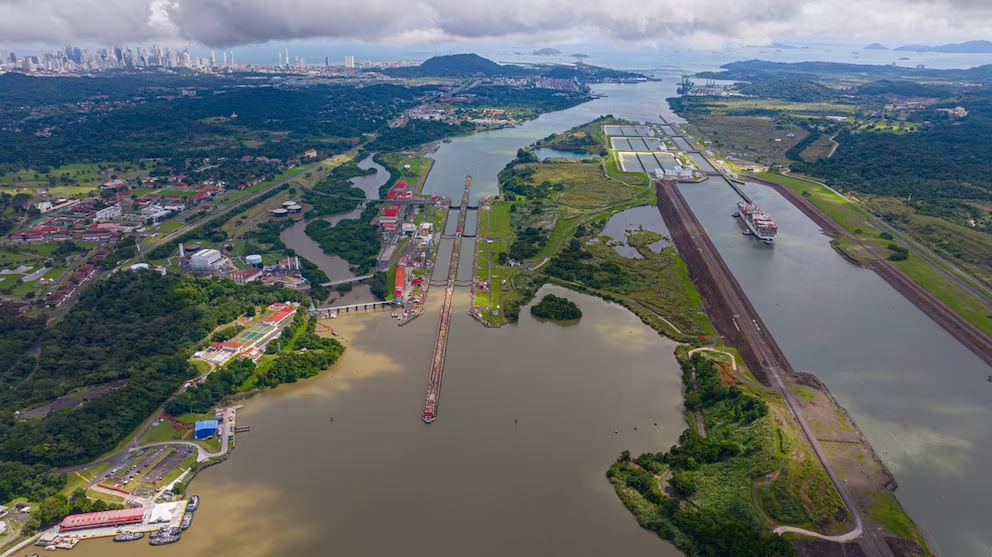
A hub must become strategy.
PANAMA CITY, May 2026. Panama’s business sector has issued a direct warning: the country can no longer rely on geography alone. The Chamber of Commerce, Industries and Agriculture argues that Panama must transform its connectivity into concrete investment, turning its ports, logistics platforms, air routes, digital networks and financial services into a more aggressive development engine.

The message reflects a larger concern inside the Panamanian economy. The country possesses one of the most privileged logistical positions in the world, but infrastructure by itself does not guarantee competitiveness. Without regulatory certainty, institutional agility, skilled labor and a clearer investment strategy, connectivity risks becoming an underused advantage rather than a national multiplier.
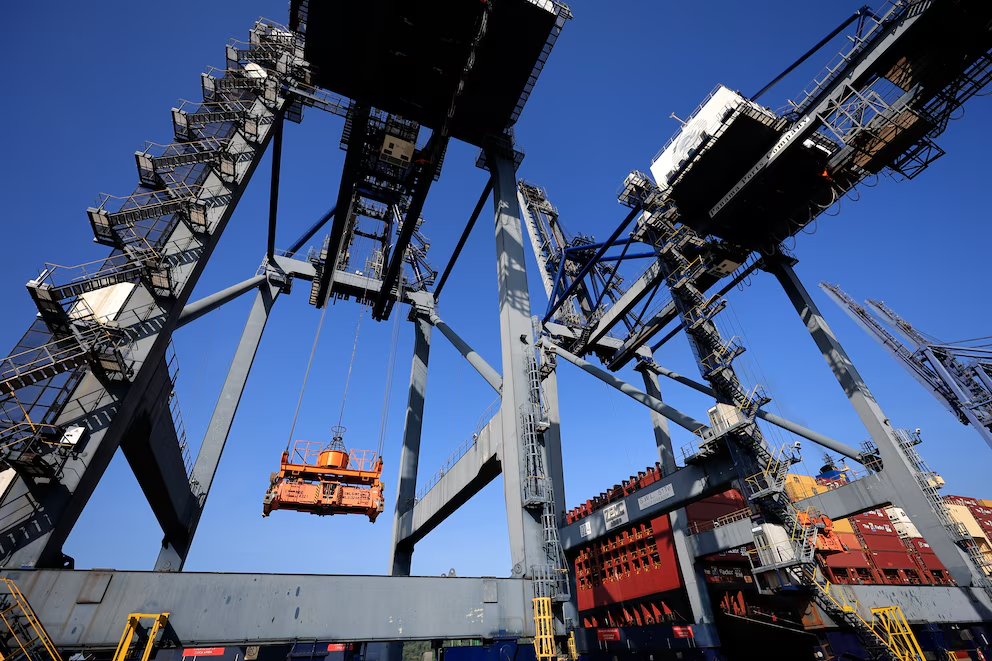
Panama’s strategic assets remain formidable. The Canal, the port system, the Colón Free Zone, Tocumen’s air connectivity and the country’s service economy give it a rare concentration of logistical and commercial capabilities. Few nations in Latin America have a comparable platform for linking the Americas with Europe, Asia and global supply chains.
Yet the business chamber’s position suggests that the real challenge is execution. Attracting investment requires more than presenting Panama as a transit point. It demands a coordinated national agenda capable of converting movement into value: more distribution centers, more technology services, more regional headquarters, more high-value logistics and stronger integration between trade, finance and innovation.
The issue also has a geopolitical dimension. Global supply chains are being reorganized by trade tensions, nearshoring, energy uncertainty and competition between major powers. In that environment, Panama could position itself as a neutral, efficient and reliable platform for companies seeking regional stability. But that opportunity will not wait indefinitely.
The warning is especially relevant as other countries in the region invest heavily in ports, logistics corridors, digital infrastructure and industrial incentives. Panama’s historical advantage can erode if competitors move faster, simplify procedures and offer stronger guarantees to investors. Connectivity is powerful only when it is paired with speed, trust and policy coherence.
The private sector is therefore pushing for a shift from passive advantage to active strategy. The country must not simply celebrate its location; it must monetize it through planning, human capital, technological modernization and public-private coordination. The question is whether Panama can turn its natural role as a bridge into a more sophisticated platform for production, services and investment.
Panama’s future will not be decided only by ships crossing the Canal or planes landing at Tocumen. It will be decided by whether the country can transform circulation into prosperity. Connectivity made Panama visible; investment will determine whether that visibility becomes power.
Beyond the news, the pattern. / Más allá de la noticia, el patrón.