

 Mario López Ayala, PhD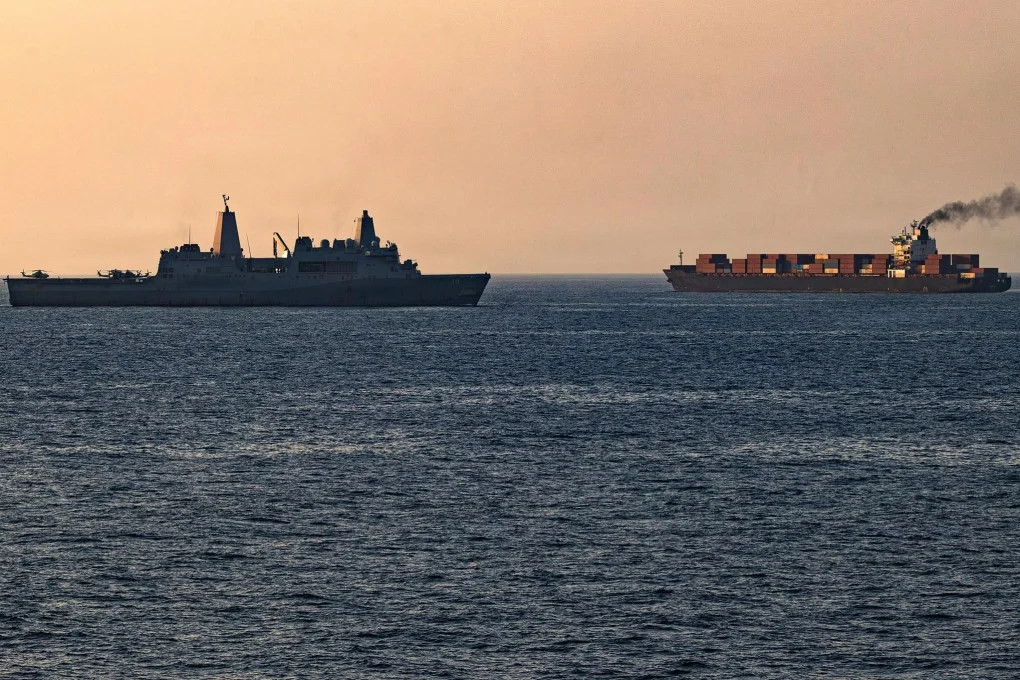
The blockade is teaching markets to fear movement.
Washington, May 2026. Something deeper than naval pressure is unfolding around the Strait of Hormuz. The diversion of commercial vessels, the immobilization of ships and the growing atmosphere of maritime uncertainty suggest that the crisis has moved beyond conventional sanctions logic. The sea itself is beginning to behave like an enforcement mechanism.
Washington appears to understand that modern pressure does not always require closure. Sometimes friction is enough. Delay a tanker. Increase insurance exposure. Force rerouting. Introduce legal ambiguity into logistics chains already stretched by inflation, energy volatility and geopolitical fatigue. A ship does not need to sink to become economically unusable.
That is what makes Hormuz so dangerous. It is narrow geography attached to oversized consequences. Oil, liquefied natural gas, industrial timing, Asian manufacturing cycles and European energy calculations all pass through the same corridor. The world built supply systems around the assumption that maritime circulation would remain relatively predictable. That assumption now looks fragile.
The blockade’s strategic value lies precisely there. Not in stopping all trade, but in disciplining movement. Every vessel entering the area now carries a political dimension that did not exist before. Cargo becomes secondary for a moment. What matters first is exposure.
Markets react quickly to that kind of atmosphere because uncertainty travels faster than ships. Traders hedge before shortages appear. Insurers recalculate before missiles launch. Governments begin contingency planning before official escalation occurs. The economic impact starts long before the military threshold is crossed.
Iran has long relied on geography as leverage. The regime understands that even the perception of instability around Hormuz can transmit pressure into global energy systems. Tehran does not necessarily need a full shutdown to influence prices or diplomatic calculations. Suggestion alone can move markets when the corridor is already tense.
Washington’s answer seems increasingly maritime. The logic resembles selective containment through mobility control rather than classic blockade imagery from the twentieth century. The difference matters. This is less about sealing the sea than about saturating it with enough risk that commerce begins regulating itself out of fear.
The consequences spread unevenly. China watches the strait through energy dependency. Europe watches it through inflation risk and industrial vulnerability. India watches it through strategic balancing. Gulf monarchies watch it through survival and revenue. Shipping firms see legal exposure. Insurers see statistical instability. Central banks see the possibility of imported pressure returning through fuel and freight costs.
The battlefield keeps expanding without formally announcing itself.
One of the least discussed dimensions is time. Waiting has become economically violent. A delayed tanker affects refinery schedules. A rerouted vessel alters costs downstream. A stalled shipment changes contractual expectations thousands of kilometers away from the Gulf. Modern economies are calibrated around synchronized movement; interruption alone can become coercive.
That may be the real mutation exposed by this crisis. Economic warfare no longer depends only on sanctions lists, frozen assets or tariffs. It increasingly operates through circulation itself. Through corridors. Through bottlenecks. Through the psychology of interruption.
Ports begin to change under that logic. They stop behaving like neutral infrastructure and start functioning as geopolitical organs: monitored, pressured, vulnerable and symbolically charged. A commercial terminal can suddenly become a strategic signal. A shipping route can become an ideological boundary.
The implications extend far beyond Iran. Other powers are watching carefully because every successful pressure model eventually becomes transferable doctrine. Hormuz today. Taiwan tomorrow. The Red Sea after that. Perhaps future conflicts will not begin with territorial invasion, but with manipulated logistics and weaponized waiting.
And yet the architecture remains unstable. Maritime coercion creates chain reactions that are difficult to fully contain. Too much pressure and markets panic. Too little and deterrence weakens. The middle zone between war and commerce becomes crowded with drones, escorts, inspections, satellite tracking and political improvisation.
The old globalization imagined uninterrupted movement as the natural condition of the world economy. That era may already be ending. What is emerging instead looks more fragmented, more conditional and more militarized. Trade still flows, but now under surveillance, strategic calculation and latent force.
Hormuz is no longer simply an energy chokepoint. It is becoming a prototype. A place where the infrastructure of globalization is tested under pressure and where the future grammar of economic conflict is quietly being written in shipping lanes, insurance clauses and delayed departures.
Lo visible y lo oculto, en contexto. / The visible and the hidden, in context.
Mario López Ayala, PhD
Researcher and Director of Phoenix24