

 Phoenix 24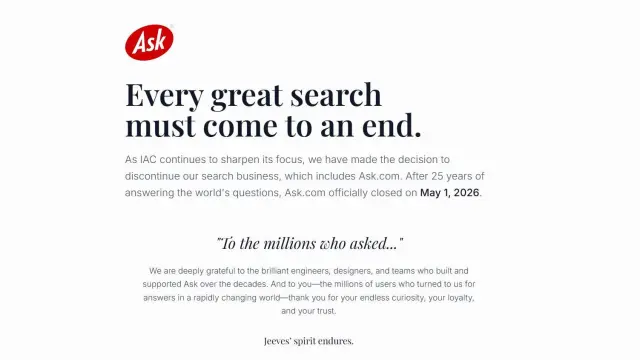
The past predicted the interface we now inhabit.
Mexico City, May 2026. The disappearance of Ask.com is not simply the closure of an obsolete search engine, but the symbolic end of a digital philosophy that arrived too early for its own time. Born in 1997 as Ask Jeeves, the platform introduced a radically different logic to navigating the web: instead of fragmented keywords, users could ask complete questions, as if interacting with a human assistant.

That design choice positioned Ask.com as one of the first large-scale experiments in conversational interfaces. Its iconic butler, Jeeves, was not just branding; it embodied an attempt to humanize information retrieval in an internet that was still chaotic, unstructured and difficult to navigate. The platform tried to translate curiosity into dialogue, anticipating a user behavior that would only become dominant decades later.
However, the evolution of the web did not reward that vision at the time. The rise of Google imposed a different paradigm based on algorithmic efficiency, keyword optimization and scalable indexing. In that environment, Ask.com’s model became structurally disadvantaged. By 2010, it had already abandoned its own search technology, effectively conceding the competitive battlefield and transitioning into a secondary content-driven platform.

What makes its closure strategically relevant today is not its decline, but its conceptual persistence. The current dominance of conversational systems, from virtual assistants to generative AI, operates on the same premise Ask.com attempted to normalize: natural language as the primary interface between humans and information systems. The difference is not conceptual, but technological maturity.
Ask.com therefore exits the stage not as a failure, but as a precursor displaced by timing. It represents a transitional artifact between two eras: the early internet of fragmented exploration and the current environment of structured, responsive intelligence. Its shutdown confirms a deeper shift in digital architecture, where search is no longer about finding information, but about interacting with systems that interpret intent.
Más allá de la noticia, el patrón. / Beyond the news, the pattern.