

 Phoenix 24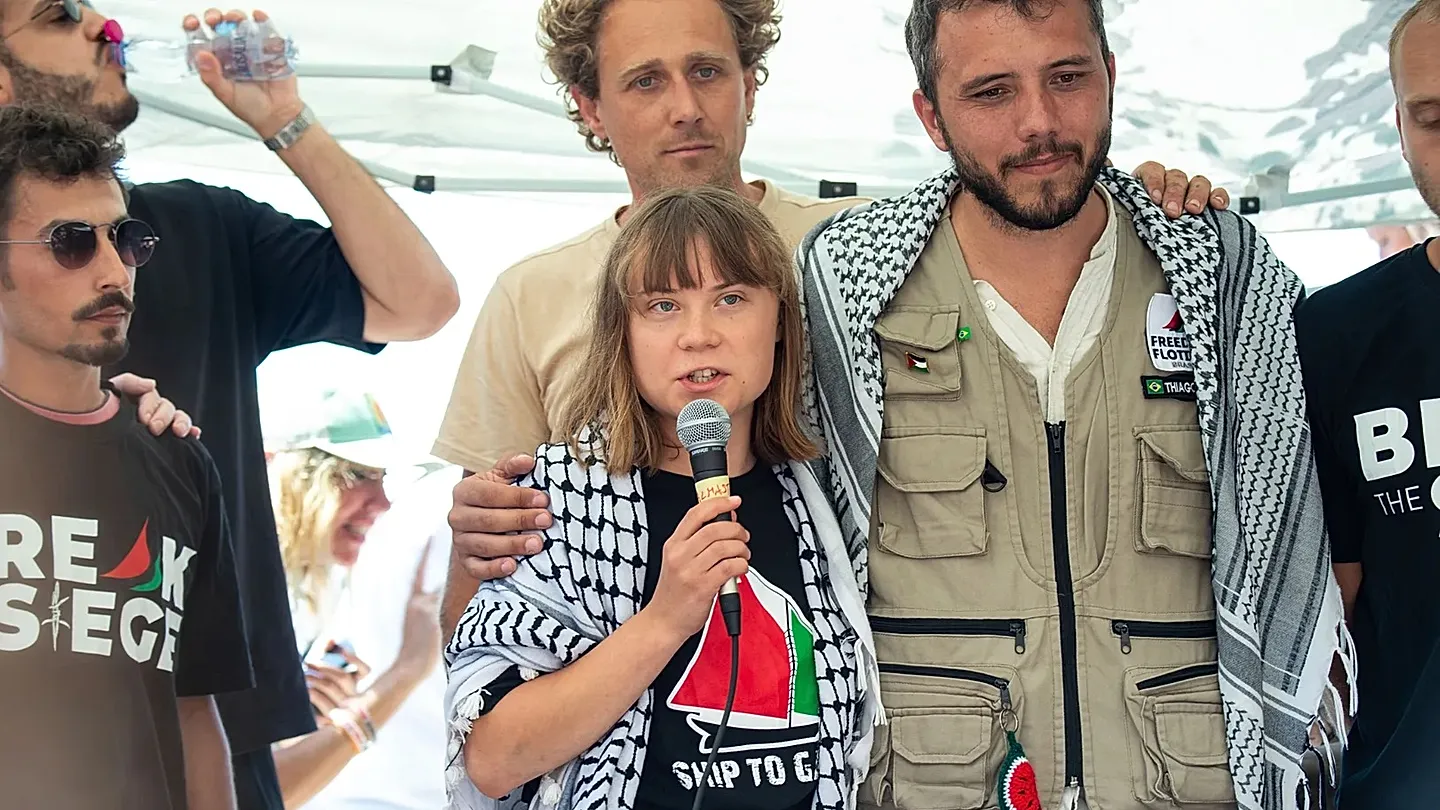
Aid became pressure on open water.
Crete, May 2026. Israel’s decision to retain two activists from the intercepted Gaza-bound flotilla has turned a maritime enforcement operation into a diplomatic flashpoint with direct consequences for Europe, Latin America and the politics of humanitarian access. Most of the activists were transferred to Greece after the interception, but the continued detention of two visible figures has shifted the center of gravity from the flotilla itself to the legal and political meaning of Israel’s control over Gaza’s maritime perimeter. The case now sits at the intersection of blockade enforcement, international activism and the widening reputational cost of the war.
The two retained activists, identified by international reporting as Saif Abu Keshek and Thiago Ávila, became the focal point of a dispute that neither side frames as merely procedural. Israel presents the flotilla as a deliberate provocation against a security blockade, while the organizers describe the interception as an unlawful act against a humanitarian mission. That contradiction is the core of the crisis: one side reads the sea as a defensive boundary, the other as a corridor of emergency relief.
For Israel, the message is operational discipline. Allowing a flotilla to reach Gaza would weaken the architecture of the blockade and invite further maritime challenges from activists, governments and transnational networks. For the activists, the same event functions as political exposure, forcing states to answer whether humanitarian access can be subordinated indefinitely to security logic when Gaza remains under extreme pressure.
The diplomatic risk is no longer confined to Israel and the flotilla organizers. Spain and Brazil now face domestic and international pressure to defend their citizens, while European governments must manage the gap between humanitarian language and strategic alignment with Israel. Greece, as the point of transfer for the released activists, also becomes part of the geography of containment, even if its role is more logistical than political.
The deeper issue is that the Mediterranean is again functioning as a stage where law, force and narrative compete in real time. A small civilian flotilla can no longer be treated as a marginal protest when its interception triggers state responses, consular pressure and global media attention. In that sense, the retained activists are not only detainees; they are symbols of a broader struggle over who controls the channels through which Gaza is seen, supplied and politically understood.
The visible outcome may be a detention dispute, but the structural outcome is sharper: Israel is demonstrating that maritime access to Gaza remains non-negotiable, while activists are proving that every interdiction carries a political price. The sea has become another front of the conflict, not because it changes the battlefield immediately, but because it exposes the limits of diplomacy when humanitarian urgency collides with state power.
Phoenix24: claridad en la zona gris. / Phoenix24: clarity in the grey zone.