

 Phoenix 24
Power looked exposed before the world’s cameras.
Washington, April 2026. The shooting near the White House Correspondents’ Dinner has become more than an attempted attack; it has become a direct question about how an armed man managed to get so close to one of the most protected political events in the United States. Authorities say the suspect carried multiple weapons and opened fire near a security checkpoint outside the main ballroom, where President Donald Trump, senior officials, journalists and public figures were gathered.

The emerging explanation points to a layered failure, not a single broken door. The attacker reportedly arrived at the Washington Hilton before the event, moved through areas not secured with the same intensity as the ballroom itself, and reached a zone close enough to trigger a presidential evacuation. That sequence suggests that the vulnerability may have existed in the perimeter architecture around the event, rather than inside the most restricted ceremonial space.
The most sensitive detail is operational: high-profile venues often contain uneven zones of control. A ballroom, stage and presidential pathway may be heavily protected, while service corridors, storage areas, hotel access points and transitional spaces can create gaps between public infrastructure and security doctrine. In this case, the alleged use of a bag and the possibility that a long weapon was assembled near a lightly monitored area intensify scrutiny over how the outer perimeter was managed.

The incident does not mean the protective response failed entirely. Secret Service agents reacted quickly, removed Trump and other protected figures, contained the threat and prevented the attacker from entering the main event space. But prevention and response are different measures of security. The response may have been effective, while the preventive screen still revealed a dangerous weakness.
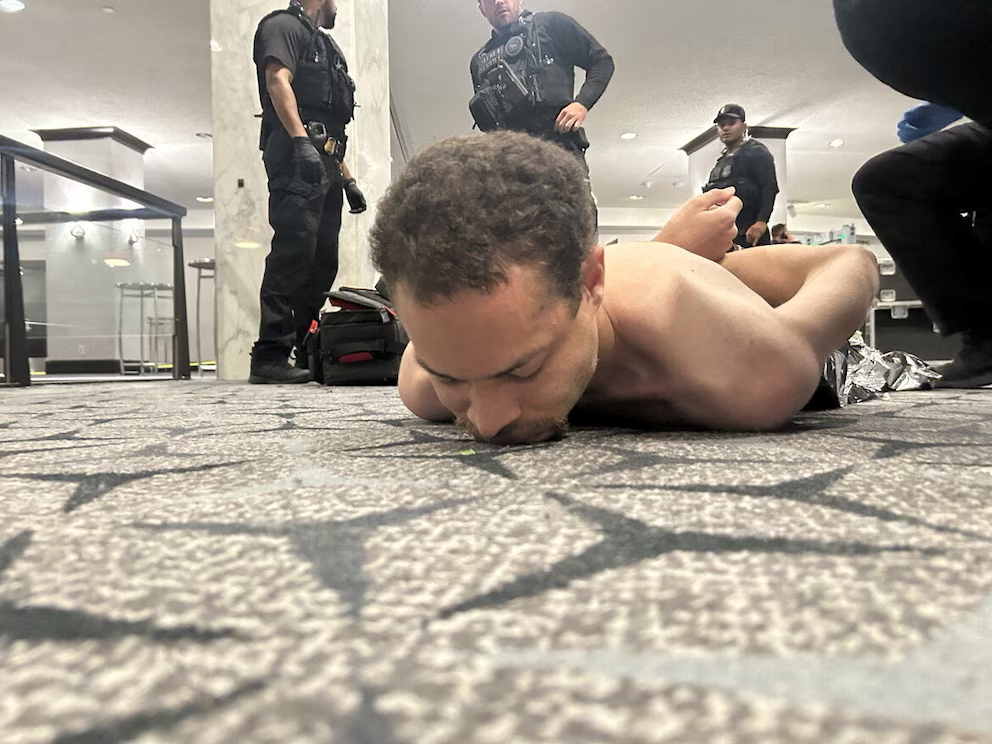
That distinction matters because presidential security is not only about shielding a person; it is about preserving the appearance and reality of institutional control. When gunfire erupts near an event designed to stage political normalcy, the symbolic damage begins before any physical casualty count is known. The public does not simply ask who fired; it asks how the weapon got that far.

The broader concern is that elite political events now operate inside a threat environment shaped by lone actors, radicalization, online grievance and tactical improvisation. Traditional security systems are built to detect organized plots, visible weapons and direct approaches. But the contemporary attacker may exploit ordinary movement, fragmented surveillance and the complexity of mixed-use venues.

For Washington, the lesson is severe. Any future investigation will have to determine whether the breach came from planning failure, venue design, screening gaps, intelligence limits or a combination of all four. The deeper issue is already visible: in a fractured political climate, proximity has become a weapon, and every symbolic gathering of power must be treated as both ceremony and target.
Detrás de cada dato, hay una intención. Detrás de cada silencio, una estructura.