

 Phoenix 24
Streaming has become cultural infrastructure.
Stockholm, April 2026. Taylor Swift’s rise to the top of Spotify’s all-time artist ranking is more than another milestone in a career built on scale, reinvention, and fan mobilization. It marks a deeper shift in how cultural authority is measured in the streaming era. Spotify released its first historical ranking to mark its 20th anniversary, placing Swift ahead of Bad Bunny, Drake, The Weeknd, and Ariana Grande among the most streamed artists in the platform’s history. The list does not simply show who was played most often. It reveals how music consumption has become a global system of attention, repetition, and algorithmic memory.
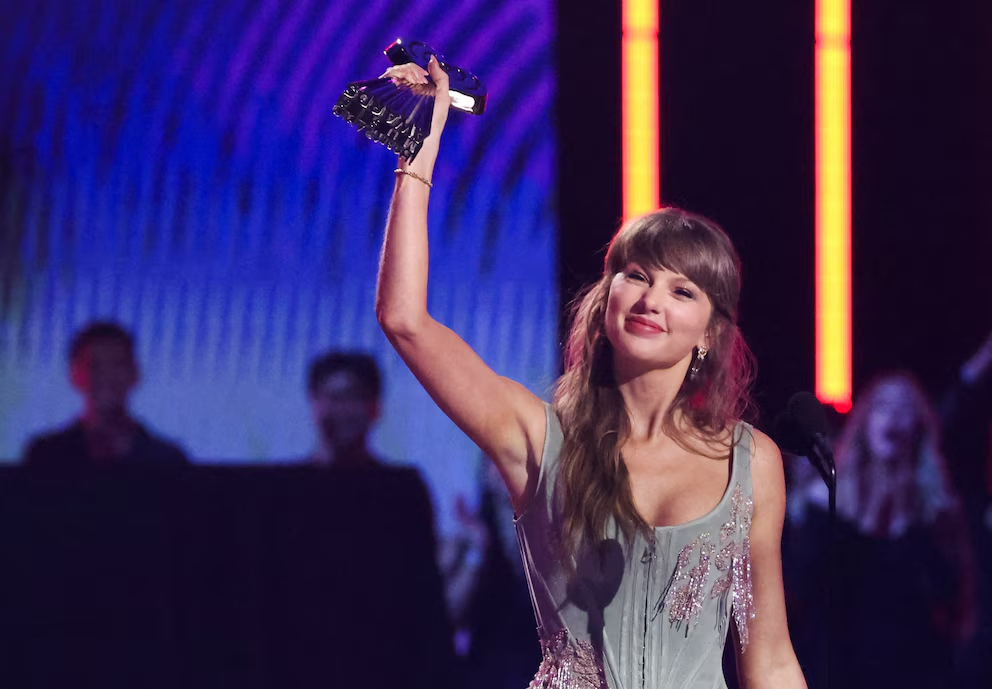
What makes Swift’s position especially significant is the structure behind her dominance. Her catalog is not built around one viral track or one compressed period of visibility, but around sustained listening across albums, eras, rerecordings, fandom rituals, tours, and digital campaigns. That kind of longevity matters in streaming because platforms reward recurrence as much as novelty. A song can explode and disappear, but a catalog that keeps circulating becomes infrastructure. Swift has turned her discography into a living system, repeatedly reactivated by narrative, ownership disputes, aesthetic reinvention, and collective fan participation.
The ranking also shows that global streaming power is no longer organized through a single genre or geography. Bad Bunny’s position near the top, combined with Un Verano Sin Ti leading the all-time album ranking, confirms the structural force of Latin music in the platform economy. The Weeknd’s “Blinding Lights” leading the songs category adds another layer, showing how a single track can become a cross-generational streaming object through radio memory, playlist permanence, and global pop familiarity. Spotify’s historical list therefore does not describe one musical center. It maps a multipolar sound economy where English-language pop, Latin urbano, hip-hop, and global R&B compete inside the same architecture.
There is also a methodological shadow around the announcement. Spotify revealed the rankings, but not a detailed public explanation of how every historical metric was weighted or audited. That absence matters because platforms do not merely report culture. They shape the categories through which culture becomes visible. A ranking of this kind produces prestige, headlines, market value, and narrative hierarchy. It tells audiences not only what was listened to, but what should be remembered as dominant.
From a Phoenix24 perspective, the deeper significance lies in the conversion of music into measurable behavioral power. The most streamed artist is not only the most heard artist. It is the artist most successfully embedded into routines, moods, playlists, commutes, workouts, heartbreaks, and collective identity. Swift’s lead reflects a form of soft power built not through state institutions or traditional media alone, but through millions of repeated private acts that become public data. In the streaming age, cultural dominance is no longer declared by critics. It is accumulated silently, one play at a time.
Phoenix24 Editorial Note: analysis, context, and strategic narrative to read power beyond the headline.