

 Phoenix 24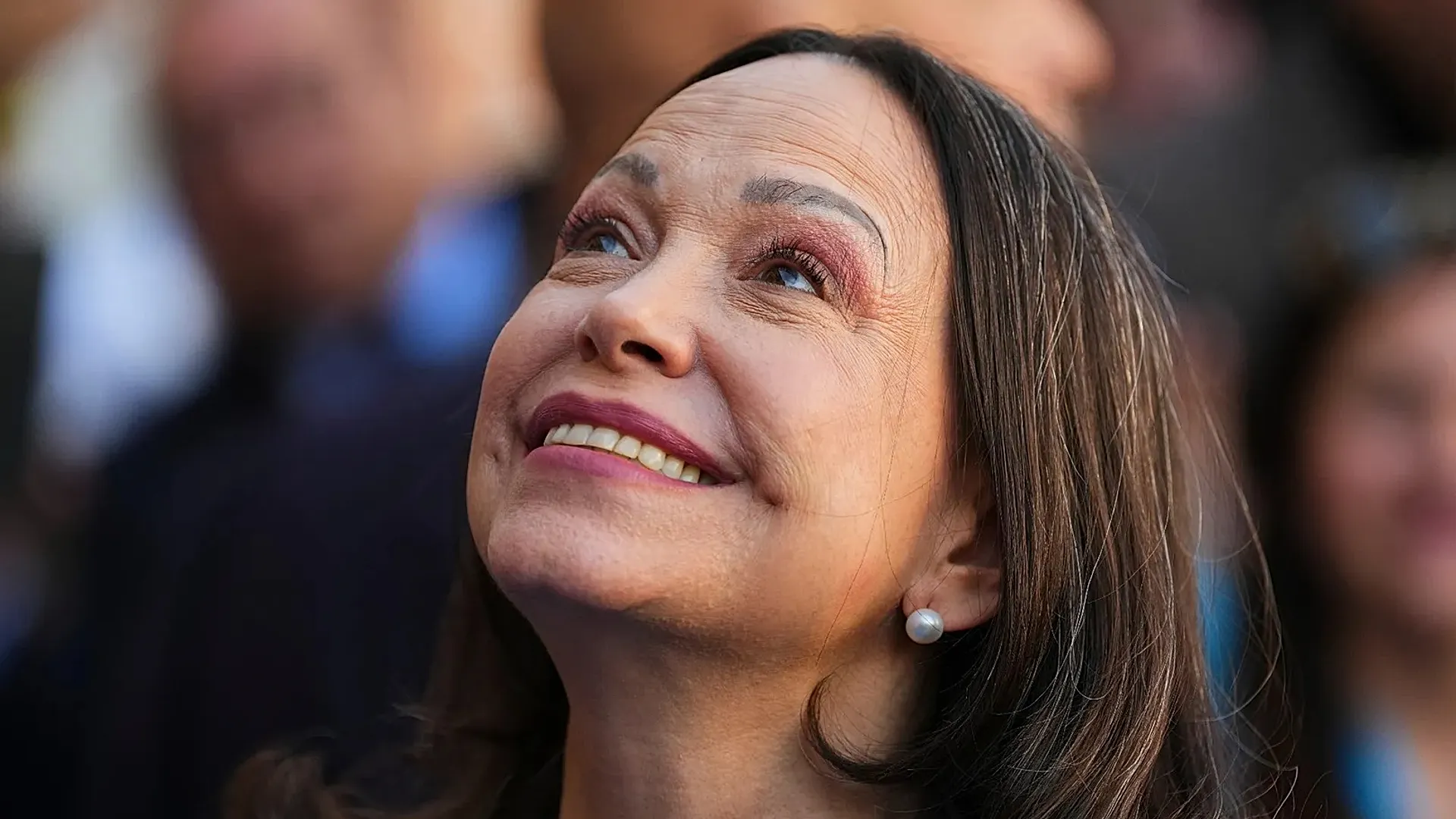
Democracy talk turns political the moment it localizes.
Madrid, April 2026. María Corina Machado arrived in Spain carrying the moral capital of Venezuela’s opposition, but her message quickly collided with the sensitivities of Spanish domestic politics. By calling for “impeccable elections” in Spain during a public appearance in Madrid, she crossed an invisible line that often governs transnational dissidence: a foreign democratic icon can be celebrated as long as she does not seem to comment on the host country’s internal tensions. The phrase was brief, but its political charge was immediate. What may have sounded like a generic defense of democratic standards was interpreted by many in Spain as a loaded intervention at a moment of growing polarization.
The controversy did not emerge from the words alone. It was also shaped by the choreography of her visit. Machado’s agenda in Madrid leaned clearly toward the Spanish opposition, with meetings held with figures from the conservative and hard right camps rather than with the Socialist-led government. That asymmetry transformed the visit from a symbolic stop on a European tour into a politically legible act. In highly polarized democracies, who you meet often speaks louder than what you say. Once that pattern became visible, the phrase about “impeccable elections” stopped sounding procedural and began to look ideological.
That was precisely the point emphasized by the Spanish government. Foreign Minister José Manuel Albares criticized Machado’s posture and argued that it was contradictory to seek solidarity from Spanish institutions while publicly diminishing them. The official irritation was not simply about protocol. It reflected a deeper concern inside the government that Spain’s internal contest is increasingly becoming a stage onto which international actors project their own struggles, alliances, and symbolic battles. Machado may represent anti-authoritarian resistance in Venezuela, but in Madrid she was no longer read only through the Venezuelan lens. She was absorbed into Spain’s own partisan circuitry.
This is what makes the episode more interesting than a passing diplomatic spat. The event shows how opposition figures in exile or semi-exile can acquire a dual political identity. They remain protagonists in their national crisis, yet once they move across borders they are also recoded by the local ideological environment of the countries that receive them. Machado’s remarks were therefore not evaluated in a vacuum. They entered a Spanish political context already marked by distrust, rhetorical escalation, and mutual accusations over institutional legitimacy. In that atmosphere, even a call for clean elections becomes combustible.
Machado tried to preserve a formal distinction by suggesting that she did not intend to intervene directly in Spanish domestic affairs. But that disclaimer was weakened by her own signals. She openly hinted that her sympathies were obvious to everyone in the room, which in practice dissolved the protective distance between principle and preference. Once that happened, the controversy became unavoidable. The issue was no longer whether she supported democratic safeguards in the abstract, but whether she had implicitly aligned herself with one side of Spain’s internal struggle while claiming neutrality.
There is a larger European pattern beneath this moment. Political exiles, opposition leaders, and democratic dissidents are increasingly treated not just as witnesses of repression abroad, but as symbolic assets inside the ideological contests of the democracies that host them. Their legitimacy can be embraced selectively, amplified when useful, and contested when inconvenient. Machado’s visit to Madrid reflects that mechanism with unusual clarity. Her authority as a critic of authoritarianism did not disappear in Spain, but it was immediately reinterpreted through local strategic interests. She became, at once, a Venezuelan leader and a Spanish political signal.
This dual reading carries risks for everyone involved. For Machado, it can blur the international clarity of her democratic message by tying it too closely to partisan alignments outside Venezuela. For the Spanish government, the response can appear defensive if it is seen as overreacting to a phrase that, on its face, invokes standards no democracy should reject. For the opposition, the temptation is to weaponize Machado’s moral stature as indirect validation of its own domestic narrative. In all three cases, the original issue of democratic legitimacy becomes entangled with short-term positioning.
What remains after the controversy is not simply a dispute over etiquette. It is a reminder that democratic language is never politically neutral once it enters a polarized arena. “Impeccable elections” sounds universal until it is spoken in a country already arguing about institutions, legitimacy, and ideological capture. Then the phrase changes texture. It becomes a mirror into which each side projects its anxieties and ambitions.
Machado did not need to endorse a party to trigger backlash. In the current European climate, symbolic placement is often enough. A carefully chosen audience, a selective agenda, and one apparently simple sentence can produce the effect of a political alignment without ever formally declaring one. That is the paradox of contemporary democratic rhetoric: the more universal its vocabulary, the more explosive its local reception can become.
Behind every datum, there is an intention. Behind every silence, a structure.
Detrás de cada dato, hay una intención. Detrás de cada silencio, una estructura.