

 Phoenix 24
When strategy yields to the price of instability.
Washington, April 2026
The United States has authorized the delivery and sale of Russian oil already loaded onto tankers through mid-May, extending a waiver that reveals how quickly sanctions discipline can soften when global energy pressure intensifies. Formally, the measure does not erase the broader punitive architecture against Moscow. Politically, however, it exposes a more uncomfortable truth. Even in a climate of declared confrontation, strategic necessity can reopen channels that official rhetoric insists should remain closed.

What makes the decision especially striking is its timing. Only days earlier, signals from Washington suggested that this flexibility would not be renewed. The extension therefore does more than prolong a technical exception. It highlights the instability of policy itself under conditions of market stress, war-linked supply disruption, and rising concern over energy affordability. In moments like this, sanctions stop looking like fixed instruments of principle and start behaving like adjustable mechanisms of damage control.
The broader context matters. With energy markets already strained by conflict in the Middle East and renewed anxiety around key maritime corridors, the United States appears to have concluded that preserving supply now outweighs the symbolic coherence of a harder line on Russian crude. That calculation may be pragmatic, but it is not cost-free. Every waiver of this kind weakens the moral clarity that sanctions are meant to project. It tells allies and rivals alike that enforcement remains contingent, elastic, and ultimately subordinate to systemic pressure.
For Europe, the implications are particularly sensitive. The European project of reducing structural dependence on Russian hydrocarbons was built not only as an energy strategy, but as a geopolitical doctrine after the war in Ukraine. When Washington allows even limited breathing room for Russian oil flows, it complicates that doctrine. The result is not necessarily a rupture in Western alignment, but a visible divergence in priorities. Europe is still thinking in terms of long-term decoupling. The United States appears to be thinking in terms of short-term stabilization.
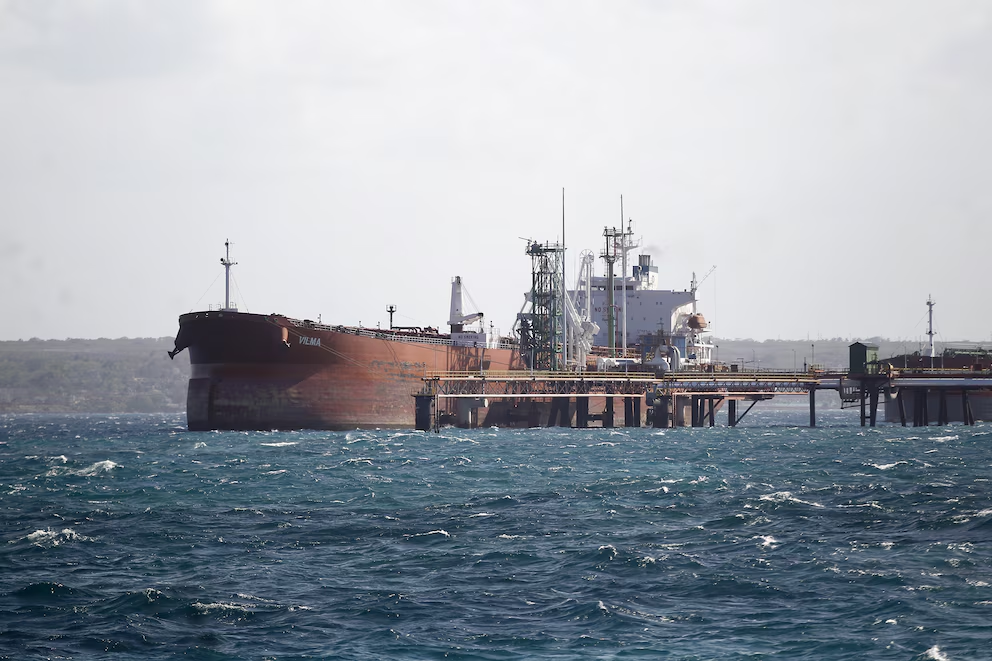
Russia benefits from that divergence. Even a narrow extension provides selective oxygen to a revenue structure that sanctions were designed to constrain. It does not normalize Russian energy in full, but it does remind the market that Russian barrels remain difficult to exclude completely when wider supply conditions deteriorate. In a global energy system shaped by interdependence, partial reintegration can be enough to erode the coercive edge of isolation.
There is also a deeper lesson here about the architecture of contemporary power. Sanctions are often presented as instruments of discipline, but their durability depends on how much pain sanctioning states are willing to absorb themselves. Once domestic cost, inflation risk, or wider geopolitical instability begins to rise, exceptions multiply and principles are reinterpreted. What appears as technical flexibility is often a public admission that the system cannot withstand full consistency under pressure.
This is why the waiver matters beyond oil. It reveals the hierarchy of priorities inside a moment of strategic stress. Market stability came first. Punitive coherence came second. The official message may still be one of pressure on Moscow, but the operational reality is more layered and less doctrinal. In that gap between discourse and practice, the true logic of power becomes visible.
What Washington has done, then, is not merely extend an authorization. It has shown that in the current global order, even adversarial flows can become temporarily indispensable when crisis narrows the room for ideological purity. That may calm prices in the short term. But it also reinforces a harder conclusion: sanctions remain powerful only until the system that imposes them starts needing the very thing it claims to reject.
Detrás de cada dato, hay una intención. Detrás de cada silencio, una estructura.
Behind every data point lies an intention. Behind every silence, a structure.