

 Phoenix 24
A few seconds can expose more than expected.
Mexico City, April 2026. Answering a spam call by accident may seem like a minor distraction, but in today’s fraud ecosystem it can quickly become a signal that your number is active, reachable, and potentially vulnerable. What used to be an annoying interruption has evolved into a filtering mechanism for criminal networks, automated dialing systems, and social engineering operations that measure not only whether you respond, but how you respond. The real risk is not always the first call itself. It is what your reaction may trigger afterward.
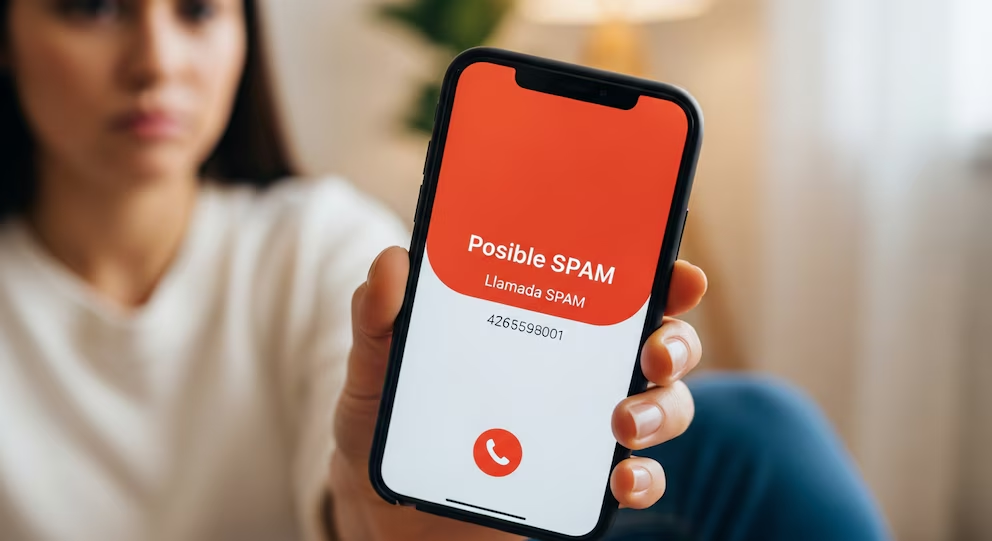
That is why the first rule is simple: do not prolong the interaction. If the voice, recording, or tone of the call begins to feel suspicious, the smartest move is to hang up immediately rather than argue, ask questions, or try to outsmart the caller. Regulatory guidance in the United States has long warned that engaging with these calls can confirm to scammers that the line is active, while pressing buttons or following instructions can lead to more calls rather than fewer. In practical terms, curiosity often helps the spammer more than the user.
The second step is defensive containment. Once the call ends, the number should be blocked and the phone’s anti spam protections should be activated or reviewed. On most devices, there are already built in tools to silence unknown callers, identify suspected spam, or filter suspicious numbers before they reach the user directly. These options do not eliminate fraud, but they do reduce the volume of exposure and make repeated targeting more difficult. In a threat environment driven by scale, even modest friction matters.
What should not happen is a return call. One of the most common mistakes after a missed or suspicious call is dialing back out of irritation, politeness, or uncertainty. That can deepen the problem, especially when spoofed numbers, premium rate traps, or callback schemes are involved. The caller ID itself may be fake, borrowed, or manipulated, which means the number on screen cannot automatically be treated as authentic. A person who calls back thinking they are clarifying the situation may actually be validating it for the other side.

There is also a more subtle dimension of risk: voice exposure. Security agencies and consumer protection bodies increasingly caution users against sharing personal information, payment data, one time codes, or even extended conversational detail during unexpected calls. The threat is not limited to old fashioned scams. Fraud now operates through layered persuasion, pressure scripts, impersonation, and, in some cases, attempts to collect speech patterns or identifiable personal data that can be reused later in broader deception campaigns. The less said, the safer the line remains.
If the call included a direct request for money, banking credentials, account verification, or urgent action, the matter should no longer be treated as simple spam. It should be treated as an attempted fraud event. At that point, the priority is not only to block the number, but to monitor accounts, verify activity directly with banks or service providers through official channels, and report the incident to the relevant telecom, consumer protection, or anti fraud authority in the user’s country. The logic is straightforward: once the interaction crosses into extraction, response must move from annoyance management to damage control.

This is where the broader meaning of the issue becomes clear. Spam calls are not just a nuisance of digital life. They are part of an industrialized architecture of low cost intrusion, built on automation, spoofing, data brokerage, and behavioral testing. Every answered call becomes a tiny data point in that architecture. Did the person answer quickly. Did they sound elderly, distracted, anxious, polite. Did they stay on the line. Did they obey a prompt. Modern scam systems are designed to learn from these signals.
That is why the safest mindset is not embarrassment, but discipline. If you answered once, nothing is automatically lost. But the mistake should end there. Do not continue the script for the caller. Do not volunteer information. Do not trust caller ID. Do not call back. Block, document, and report where appropriate. In the age of automated fraud, the user who disengages fastest is often the one who denies the scammer the only thing they truly need: usable confirmation that a real person is on the other end.
Detrás de cada dato, hay una intención. Detrás de cada silencio, una estructura.
Behind every data point, there is an intention. Behind every silence, a structure.