

 Phoenix 24
The new universe arrives with sharper teeth.
Los Angeles, March 2026
The first trailer for Supergirl has landed with a clear objective: to prove that this new chapter of DC will not be built on innocence alone. One of its strongest signals is the arrival of Jason Momoa as Lobo, a character whose presence immediately alters the emotional and tonal register of the film. What could have been introduced as a conventional superhero launch now feels more unruly, more abrasive, and more willing to embrace comic book excess without apology. The trailer does not simply present a heroine. It presents a world in which volatility, attitude, and cosmic disorder are part of the attraction.
That matters because Supergirl carries more pressure than a typical franchise installment. DC is still trying to stabilize a cinematic identity that for years oscillated between ambition, inconsistency, and reboot fatigue. Every first look now functions as a referendum on whether the new direction really has a distinct voice. In that context, the use of Lobo is not a decorative surprise. It is a strategic declaration that this universe intends to differentiate itself through bolder character energy and a less sanitized heroic atmosphere.
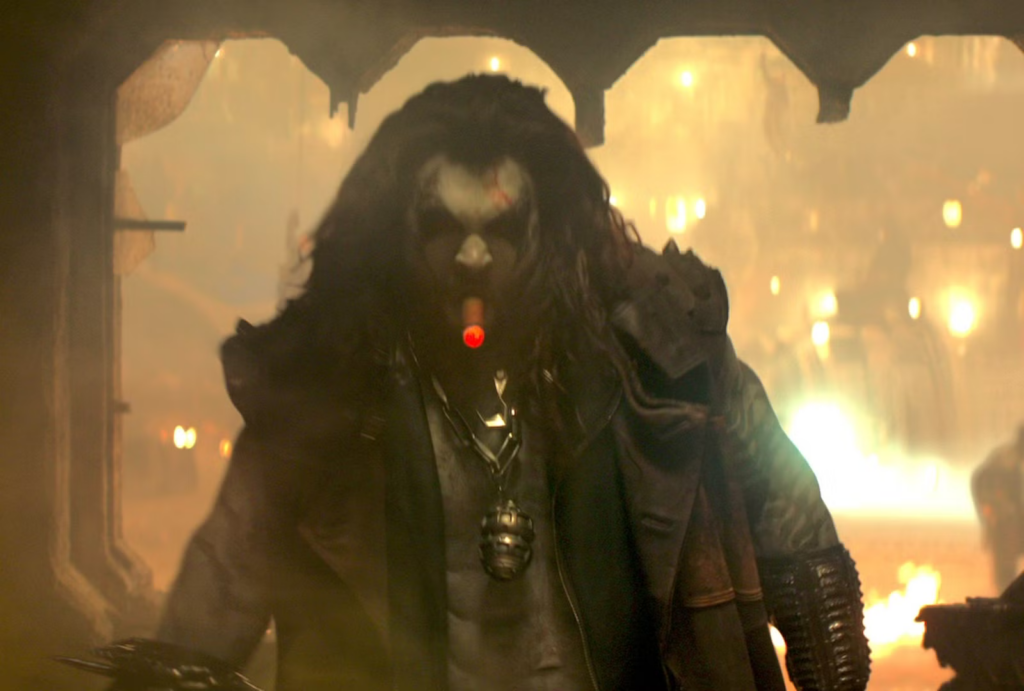
Momoa’s casting amplifies that effect almost instantly. He arrives with a screen presence that already carries brute charisma, and Lobo gives that charisma a form built for provocation rather than restraint. This is important because trailers do not only sell plot. They sell emotional chemistry and future expectations. By showing Lobo early, the film hints that Supergirl will not rely solely on idealism or origin story sentiment. It wants collision, friction, and a more dangerous kind of comic book spectacle.
For Supergirl herself, that creates an interesting challenge. The character has often been framed in popular culture through proximity to Superman, whether as legacy figure, counterpart, or variation on a familiar symbol of hope. A trailer like this suggests a more independent path. If the film places her in a harsher, stranger, and less morally tidy environment, then her identity has room to develop through contrast rather than inheritance. She is not being introduced in a vacuum of purity, but in a universe that appears prepared to test her.

There is also a tonal calculation behind all of this. Superhero audiences have become increasingly sensitive to sameness, especially when studios rely too heavily on recycled emotional beats and interchangeable visual rhetoric. Introducing Lobo in a prominent way helps the trailer break that pattern. His presence injects unpredictability, and unpredictability is now one of the most marketable commodities in franchise storytelling. The message is subtle but unmistakable: this film wants to feel less polished in the generic sense and more alive in its own eccentric register.
That strategy could help DC at a crucial moment. Reboots do not succeed simply because continuity is reset. They succeed when viewers believe the new world has a stronger pulse than the one it replaced. A trailer that pairs Supergirl with a figure like Lobo signals that the studio understands the value of contrast, disorder, and personality in rebuilding audience interest. The universe being proposed here seems less concerned with restoring old prestige than with generating new appetite.
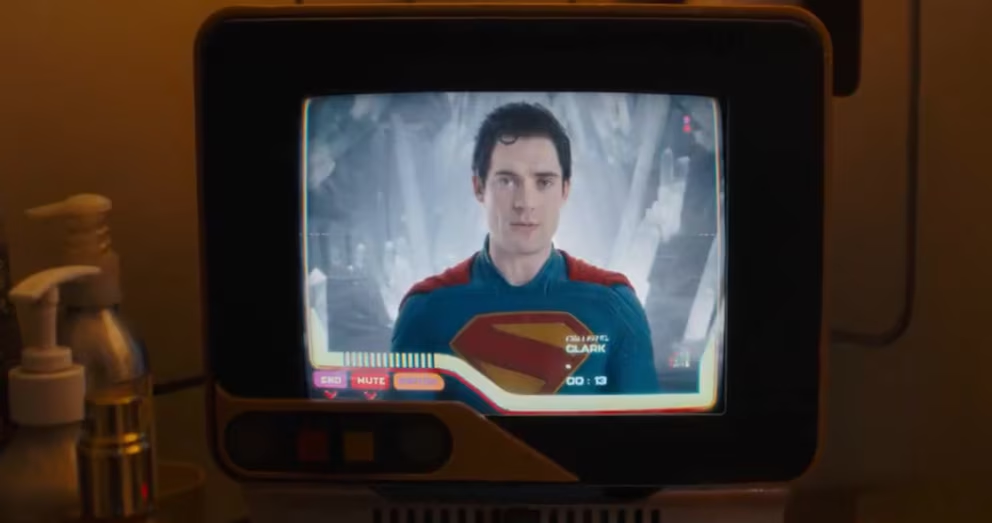
At the same time, the film will have to balance tonal force with coherence. A scene stealing character can energize a trailer, but the real test will be whether the final film keeps Supergirl at the center of its emotional architecture. If Lobo becomes too dominant, the movie risks shifting attention away from the very figure it is trying to establish. If the balance holds, however, his presence could sharpen her identity rather than dilute it. That is often where these films either become memorable or collapse into noisy misalignment.
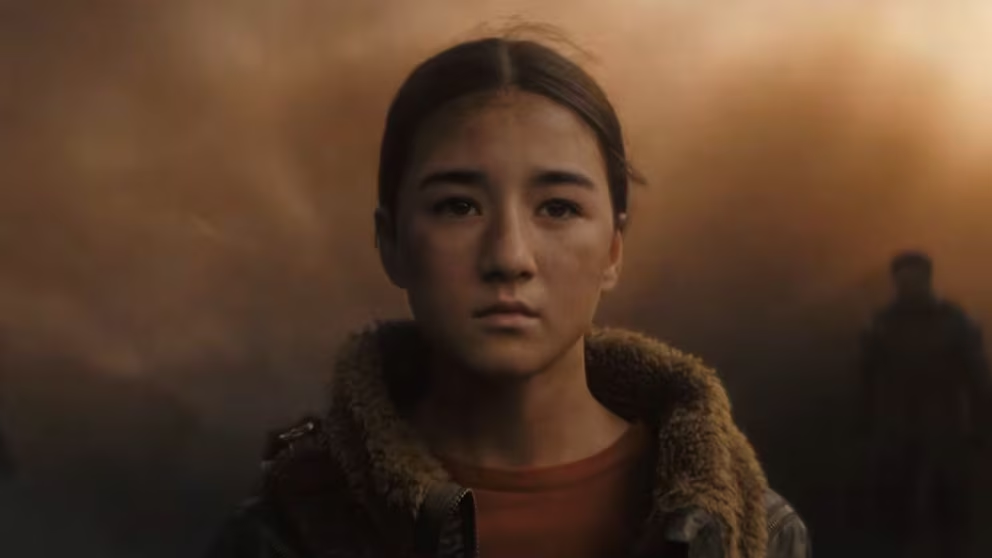
The larger pattern is easy to see. Comic book cinema is entering a phase in which character attitude matters almost as much as mythology. Audiences still want scale, but they also want singularity. The first Supergirl trailer appears to understand that demand. By bringing Jason Momoa’s Lobo into the frame so decisively, it is not just teasing a supporting role. It is announcing that DC’s next move may depend less on reverence and more on controlled chaos.
La narrativa también es poder. / Narrative is power too.