

 Phoenix 24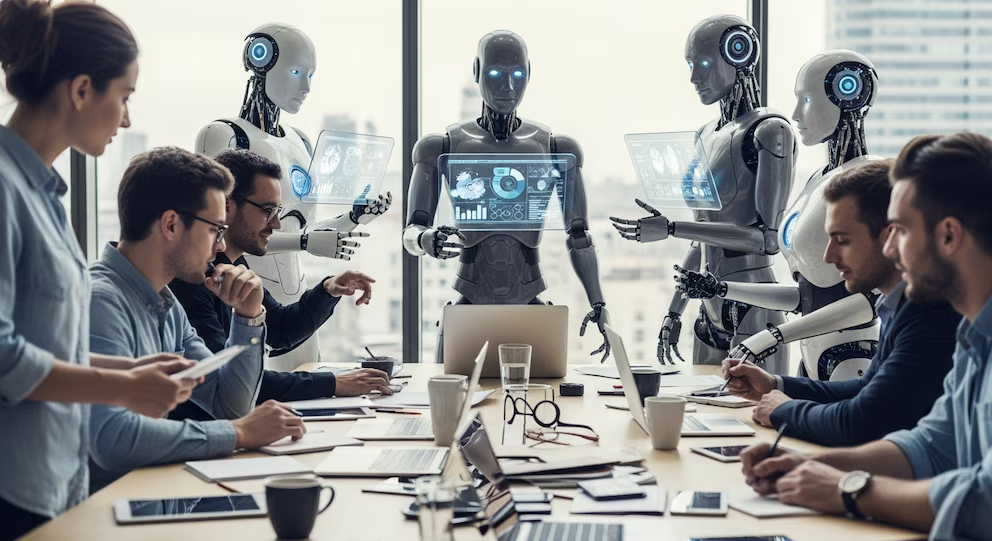
The gap is now harder to hide.
San Francisco, March 2026
The promise that artificial intelligence would rapidly absorb large portions of everyday professional work is running into a more difficult reality. Across the technology sector, the conversation has begun to shift from what AI can demonstrate in controlled environments to what it can actually sustain in messy, real-world workflows. The distinction matters because many of the tasks that define modern work are not isolated prompts or neat outputs, but sequences of judgment, context, revision, coordination and adaptation.
That gap has become more visible even inside the industry building these systems. Companies and researchers developing advanced models have spent the last two years showing that AI can summarize documents, draft emails, write code, classify information and respond convincingly across a broad range of domains. Yet the harder question is whether those capabilities add up to dependable job performance over time. Increasingly, the answer appears to be more limited than the market’s early rhetoric suggested.
One reason is that work rarely happens in the structured format most AI demonstrations prefer. Many jobs involve incomplete instructions, changing priorities, contradictory information and decisions that depend on social cues or institutional memory. A model may solve a clearly framed task, but still fail when asked to operate across shifting constraints, vague objectives or multi-step responsibilities that require continuity rather than isolated competence. That is one of the reasons AI can look impressive at the level of task completion and still remain weak at the level of actual role substitution.
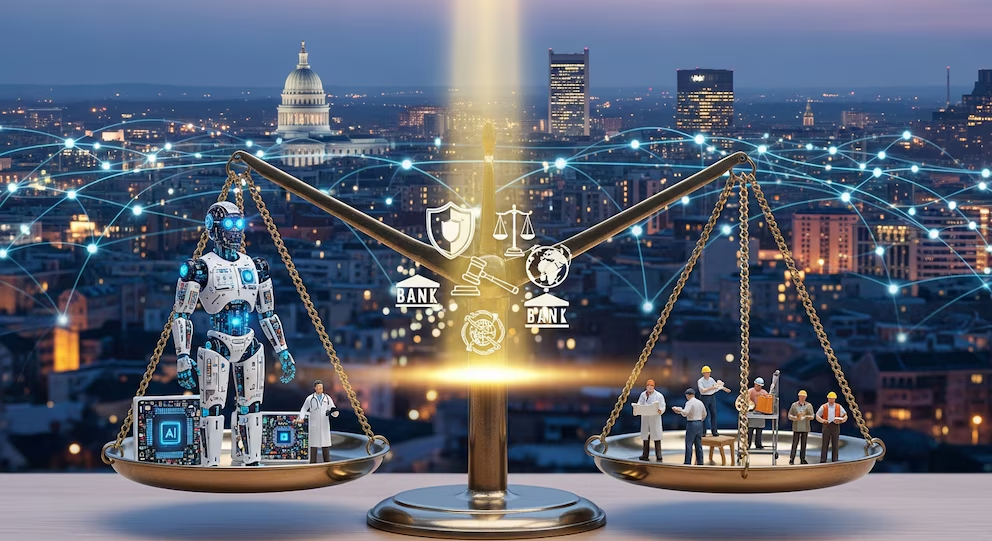
The problem is not simply technical error, though error remains central. It is also about endurance, consistency and judgment. A system may perform well on ten or twenty discrete tasks and still break down when those tasks have to be chained together over hours, days or weeks. That is especially visible in environments where the work depends on follow-through, tacit knowledge and the ability to notice what has not been said. In those settings, AI often behaves more like an irregular assistant than a reliable stand-in.
Recent industry evidence has reinforced that conclusion. Research published by companies in the sector shows that AI usage remains concentrated in a relatively narrow set of activities, especially coding, writing, educational support and other bounded knowledge tasks. Even where usage is growing, adoption patterns still suggest concentration rather than full occupational replacement. Separate experiments designed to test whether advanced models can run small real-world economic operations have also shown repeated failures in planning, continuity and business judgment.
This matters because the public narrative around AI has often confused visible capability with practical autonomy. A model that can produce a plausible output is not necessarily a system that can carry responsibility. In many workplaces, the most valuable part of the job is not generating text or answering a question, but knowing what matters, what can go wrong, what should be escalated and what should never be done automatically. Those forms of judgment remain harder to replicate than headline claims about productivity gains tend to imply.
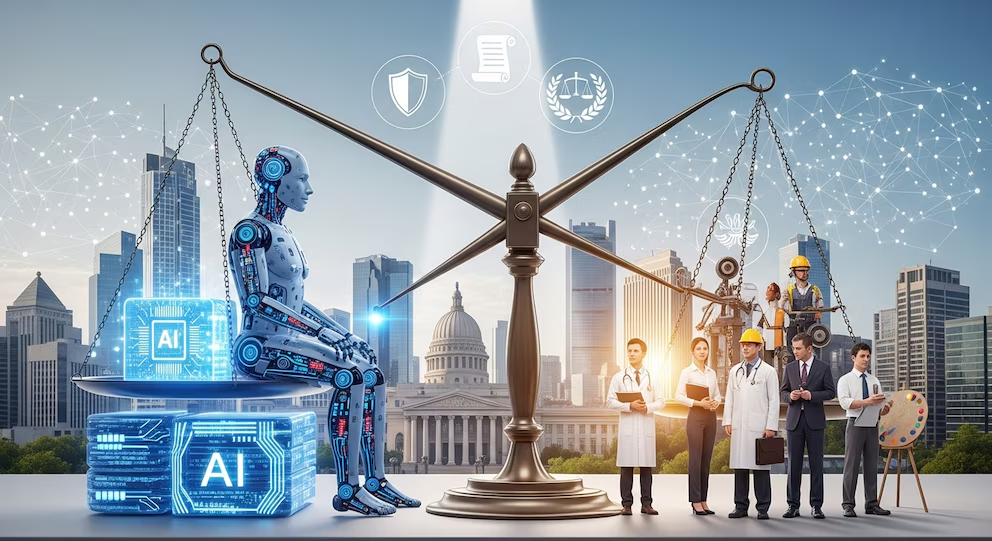
The same pattern is emerging in the labor market built around training these systems. Recent reporting on the AI supply chain has shown that model builders frequently discover weaknesses only after deployment pressures intensify, then return to specialists such as lawyers, scientists or domain experts to produce data that patches those gaps. That cycle suggests the technology is still learning through repeated exposure to the very human expertise it is supposed to replace. In that sense, the people helping train the systems are also exposing their limits.
None of this means AI is irrelevant to work. On the contrary, it is becoming more important as a support layer across many professions. But support is not the same as replacement. In its current form, AI is often strongest when the task is narrow, well-bounded and easy to evaluate, and weakest when the work is dynamic, relational or dependent on context that cannot be fully stated in advance. That distinction is now becoming clearer not only to critics, but also to the companies building the tools.
The result is a more sober phase in the AI debate. The question is no longer whether these systems can produce useful outputs. They can. The question is whether that usefulness is enough to perform the full substance of a job without constant human correction, supervision or reconstruction. For now, the answer remains uneven. What AI has exposed most clearly is not the end of work, but the depth of the human coordination that many forms of work still require.
Verified against current reporting on AI adoption patterns, model limitations in sustained real-world tasks, and recent industry coverage of how AI companies rely on human experts to patch capability gaps.