

 Phoenix 24
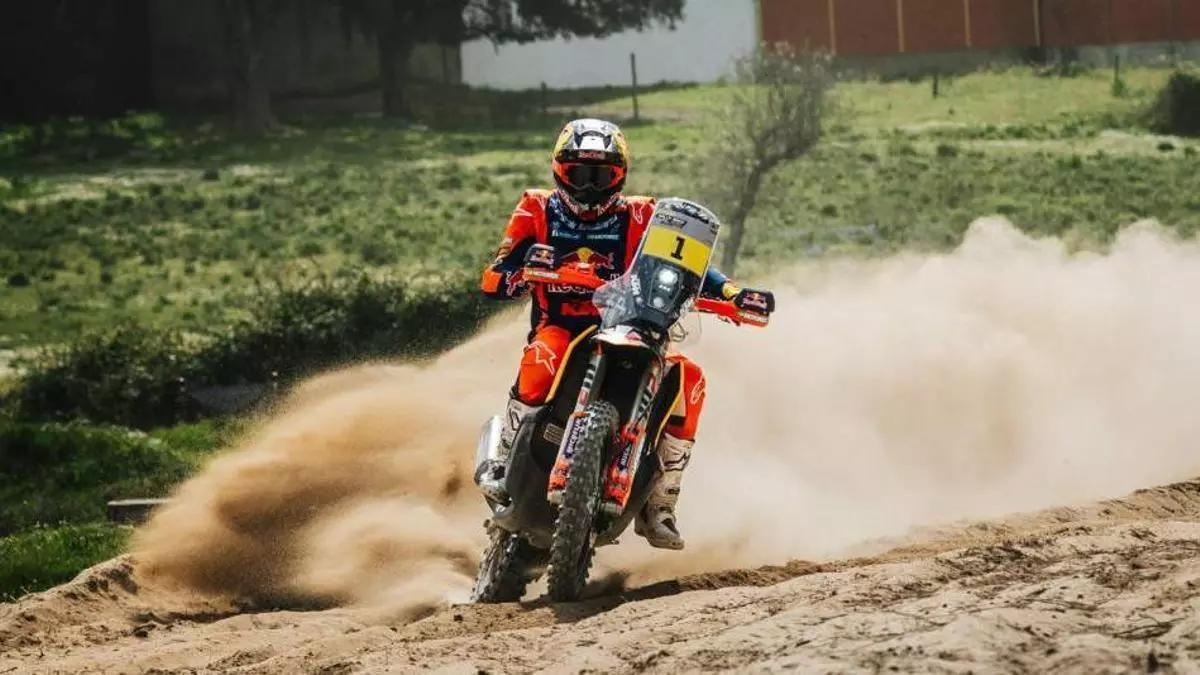
A prologue can reveal the season’s tension.
Portimão, March 2026. Daniel Sanders and Tosha Schareina did more than top the prologue times at Rally-Raid Portugal. They reopened one of the most compelling rivalries in the current rally-raid season and signaled, almost immediately, that the fight between KTM and Honda is entering a more volatile phase. Sanders edged Schareina by a single second in the opening test, according to championship and team reporting, with Ricky Brabec and Edgar Canet also placing themselves close enough to confirm that the margins at the front remain brutally narrow. A prologue is never the whole rally, but it often exposes the tone of the week. This one suggested that control will be fragile, pace alone will not be enough, and every small tactical gain may carry disproportionate value once the longer stages begin.
The result matters because Sanders arrived carrying the aura of a rider who knows how to impose rhythm early. His advantage was minimal, yet in rally-raid a one second lead in the prologue is not just a statistic. It is a statement of timing, confidence, and discipline. KTM needed that tone after a season in which every opening has felt contested rather than guaranteed. Sanders remains one of the most complete riders in the field, strong enough to dictate pace but experienced enough to understand that these events are not won by speed in isolation. They are won through controlled aggression, navigation management, and the ability to stay clean when the terrain begins to punish ambition. His prologue win did not settle anything, but it restored the impression that KTM still possesses a rider capable of setting the emotional temperature of a rally before the real attrition begins.
Schareina, however, may have emerged with something almost as valuable. Finishing one second behind does not read like defeat in this context. It reads like proximity, threat, and unfinished business. The Spaniard has increasingly become one of Honda’s most strategically significant assets, not only because of his raw pace but because of the way he rides under pressure. He rarely looks detached from the front, and that matters in a discipline where the difference between contention and irrelevance can open very quickly. Team reporting from Honda placed Schareina squarely in the center of the early fight, and that should concern KTM as much as the final prologue order itself. A rival who sits that close on day one is not chasing the rally. He is already inside it.
The wider classification reinforced that this is not a two man event, even if Sanders and Schareina are the names shaping the headline tension. Brabec remained close enough to preserve Honda’s tactical depth, while Canet continued to show that KTM’s structure is not resting on one rider alone. Adrien Van Beveren also stayed within immediate striking distance, underlining how little separation currently exists among the front runners. In practical terms, that means the rally will likely evolve through compounding pressure rather than through one decisive break. The front group is dense, and dense lead groups create unstable race dynamics. A navigation error, a poor opening order, or a small mechanical interruption can move a rider several positions in a single day.
This is where Rally-Raid Portugal acquires significance beyond its own terrain. The World Rally-Raid Championship has become an increasingly compressed contest in which momentum now behaves like a strategic resource. Riders are not only defending places on a stage. They are shaping psychological narratives that travel into the next round and sometimes into the next month. Sanders needed to remind the paddock that he can still strike first. Schareina needed to show that Honda’s pressure is not fading. Both accomplished that. The result is a front line that feels less settled than it did on paper. On paper, factory depth and championship status suggest control. On the ground, the opening numbers say something else: volatility.
There is also a symbolic layer to this prologue battle that should not be ignored. Rally-raid has always sold itself on endurance, navigation, and elemental hardship, yet modern elite competition in the discipline is now increasingly about precision under compression. The prologue in Portugal was short, but that is exactly why it matters. Short stages remove excuses. They strip the race down to execution. A rider either converts the moment or leaves it to someone else. Sanders converted by the smallest possible margin. Schareina converted enough to remain embedded in the same narrative. What emerges is not a casual season subplot, but the outline of a durable duel between riders and machines who understand that the championship can tilt long before the desert, forest, or rock finally breaks someone open.
That is why this opening exchange should be read as more than a timing sheet. According to championship reporting, Sanders beat Schareina by one second, and Honda’s own results placed Brabec and the rest of the leading group within immediate range. Those numbers are small, but their meaning is not. Rally-Raid Portugal has already made one thing clear: the battle at the front will not be decided by reputation, and the distance between control and vulnerability may be measured in moments so brief they barely register on a stopwatch. In a season that increasingly rewards composure over spectacle, Sanders drew first blood. Schareina made sure it did not look decisive.
Phoenix24: journalism without borders. / Phoenix24: journalism without borders.