

 Phoenix 24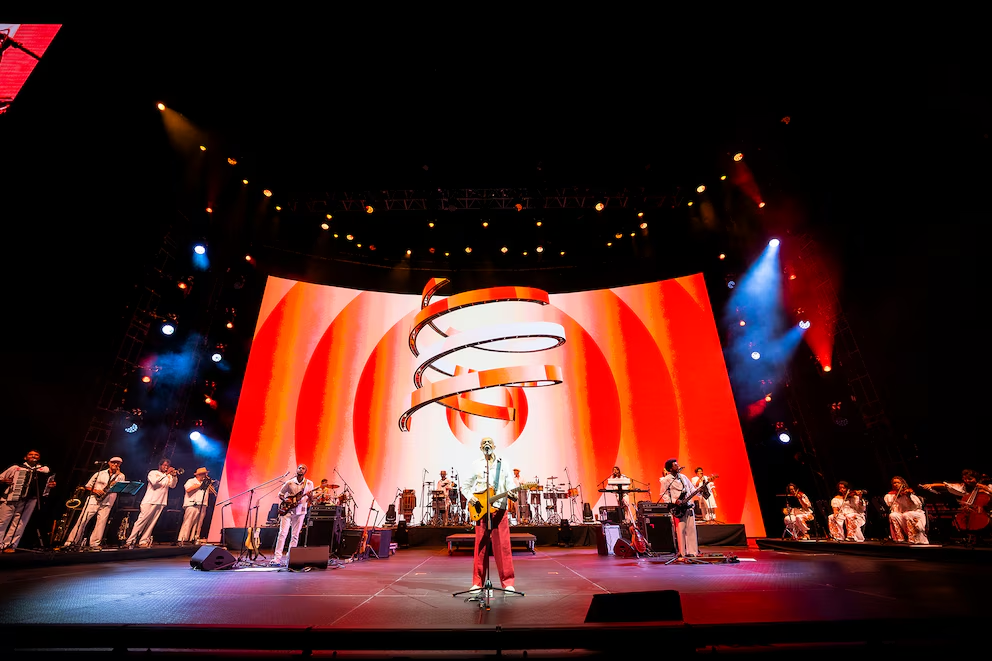
Legends do not leave quietly.
Buenos Aires, March 2026
Gilberto Gil’s latest performance in Buenos Aires did more than satisfy the expectations attached to a historic name. It reminded the region that certain artists no longer operate only as musicians. They function as cultural institutions. His March 11 concert at Movistar Arena, part of the Tempo Rei tour, was framed as a retrospective and farewell gesture, but the real effect was larger than nostalgia. At 83, Gil was not simply revisiting a celebrated catalogue. He was reaffirming a continental scale of influence built across music, politics, language, and identity.
That matters because farewell tours often collapse into sentiment or self mythology. Gilberto Gil’s case appears to have avoided both traps. Coverage from Buenos Aires described the show as emotionally rich, musically expansive, and fully consistent with the stature of an artist whose career exceeds any single era or style. That is precisely what gives the concert its weight. Gil is not remembered only for a sequence of famous songs or for a nostalgic Brazilian repertoire. He belongs to a generation that transformed popular music into a language of intellectual and civic intervention, and that legacy cannot be staged effectively through greatest hits mechanics alone.

The Buenos Aires stop also reinforced the magnitude of his regional role. Gil has long exceeded the boundaries of Brazilian music as a national category. He is one of the rare artists whose work became legible across Latin America as both aesthetic innovation and democratic imagination. Tropicalismo was never just a musical experiment. It was a way of reorganizing cultural perception under pressure, blending modernity, dissent, memory, and mass appeal into a new grammar of public expression. When Gil steps onto a stage in Argentina, he does not arrive as a foreign veteran visiting a neighboring market. He arrives as one of the architects of a shared Latin American cultural vocabulary.
That is one reason the show resonates beyond concert culture. In a time when much of the music industry is structured around accelerated novelty, algorithmic visibility, and the short half life of attention, Gilberto Gil represents a very different model of artistic legitimacy. His authority was not built through constant reinvention for market survival alone, but through a sustained ability to remain historically meaningful while still sounding alive. Reports on the Buenos Aires concert emphasized both the emotional warmth of the audience response and the density of the repertoire, which suggests that the evening functioned less as a memorial to the past than as a demonstration of enduring relevance.
There is also something politically revealing in the shape of this farewell. Gilberto Gil is not only a singer and songwriter. He is a former Brazilian minister of culture, a public intellectual, and a figure whose artistic biography is inseparable from exile, censorship, democratic transition, and the long struggle over what culture means in public life. That history changes the meaning of a concert like this one. The audience is not merely consuming songs. It is encountering a living archive of Latin American modernity, one that carries the memory of authoritarianism, experimentation, and civic resilience without needing to spell those themes out didactically.
The emotional charge of the Buenos Aires performance was heightened by the sense of closure. Reports described the concert as a goodbye to Argentine stages within the final tour’s broader itinerary, and one widely noted detail was a symbolic embrace with Charly García. Even without overreading the gesture, the scene matters. It condensed two traditions of Latin American musical intelligence into a single image: Brazil and Argentina, song and experiment, endurance and fragility, all meeting inside one farewell night. That is the kind of symbolic compression only certain artists can generate.
What makes Gilberto Gil’s presence so unusual is that he belongs to a category of artist who expands with time rather than narrowing into canon. Many celebrated musicians become easier to honor than to hear. Gil seems to resist that fate. Current accounts of the show stressed not just reverence, but vitality, stage command, and the capacity to hold an audience through a sweeping retrospective of more than six decades. That distinction is crucial. A legend can fill a venue through memory. A giant still has to justify the room in the present tense. Buenos Aires suggests he did exactly that.
What remains after a concert like this is not only admiration, but perspective. Gilberto Gil’s stop in Buenos Aires was a reminder that Latin America still produces artists whose significance cannot be contained by industry categories or national labels. He is a musician, yes, but also a carrier of historical continuity, a translator of cultural complexity, and a rare figure who makes popular music feel equal to the intellectual life of a continent. That is why the show was worthy of his legend. It did not merely celebrate an old master. It confirmed that some masters never become old in the narrow sense. They become larger than the stage that hosts them.
Phoenix24: journalism without borders. / Phoenix24: journalism without borders.