

 Phoenix 24
Small money can trigger durable change.
Madrid, March 2026
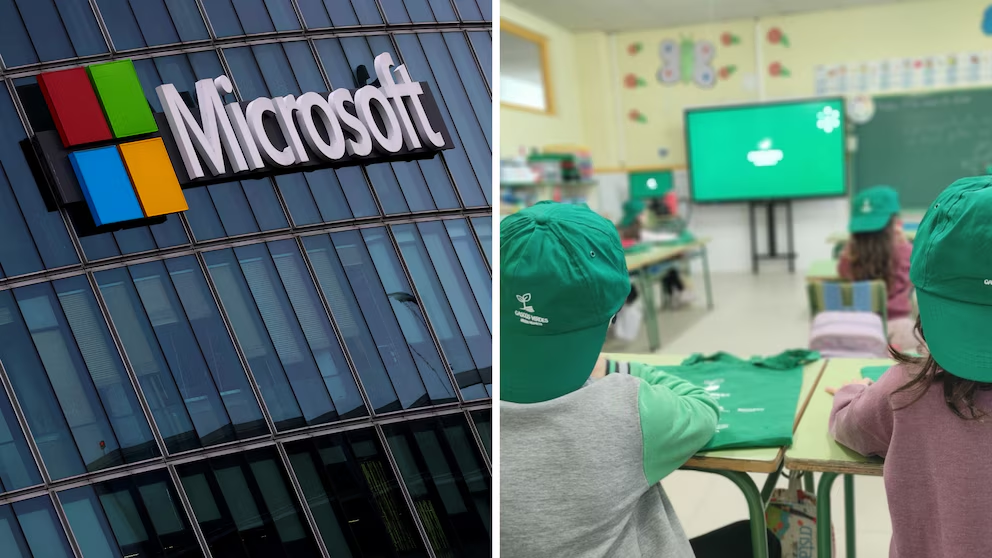
Microsoft has opened a new call under its Madrid Community Fund offering up to 10,000 euros per project, and the structure of the program reveals a quiet but strategic shift in how large tech firms try to buy legitimacy around critical infrastructure. This is not a generic innovation prize. It is a place-based funding mechanism aimed specifically at nonprofit organizations working in the municipalities that host Microsoft’s data centers in the Community of Madrid: Algete, Meco, and San Sebastián de los Reyes. The message embedded in the design is straightforward: if a company anchors long-term digital infrastructure in a territory, it will increasingly be expected to anchor visible social value there as well, not just pay taxes and hire contractors.

The funding ceiling, 10,000 euros, is deliberately modest for a global corporation, but that is the point. At this scale, the grants are built to be accessible to grassroots associations, local foundations, and small NGOs that can move fast without bureaucratic overhead. The program’s emphasis is not on grand innovation narratives. It is on tangible, local impact that can be executed within a maximum of 12 months from receipt of funds. In practical terms, this is micro-capital intended to convert existing community energy into structured projects, while giving Microsoft a credible story about “responsible presence” in the same places where it is expanding cloud capacity.
The call is managed by ChangeX, a nonprofit platform that helps administer community funding programs and guide applicants through selection and implementation. That operational choice is not cosmetic. Outsourcing management to a social-impact intermediary helps Microsoft avoid the optics of directly picking winners in local politics and helps impose a standardized evaluation process that can be defended publicly. At the same time, it is still a corporate fund. The selection logic prioritizes proposals with strong local roots, community mobilization capacity, and measurable social, educational, or environmental results. Put bluntly, the fund is not trying to discover the most original idea on paper. It is trying to find the ideas most likely to work on the ground.
The program defines three priority pillars: education and training, sustainability and environmental education, and social empowerment. Within those pillars, applicants are expected to address at least one thematic area, including digital skills, biodiversity and community, education and access, future workforce development, sustainability and environment, STEAM, social cohesion, and water. This thematic list is telling because it maps cleanly onto two converging agendas: the local needs of municipalities dealing with growth and change, and the reputational agenda of a technology company building data infrastructure. Digital skills and workforce development align with Microsoft’s corporate identity. Biodiversity, sustainability, and water align with the environmental scrutiny data centers attract. Social cohesion and access align with the political expectation that large firms should not deepen inequality in the places they operate.
The deadline is also part of the strategic posture. Applications remain open until April 17, 2026, a window long enough to allow community organizations to assemble proposals without professional grant-writing teams, but short enough to preserve momentum and deliver outcomes within the year. The program is framed as a fifth edition and is presented as already having supported 39 projects and reached more than 11,500 people, which functions as a credibility shield: this is not an experiment, it is a recurring mechanism. Recurrence matters because one-off philanthropy looks like publicity. A repeated fund begins to look like governance.
The projects highlighted in prior editions signal the kind of work the fund wants to reproduce. Examples include hands-on technology education for children through robotics and programming workshops, intensive short-format credentials for unemployed people to build applied tech skills, school-based sustainability initiatives that mix environmental learning with community participation, and inclusion projects that improve accessibility and social integration. Even animal welfare appears in the portfolio through programs aimed at ethical management of urban cat colonies. The range is wide, but the pattern is consistent: initiatives that are legible to the public, practical in execution, and easy to defend as “real benefit” rather than abstract innovation.
The most important way to read this call is not as charity but as social licensing. Data centers generate jobs and tax revenue, but they also generate civic anxiety: energy demand, water use, land footprint, traffic, and a sense that global infrastructure arrives faster than local bargaining power. Community funds are one way corporations attempt to reduce that friction. A 10,000-euro grant will not solve structural inequality or infrastructure stress. But it can change the emotional map of a municipality by making the company’s presence visible in schools, training programs, environmental restoration projects, and local associations. In that sense, the fund is a reputational instrument that operates through small wins.
For applicants, the opportunity is clear but bounded. The fund is well-suited to projects that can deliver measurable outcomes quickly: a training cohort, a school program, a community restoration action, an inclusion initiative, a pilot that can later be scaled with other funding. It is not designed for multi-year institutional transformation. The 12-month execution limit enforces that reality. The strongest proposals will likely be those that already have community networks and can use the grant as acceleration capital rather than as their only resource.
What changes on the wider board is the standard now forming around cloud infrastructure expansion. Communities are no longer being asked to accept data centers as neutral technical assets. They increasingly demand a visible social dividend, and corporations increasingly respond with programs that look small individually but large collectively over time. Microsoft’s Madrid Community Fund is a compact example of that emerging model: targeted geography, manageable grant size, fast execution, and themes aligned with both local needs and corporate risk. The money is modest, but the logic is strategic.
Phoenix24: clarity in the grey zone. / Phoenix24: claridad en la zona gris.