

 Phoenix 24
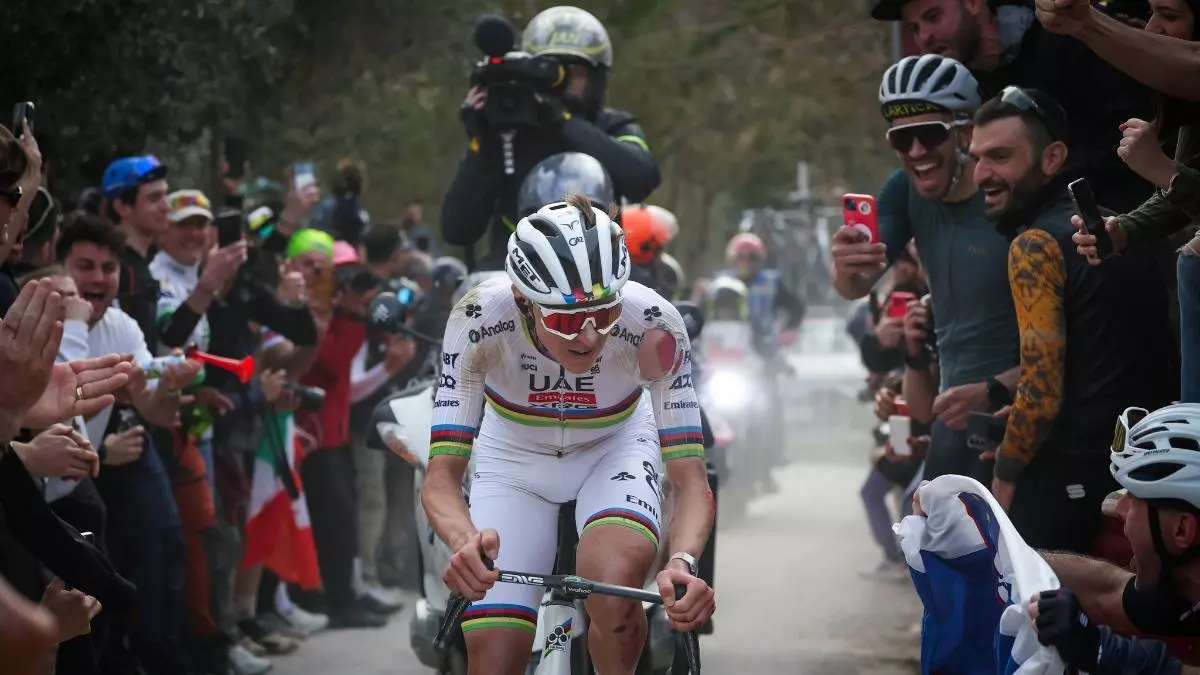
Route design can also be competitive politics.
Siena, March 2026
The debate around Strade Bianche’s 2026 route is not only about cycling spectacle, but about how race organizers manage dominance when one rider begins to distort the competitive logic of an event. Recent Spanish coverage has focused on the idea that Tadej Pogačar will face a modified sterrato layout, with fewer gravel sectors and changes that affect how the race builds toward decisive points such as Le Tolfe. On paper, this looks like a technical adjustment in a race that has always evolved. In strategic terms, it is also a response to a recurring problem in elite sport: what organizers do when a champion becomes so superior that the event risks turning predictable. The question is not whether the course still suits Pogačar, because it clearly does. The question is whether route calibration can widen the tactical window for everyone else.
The key structural change discussed across cycling coverage is the reduction in gravel sectors and total sterrato distance for the men’s race, with the route trimmed from the harsher configurations seen in recent editions. Reports in the current cycle describe a move from 16 sectors to 14 and a drop to roughly 64 kilometers of gravel, while preserving the race’s identity and the iconic finish in Siena. That matters because Strade Bianche’s selective power has always come from cumulative stress, repeated accelerations, and technical attrition rather than one single climb. Reducing the sterrato load does not neutralize Pogačar, but it can compress the race and delay where decisive separation begins. In practical terms, fewer dirt sectors may increase the number of riders still in contention deeper into the finale.
At the same time, the symbolic weight of Pogačar in this race has only grown. International cycling coverage has highlighted that organizers are honoring him with a named gravel sector after his third victory, placing him in a lineage of race-defining figures and reinforcing how deeply he is now identified with Strade Bianche’s modern image. This creates a paradox for the event. The race benefits from his presence because he elevates prestige, attention, and narrative intensity. Yet the same dominance pressures the competition to remain uncertain enough to preserve drama. That is why route adjustments, sector emphasis, and discussion around terrain such as Le Tolfe are not neutral technicalities. They are part of the governance of spectacle in a sport where myth and competition must coexist.
Le Tolfe remains central in that equation because it is one of the points where fatigue, positioning, and explosive power converge under pressure. Even if the route reduces overall sterrato severity, the late-race sequence around the decisive sectors still forces tactical choices that expose weaker teams and punish hesitation. For rivals, the challenge is not simply to survive until Siena, but to avoid letting the race settle into a rhythm where Pogačar can launch on terrain that amplifies his strengths. For organizers, preserving those selective landmarks helps maintain the event’s character while softening the broader accumulation of damage. That balance is delicate. If the course becomes too easy, Strade Bianche loses identity. If it remains too brutal, the race risks reinforcing the same script year after year.
There is also a wider cycling pattern behind this discussion. When a rider dominates a specific race repeatedly, every course design choice starts being interpreted through that rider’s silhouette, whether or not the change was intended primarily for safety, spectacle, or logistical reasons. Fans read it as protection or resistance. Teams read it as opportunity or futility. Media read it as narrative strategy. In that environment, even modest route revisions become political objects inside the sport’s symbolic economy. Pogačar’s case is especially potent because his victories in Siena have not been narrow procedural wins, but performances that reshape expectations about what is possible on these roads.
This does not mean the route has been redesigned to stop him outright, and framing it that way would oversimplify how races are built. Organizers must manage safety, television rhythm, competitive variety, and historical continuity at the same time. Still, the timing and framing of the 2026 changes make it impossible to ignore the competitive context. Strade Bianche is trying to preserve uncertainty without surrendering identity, and that is exactly the kind of tension elite events face when excellence becomes monopolizing. If Pogačar wins again, the changes will be read as insufficient. If the race opens up and another contender survives the sterrato sequence to challenge late, the route will be seen as a successful recalibration.
What changes on the wider board is how Strade Bianche is now perceived within the calendar. It is no longer only a beautiful early-season classic defined by white roads and Tuscan aesthetics. It is also a testing ground for how modern cycling manages superstar gravity without diluting competitive meaning. Pogačar remains the reference point, and the terrain still speaks his language. But the 2026 route discussion shows that the race is no longer just hosting his dominance. It is actively negotiating with it.
Facts that do not bend. / Facts that do not bend.