

 Phoenix 24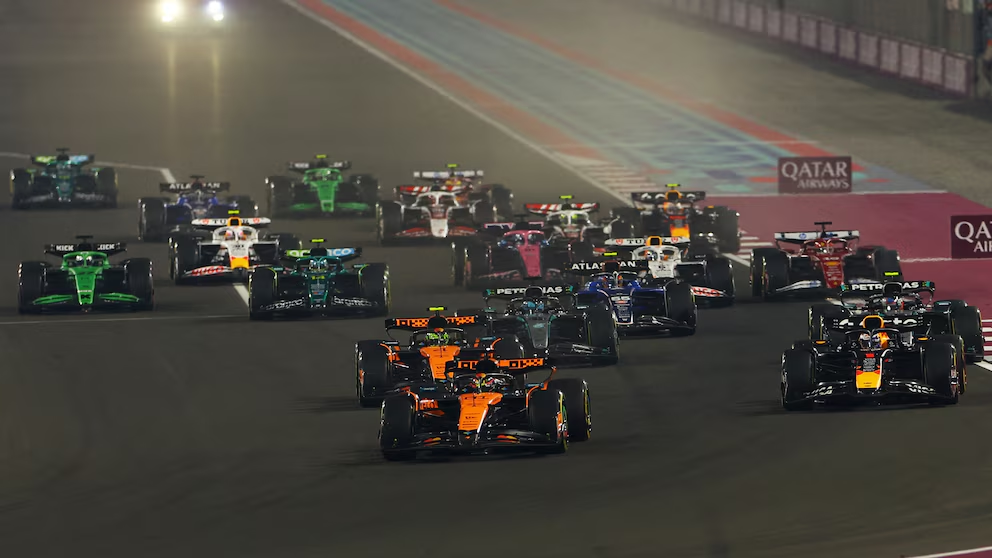
The first 200 meters suddenly look unstable.
Sakhir, February 2026.
Formula 1 did not expect the loudest argument of its 2026 reset to be about the start lights, yet Bahrain testing pushed the sport into exactly that corner. Engineers came for data on a new generation of cars, but the paddock left with a more uncomfortable realization: the new power-unit logic changes the physics of launching so much that the old procedure can produce stalls, uneven acceleration, and dangerous closing speeds before Turn 1. That is not a cosmetic problem for the show, it is a risk management problem for the FIA and for every driver buried in the pack.
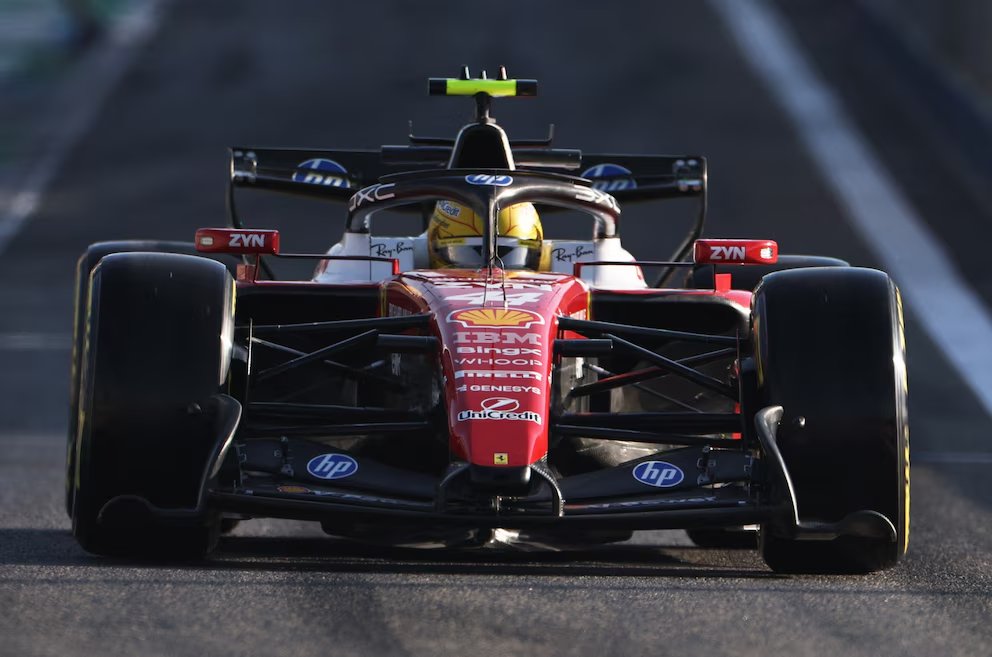
The root cause is mechanical, but the consequences are social, because race starts are collective behavior. The removal of the MGU-H means teams can no longer rely on that system to keep the turbo spooled in a predictable way at the exact moment the clutch bites. Drivers must now build the turbo with engine revs and timing, then manage traction while the car transitions into a different torque phase. In parallel, the higher reliance on electrical power comes with deployment constraints that do not always help at the first meter, so the launch can feel like two accelerations stitched together rather than one clean surge.
That stitching is where the hazards multiply. When some cars bog down and others leap forward, the variance becomes the enemy, not the absolute speed. The field compresses, reaction times shrink, and the driver behind must guess whether the car ahead is accelerating normally or is about to stall. A single hesitation can trigger a concertina effect that looks like driver error on replay but is actually a system mismatch, created by regulation architecture.
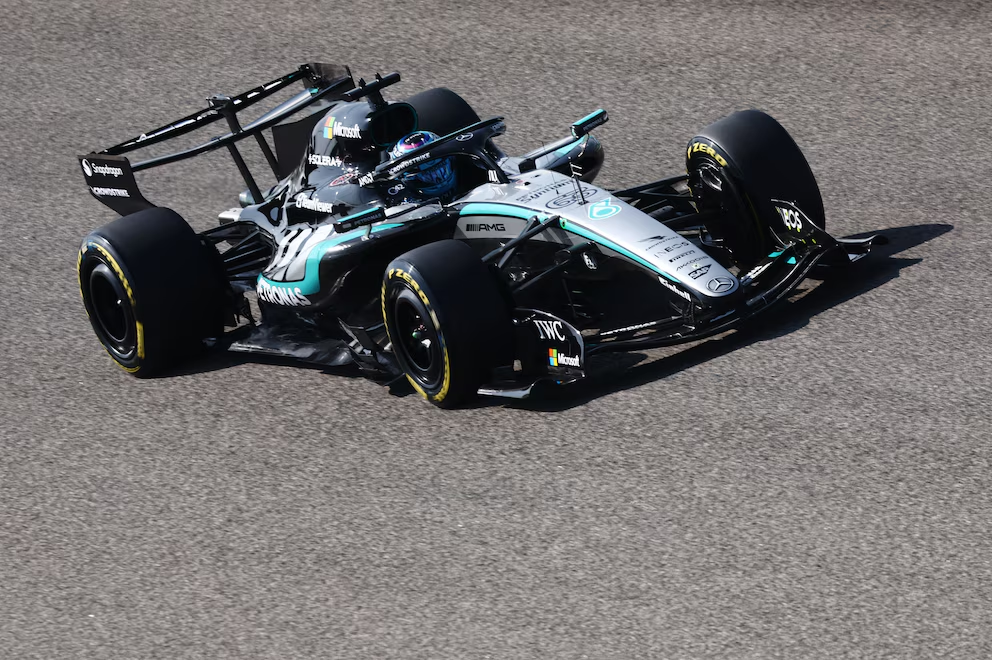
The FIA’s answer is to remove discretion and add structure, and it is happening fast because the calendar is unforgiving. Reporting across international outlets points to a revised start sequence that adds an extra preparation window on the grid, signaled by a blue light cue before the usual red-light procedure. The goal is to standardize the moment drivers begin the turbo preparation, reducing the probability that some are fully “ready” while others are still waiting for the system to come alive. This is an administrative fix for an engineering transition, a classic motorsport move when the sport needs safer uniformity without rewriting the entire rulebook.
A second adjustment is aerodynamic, and it exposes how much modern F1 relies on active systems. The plan, as described in coverage, is to constrain active aero so that cars begin the race in a stable configuration rather than using a low-drag mode from the grid to the first corner. In practical terms, this reduces the temptation to trade stability for straight-line gain at the precise moment when traction is most fragile. It also lowers the risk that a driver tries to optimize a launch with aero settings that amplify wheelspin or destabilize the car during the first braking phase.
The controversy is that “safety” and “competition” are never cleanly separable in a regulation transition. Ferrari has been the reference point in launch performance during the test program, and the sport’s own discussion has treated that advantage as both impressive and politically sensitive. If the revised sequence reduces the benefit of a team’s launch technique, the affected team can argue that the playing field is being leveled after the work was done. Yet the counterargument is hard to ignore: if a procedure creates repeatable high-variance outcomes, the sport is effectively manufacturing incidents rather than managing them.
Drivers have amplified the issue in a way that teams could not fully contain. Several have described the cognitive load of the new start as unusually high, because it involves turbo readiness, clutch bite, and energy management under maximum stress. Oscar Piastri has been quoted in international coverage warning that starts could become a “disaster” if the sport does not simplify the demands on drivers. When multiple drivers across different teams point to the same failure mode, the FIA gains political cover to act quickly, because silence becomes harder to defend than intervention.
This story also travels differently across regions, which matters for F1’s commercial posture. In Europe, where governance credibility and safety culture are closely watched, last-minute procedural fixes can look like prudent risk control or like uncertainty in stewardship, depending on how clean the rollout is. In the Middle East, where Bahrain testing is a visible gateway into the season, chaotic practice starts undermine the sense of a polished global product. In North America, where growth depends on trust from casual audiences, the sport cannot afford a season opener dominated by confusion over why cars are stalling on the grid.
The deeper pattern is that the 2026 era is not just a new car, it is a new rhythm. Hybrid rules are moving more responsibility onto the driver during transitional moments, and the start is the most compressed transition of all. F1 can sell complexity when it looks like mastery, but it struggles when complexity looks like randomness. If the start becomes a lottery, it will contaminate the legitimacy of everything that follows, strategy, overtaking, even championship narratives.
What Bahrain really exposed is that the first 200 meters are now a governance problem, not merely a driving problem. The FIA is trying to widen the margin for uniform preparation and reduce the temptation to destabilize launches with aero tricks, because uniformity is the cheapest form of safety. The teams will accept it if the risk is truly shared, and they will resist it if they believe it selectively erases earned advantage. Either way, the start procedure has become the earliest battlefield of the 2026 rules, because it is the one moment where technology, psychology, and fairness collide with no room to hide.
Contra la propaganda, memoria. / Against propaganda, memory.