

 Phoenix 24

In technology markets where user attention shifts as quickly as new capabilities appear, a double-digit drop in traffic rarely signals a single cause and often reveals deeper structural change.
San Francisco, January 2026.
Recent web analytics indicate a notable decline in traffic to ChatGPT in the weeks following the launch of Gemini 3, the latest generative artificial intelligence model introduced by Google. Estimates from digital measurement firms suggest that average weekly visits to ChatGPT’s web interface fell by roughly twenty-two percent over a period of several weeks, coinciding with the public rollout and promotion of the competing system. The timing has drawn scrutiny from analysts who view the drop not as an isolated fluctuation, but as a reflection of intensifying competition within the generative AI ecosystem.
The decline occurred during a period that traditionally includes seasonal volatility in online activity, particularly around the end-of-year holidays. Even so, the scale of the contraction has prompted closer examination. At the same time that ChatGPT’s web traffic softened, usage indicators associated with Google’s AI offerings showed relative stability, suggesting that a segment of users may be experimenting with alternatives rather than disengaging from generative AI altogether. This pattern reinforces the view that the market is entering a phase of fragmentation rather than contraction.
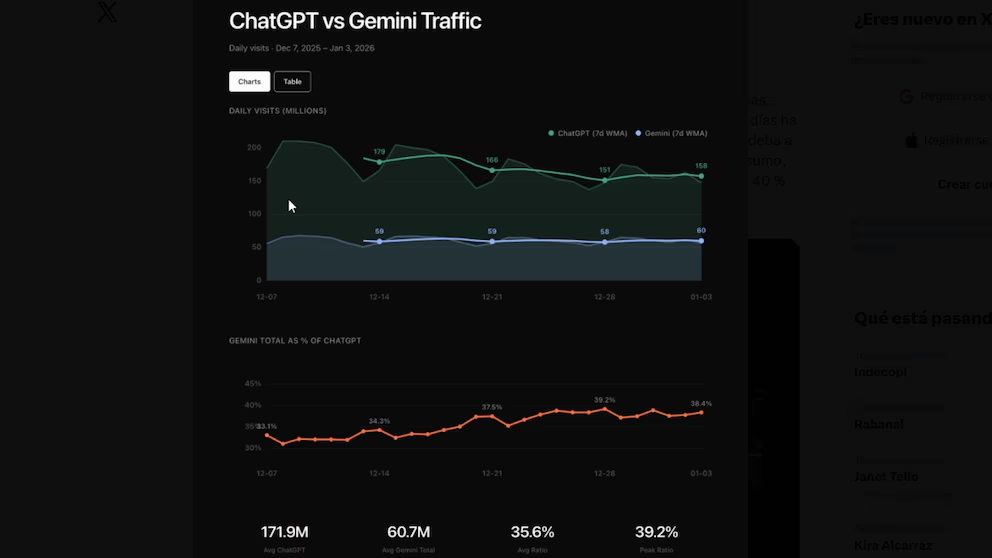
From a competitive standpoint, the launch of Gemini 3 represents more than the arrival of a new model. Its integration into Google’s broader ecosystem of services, devices, and productivity tools gives it structural advantages in distribution and visibility. For many users, access to generative AI is increasingly mediated through platforms they already use daily, reducing the friction required to test or adopt new tools. In this context, traffic shifts can reflect convenience and integration as much as perceived quality or performance.
At the same time, analysts caution against overinterpreting web traffic figures as a definitive measure of platform health. A growing share of generative AI usage now occurs through mobile applications, enterprise deployments, and application programming interfaces embedded in third-party products. These channels are often invisible to traditional web analytics, meaning that a decline in browser-based visits does not necessarily equate to an equivalent drop in overall usage or revenue. Nonetheless, public perception remains closely tied to visible metrics, especially in a sector where momentum and narrative play a strategic role.
For OpenAI, the company behind ChatGPT, the traffic data underscores the need to continually differentiate its offerings in a crowded field. The rapid pace of model releases from major technology firms has compressed innovation cycles, leaving little room for complacency. Improvements in reasoning, multimodal capabilities, customization, and enterprise reliability have become baseline expectations rather than distinguishing features. In this environment, user loyalty is increasingly fluid, shaped by incremental gains rather than long-term lock-in.
The broader implication is that the generative AI market is maturing faster than many anticipated. Early dominance based on novelty is giving way to sustained competition based on integration, trust, cost, and adaptability to specific use cases. As more actors enter the field, shifts in traffic and attention may become more frequent, reflecting experimentation rather than decisive allegiance. For users, this translates into a wider range of options. For providers, it raises the stakes of every release.
Seen through this lens, the reported decline in ChatGPT’s web traffic is less a verdict on a single platform and more an indicator of a market recalibrating itself. The emergence of Gemini 3 has accelerated that process, reminding industry leaders that leadership in artificial intelligence is provisional and must be continuously defended. In a sector defined by rapid iteration, relevance is not maintained by past breakthroughs, but by the ability to respond to each new competitive signal with speed and clarity.
Phoenix24: clarity in the grey zone. / Phoenix24: claridad en la zona gris.