

 Phoenix 24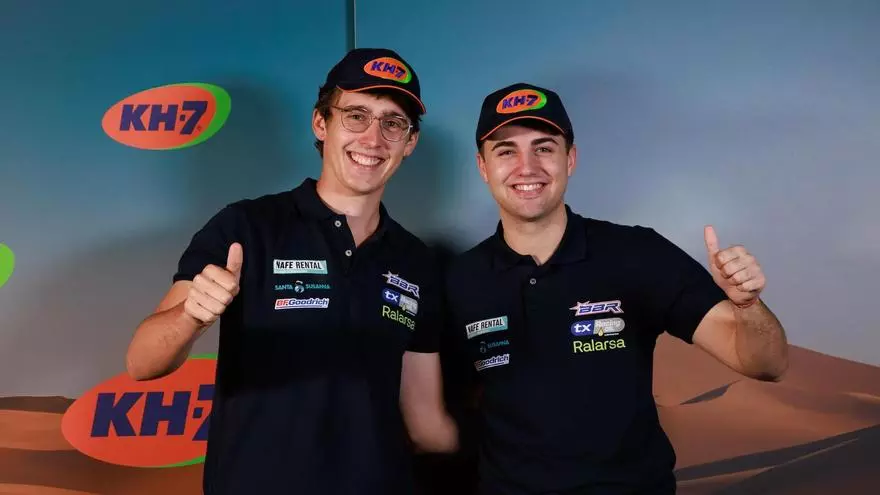
Youth is no longer a disadvantage in rally raid. It is becoming a strategic asset.
Yanbu, Saudi Arabia.
As preparations intensify for the upcoming Dakar Rally, Spain’s presence in the rally raid discipline is being redefined by a new generation of competitors who combine early exposure, technical discipline and long term strategic ambition. Among them, Pau Navarro and Jan Rosa stand out as a pairing that reflects how Dakar is evolving, not only as an endurance challenge, but as a platform for accelerated professional development.
Navarro represents one of the youngest drivers to establish continuity in the event. His progression through the Dakar ecosystem has been unusually early, shaped by formative experiences in navigation, mechanical survival and stage management rather than pure speed alone. This early exposure has allowed him to internalize Dakar’s logic as a system of decisions rather than a sequence of sprints, an approach that increasingly defines success in modern rally raid.
Alongside him, Jan Rosa brings a complementary profile rooted in navigation precision and operational consistency. In Dakar, the navigator’s role extends far beyond route reading. It involves risk calibration, error containment and mental endurance under extreme fatigue. Rosa’s contribution lies precisely in this dimension, where marginal decisions accumulate into structural advantage over the course of two weeks in the desert.
Their partnership reflects a broader shift within the sport. Dakar is no longer dominated exclusively by veteran crews whose advantage rested solely on accumulated experience. Advances in vehicle platforms, telemetry analysis and structured preparation have lowered the entry barrier for younger teams, while simultaneously raising the cognitive demands of competition. Success now depends less on improvisation and more on disciplined execution across multiple variables.
The Challenger category has become the natural arena for this transition. Positioned between production based vehicles and elite prototypes, it rewards consistency, adaptability and mechanical sympathy. For emerging crews, it offers a proving ground where learning curves are steep but survivable. Navarro and Rosa’s decision to consolidate their trajectory in this category signals an understanding that Dakar careers are built through accumulation, not acceleration.
Their preparation emphasizes reliability over spectacle. In a rally where attrition remains a defining factor, finishing strong often outweighs winning individual stages. This mindset aligns with a new generation of competitors who treat Dakar as a long term project rather than a single headline opportunity. Each edition becomes part of a broader developmental arc.
Spain’s rally raid ecosystem has matured alongside this generational shift. Training structures, technical partnerships and international exposure have improved markedly over the past decade. The result is a cohort of young drivers and navigators entering Dakar with a level of preparedness that once required multiple failed attempts to achieve. Navarro and Rosa are products of this ecosystem, but also contributors to its credibility.
The Saudi terrain reinforces this evolution. The current Dakar route demands sustained concentration across diverse environments, from deep dunes to rocky plateaus and long liaison sections that test mental resilience as much as physical stamina. In such conditions, youth alone is insufficient. What matters is the ability to manage stress, conserve equipment and maintain clarity under cumulative pressure.
For Navarro and Rosa, the objective is not framed in terms of disruption, but consolidation. Each completed stage reinforces operational maturity. Each navigational decision builds trust within the cockpit. Dakar rewards crews who understand that survival is a competitive skill, and that ambition must be sequenced rather than unleashed.
Their presence also carries symbolic weight for Spanish motorsport. It signals continuity rather than exception. Instead of isolated breakthroughs, Spain is now producing structured Dakar competitors capable of sustaining multi year careers. This normalization of presence is arguably more significant than any single result.
In a discipline where narrative often focuses on heroism and collapse, the quieter story of progression is easy to overlook. Yet it is precisely this story that reshapes the competitive landscape. Navarro and Rosa do not arrive as outsiders chasing a miracle. They arrive as part of a system that understands Dakar as an ecosystem of endurance, planning and restraint.
As the rally approaches, expectations will naturally follow. But in Dakar, expectation is secondary to execution. What defines careers here is not visibility, but accumulation of experience under pressure. For Navarro and Rosa, each edition is a layer added, not a verdict delivered.
Their trajectory reflects a deeper transformation within rally raid. The future of Dakar is being built not only by legendary names, but by disciplined pairs who understand that the desert rewards those who think in sequences rather than moments.
Detrás de cada dato, hay una intención. Detrás de cada silencio, una estructura.
Behind every data point, there is an intention. Behind every silence, a structure.