

 Phoenix 24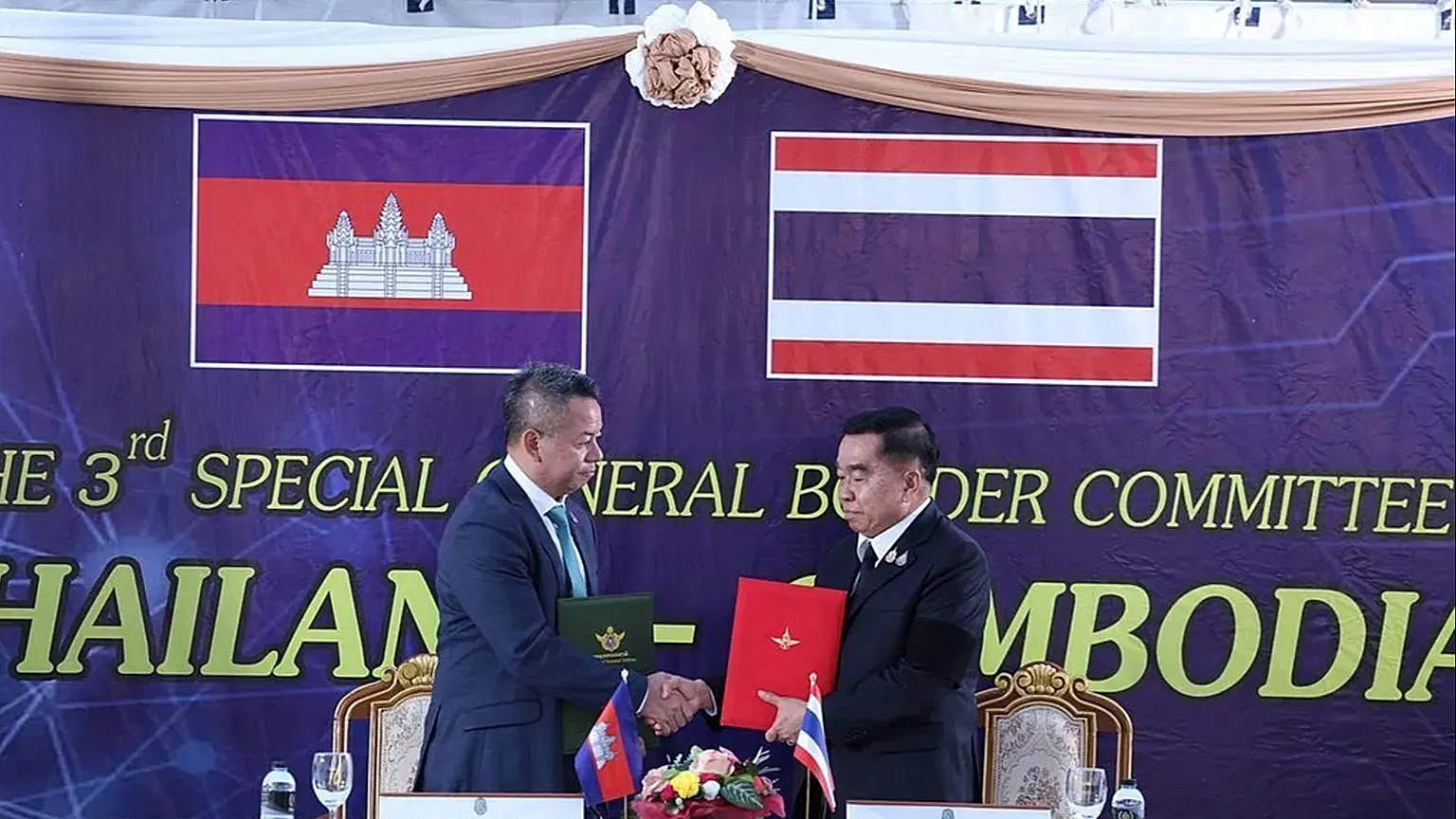
The agreement signals restraint, but not resolution, in one of Southeast Asia’s most persistent fault lines.
Bangkok, Thailand.
On December 27, Thailand and Cambodia formalized a new ceasefire agreement aimed at ending weeks of armed clashes along their shared border, marking a cautious attempt to halt an escalation that had begun to destabilize local security and displace civilian populations. The ceasefire entered into force at midday local time, following direct military and political contacts between the two sides, and was presented as an immediate measure to prevent further loss of life rather than a definitive political settlement.
The agreement commits both governments to suspend offensive military operations, freeze troop movements in contested areas, and refrain from actions that could be interpreted as provocations, including the use of air assets near sensitive zones. Border units were instructed to maintain current positions and restore basic communication channels to avoid miscalculation. While details of monitoring mechanisms remain limited, officials from both sides emphasized the urgency of de-escalation after several weeks of intermittent but increasingly intense fighting.
The clashes erupted earlier this month in disputed border areas long marked by overlapping territorial claims and unresolved demarcation issues. What began as localized confrontations between patrol units escalated into exchanges involving artillery fire and air assets, prompting evacuations of nearby villages and the temporary closure of key transit routes. The humanitarian impact, though geographically contained, exposed the vulnerability of border communities to rapid escalation driven by unresolved historical disputes.
This new truce follows the collapse of a previous ceasefire reached earlier in the year, underscoring the fragility of ad hoc de-escalation efforts in the absence of durable political frameworks. Both sides accused the other of violations in past agreements, fueling mistrust and reinforcing a cycle in which tactical pauses repeatedly give way to renewed confrontation. The December agreement seeks to break that cycle, at least temporarily, by reasserting centralized control over frontline units and reducing the operational tempo.
From a strategic perspective, the ceasefire reflects converging pressures rather than reconciliation. For Thailand, prolonged instability along the border risked internal political costs and international scrutiny at a moment of regional diplomatic sensitivity. For Cambodia, sustained clashes threatened economic disruption and humanitarian strain in already vulnerable provinces. The truce thus represents a convergence of risk management calculations rather than a transformation of underlying positions.
Regional actors have quietly encouraged restraint, viewing the conflict as a destabilizing distraction in an already complex Southeast Asian security environment. While no formal multilateral mediation framework has been announced, diplomatic channels within the region remain active, with an emphasis on preventing spillover and preserving the credibility of regional conflict-management norms. The ceasefire is therefore also a signal outward, intended to reassure neighbors that escalation will be contained.
The agreement includes provisions for confidence-building steps contingent on compliance, including the potential release and repatriation of detained soldiers once the ceasefire demonstrates durability. Such measures are designed to test intentions incrementally, creating incentives for restraint while avoiding politically costly concessions upfront. Their implementation will serve as an early indicator of whether the truce is more than a symbolic pause.
At the operational level, the ceasefire places significant responsibility on local commanders. Border disputes of this nature are particularly vulnerable to breakdowns in discipline and communication, especially in areas where terrain ambiguity and historical grievances intersect. The success of the agreement will depend less on public statements than on the ability of both militaries to enforce restraint at the tactical edge.
Historically, tensions between Thailand and Cambodia have flared episodically, often triggered by incidents that acquire symbolic weight disproportionate to their immediate military significance. Temples, border markers, and patrol routes have repeatedly become catalysts for confrontation, reflecting how unresolved history continues to shape present security dynamics.
For displaced civilians, the ceasefire offers cautious relief rather than certainty. Local authorities have begun preliminary assessments for the return of evacuees, but full normalization will depend on sustained calm and the restoration of basic services. Aid organizations warn that repeated cycles of displacement have eroded resilience in border communities, making long-term stability an urgent humanitarian concern.
Ultimately, the December ceasefire should be read as a tactical stabilization, not a strategic settlement. It pauses violence without resolving the structural drivers that have repeatedly reignited conflict. Whether it evolves into a platform for substantive dialogue or collapses under familiar pressures will depend on political will, military discipline, and the willingness of both governments to move beyond crisis management toward durable mechanisms of dispute resolution.
Behind every data point, there is an intention. Behind every silence, a structure.