

 Phoenix 24
Sometimes the smallest ritual can reveal how much technology has changed, and nothing exposes that shift more clearly than the moment you plug in a new phone for the first time.
San Francisco, December 2025
For years consumers believed that a new phone required a long initial charge, a deep discharge or a full cycle before use. These habits belonged to a different era, one shaped by nickel based batteries that responded poorly to irregular charging patterns. Modern smartphones rely instead on lithium ion and lithium polymer cells, technologies that do not need to be conditioned. Manufacturers ship devices with a moderate charge level that allows immediate use, and there is no technical requirement to fill the battery before turning on the device.
What persists is confusion. Many users still assume that the battery must be drained to zero before its first charge or that an eight hour initial cycle protects long term health. Battery specialists across Asia and Europe note that these ideas stem from the memory effect of older chemistries, a phenomenon that simply does not occur in contemporary devices. Lithium based cells benefit far more from moderate charge levels and stable temperatures than from ritualized charging routines inherited from outdated advice.
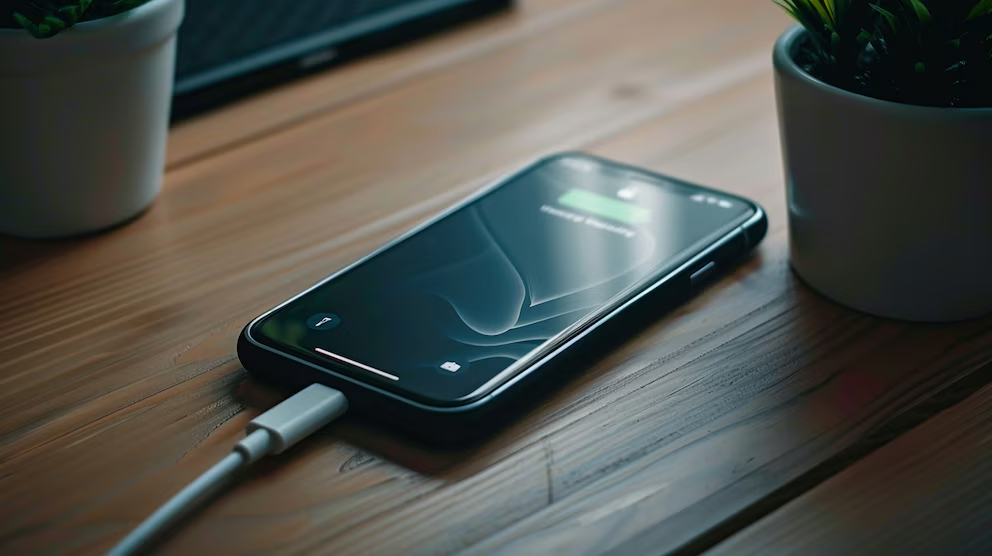
The central principle for battery longevity is avoiding extremes. Very high or very low charge levels create chemical stress. Engineers recommend keeping the battery within a moderate range during daily use, avoiding complete depletion and preventing sustained periods at full capacity. Modern phones include management systems that halt charging when the cell physically reaches its limit, but the stress created near the upper threshold still accumulates with time. The same is true at the lower end, where deep depletion accelerates wear.
Temperature also plays a decisive role. Batteries age faster when exposed to heat during charging, whether the source is the environment, a heavy workload or inadequate ventilation. Using the phone while charging tends to increase internal temperature, particularly in gaming, high resolution streaming or applications that intensively use the processor. Long term exposure to these conditions can reduce the battery’s maximum capacity, even if the device appears to behave normally in everyday conditions.
Charger quality remains another key variable. Certified or original chargers provide stable voltage and current, minimizing electrical fluctuations that strain battery cells. Low quality accessories can produce irregular current or insufficient power, generating heat and forcing the device to compensate. Specialists in North America highlight that incorrect accessories are a more common source of battery degradation than irregular charging patterns. For a new device the best practice is straightforward. Use a charger that matches the manufacturer’s specifications and avoid accessories that lack safety certification.
Many consumers also worry about charging overnight. Modern devices contain protective systems that cut power to the battery when it reaches full capacity and route electrical flow to the system instead. Although this prevents overcharge, keeping the battery at its maximum level for long stretches still contributes to chemical wear over time. Occasional overnight charging is safe, but habitual reliance on it may shorten the battery’s ideal lifespan.
The transition to fast charging has introduced additional questions. Rapid energy flow increases heat, and heat accelerates degradation. However, modern fast charging protocols include safety layers that regulate current to manage thermal buildup. Manufacturers across Asia and Europe have increasingly adopted charging algorithms that slow down the final portion of the cycle to reduce stress. Users can safely employ fast charging when needed, but regular use of slower charging modes remains gentler on the battery.
In truth, the first charge of modern phones matters far less than daily habits. The battery does not require preparation before use. It does not need long initial cycles. It does not accumulate memory. What determines long term health is a combination of temperature control, moderate charge levels and quality accessories. Choosing when and how to charge becomes a matter of convenience rather than technical obligation.
The shift from old battery chemistries to today’s designs has eliminated most of the rituals that once governed the first moments of ownership. What remains is a simple principle. Treat the battery with moderation and it will sustain performance for years. The first charge is no longer a ceremony. It is merely the beginning of an energy cycle managed by technology that protects itself better than most users realize.
Phoenix24: every silence speaks. / Cada silencio habla.