

 Phoenix 24

The quiet transformation that began in back offices now moves to the heart of medical care, promising to reshape how doctors, nurses and patients interact.
Mexico City, November 2025
Hospitals across Latin America and other regions are entering a decisive phase as artificial intelligence and automated systems begin to alter the architecture of clinical work. What once appeared to be distant experimentation has evolved into an operational shift driven by the need to reduce administrative overload, improve diagnostic accuracy and stabilize institutions under growing financial and demographic pressure. Inside medical centers the conversation no longer revolves around whether AI should be adopted, but how quickly its integration can support exhausted personnel who navigate long shifts, repetitive documentation tasks and complex patient loads. The expectation is that by 2026 most medium and large clinics will rely on interconnected digital systems capable of processing information with a speed and consistency that surpass traditional manual practices.
Across Europe, analysts focusing on health technology report similar trends, noting that automated record generation, clinical decision assistance and intelligent scheduling tools are becoming part of everyday routines. In North America specialists in medical informatics highlight that these systems can reduce delays in triage, detect early warning signs hidden in patient data and streamline communication between departments that often operate in isolation. Meanwhile research groups in Asia studying hospital efficiency emphasize that automation is not limited to digital paperwork. It extends to logistics, inventory control, supply distribution and the coordination of emergency pathways, producing gains that accumulate silently but significantly.
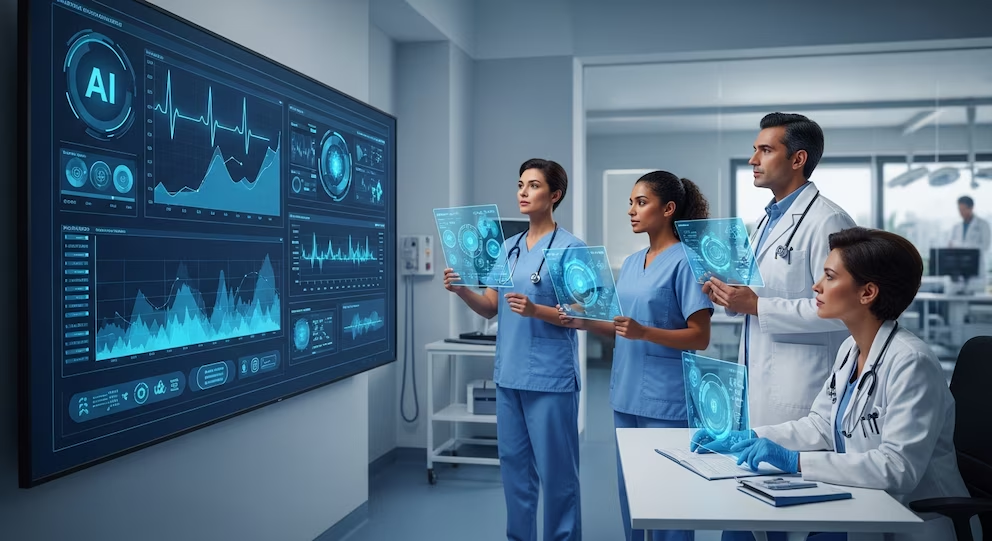
For physicians the most immediate change will stem from the reduction of administrative burden. Doctors who previously spent hours updating charts or drafting notes will increasingly rely on AI supported summaries that prioritize clinically relevant information, allowing them to devote more time to direct patient care. Nurses stand to benefit as well, particularly in environments where staffing shortages create gaps that automated monitoring tools can help mitigate by tracking vital signs, alerting teams of abnormalities and reducing the risk of human error. These improvements, however, require careful oversight to ensure that technology assists rather than replaces essential human judgment.
Ethical and regulatory challenges accompany this transformation. Experts in the Middle East who advise health ministries underline the importance of establishing clear rules regarding data protection, algorithmic transparency and accountability when a decision is influenced by automated systems. Without robust governance frameworks, hospitals risk creating an environment where technological convenience outweighs patient rights. In Latin America policymakers remain cautious about uneven access, warning that if only well funded institutions can deploy advanced AI systems, the digital divide within healthcare could widen rather than close.
Despite these concerns the drive toward automation appears irreversible. Demographic shifts and the rising prevalence of chronic conditions have pushed health systems to seek tools that optimize scarce resources. Hospital administrators increasingly recognize that workflows designed decades ago cannot respond effectively to current pressures. The debate now focuses on how to align technological capability with institutional culture, ensuring that teams are trained to interpret AI generated insights and understand the limits of automated recommendations. In educational institutions curricular reforms are underway to incorporate technological literacy as a core component of medical training.

As 2026 approaches the sense is that healthcare is crossing a threshold from analog routines to integrated digital ecosystems. Whether this shift produces a more humane, efficient and resilient model will depend on how well institutions harmonize innovation with responsibility. What remains clear is that AI and automation are no longer peripheral experiments; they are becoming the structural scaffolding through which modern clinical practice will operate.
Analysis that transcends power. / Análisis que trasciende al poder.