

 Mario López Ayala, PhD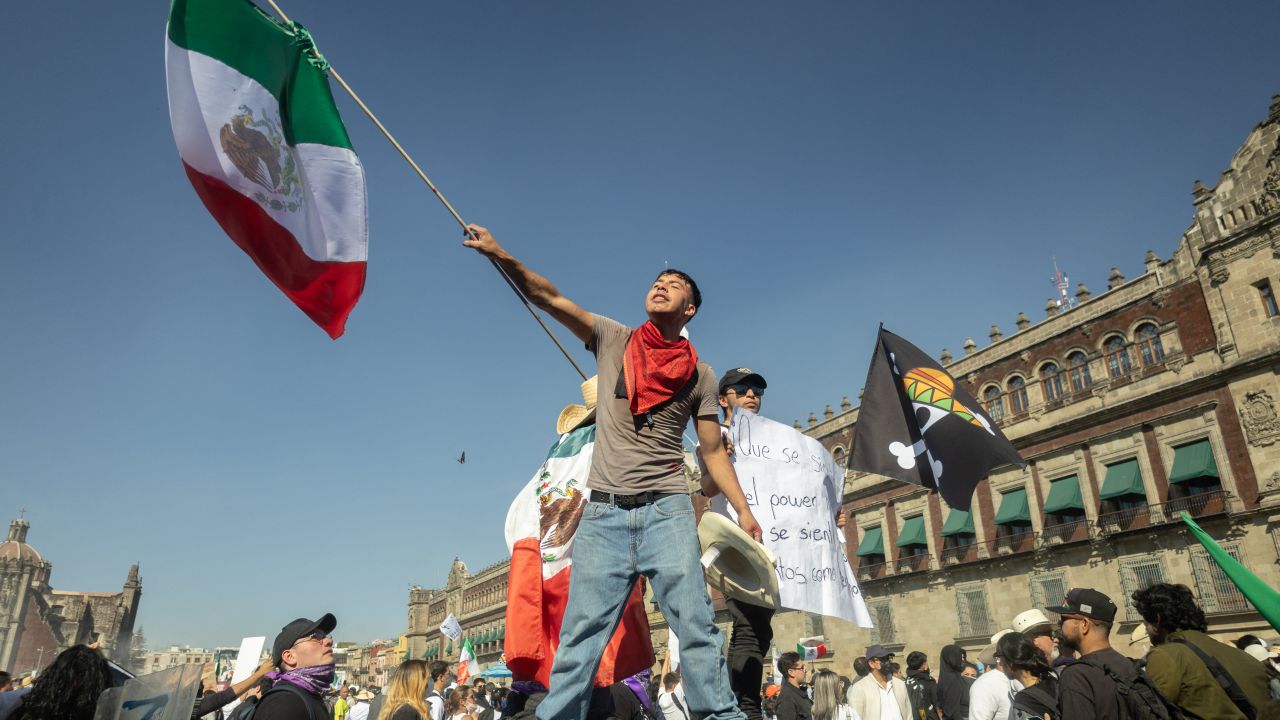
Every generation has defied a regime; this one defies the entire century.
Mexico City
The youth march that moved through the avenues of the Mexican capital did not erupt as an unexpected outburst, but as part of a global sequence connecting young people from Hong Kong, Lagos, Santiago, Melbourne and Bangkok under a shared emotional pulse: the intuition that the State no longer protects, no longer listens, and no longer interprets. The arrival of the black bloc, far from being a local anomaly, acted as a tactical bridge between Mexico and the new protest repertoires that Generation Z has refined across the planet. What unfolded in Mexico City shows that the country is now part of a map where young people are not seeking to integrate into the system; they seek to diagnose it, stress it, and expose its fractures. When the future decides to walk, no government is prepared for its pace.
The landscape becomes clearer when observed through other latitudes. In Hong Kong, young people turned the city into a board of micro-battles coordinated by digital swarms capable of dissolving in seconds. In Bangkok, students broke a monarchical taboo that had seemed untouchable for decades. In Singapore, where protest is usually confined to State-designed spaces, climate activists have managed to stretch the official narrative despite an increasingly restrictive legal environment. In Lagos, the EndSARS movement revealed that indignation organized by citizens under thirty could challenge a police structure accustomed to operating with absolute impunity. Across Europe, climate marches led by teenagers forced entire governments to redirect budgets and adjust energy-transition policies. In every case, the formula was the same: a generation without fixed leaders, without traditional hierarchies, and without fear of breaking the political mold they inherited.
Mexico is not arriving late to this international conversation; it arrives carrying a historical weight that shapes its complexity. The memories of 1968 and 1971 are not archaeological events: they are living warnings. Tlatelolco demonstrated that the State was willing to fire upon its youth without altering the official narrative. The Halconazo revealed that repression could be outsourced to para-State groups without leaving direct traces on the authorities. Although the country no longer reproduces those mechanisms, generational sensitivity persists. Every time a youth contingent organizes, the suspicion revives that a protest could become the spark the State is unprepared to manage. This is why the aesthetics of the black bloc generate so much friction: they can protect identities, but they can also be used as a State-crafted pretext to tighten surveillance, justify police operations, discredit demands, or shift the discussion from the narrative of “discontent” to the narrative of “order.”
The Mexican paradox is evident. A political movement that built its identity denouncing repression in the past now faces a generation that challenges it with the same intensity with which that movement once confronted previous governments. This is not historical ingratitude; it is an inevitable generational transition. Generation Z does not operate through the linear codes of traditional politics: it grows in environments of digital surveillance, understands virality as a tool, organizes its discourse through multiple platforms, and perceives every attempt at disqualification as part of the global manual States use to contain those who expose internal fractures. Youth are no longer waiting for the State to interpret reality: they produce it, revise it, publish it, and transmit it within seconds. That displacement of the narrative center is what unsettles modern governments. Losing the monopoly over the story is losing the monopoly over legitimacy.
None of this signals an immediate collapse, but it reveals that Mexican institutions are entering a phase in which generational tensions can no longer be resolved through traditional formulas. Open repression, aside from being dangerous, is ineffective. Co-optation has limits. Strategic indifference feeds the perception of distance. And the stigmatization of the black bloc only multiplies youth distrust. Mexico is facing a generation unafraid of surveillance because it has learned to operate under that condition; a generation that does not seek leaders because it trusts distributed dynamics; a generation that does not fear accusations of destabilization because it recognizes them as part of the script States use to restrain those who reveal internal weaknesses.
Governments do not fear youth protests; they fear youth revealing that governments have become irrelevant. And when a State confronts its own irrelevance, its reaction is never democratic. Mexico still has an opportunity to decide whether to interpret this irruption as a sign of democratic vitality or as a challenge that warrants containment. Generation Z is not demanding the collapse of the State; it is demanding that the State update itself at the speed of reality. This is not a rebellion against authority; it is a rebellion against obsolescence. Those who fail to understand this will lose much more than a march.
Mario López Ayala is a senior Mexican journalist and geopolitical analyst specializing in political behavior, information security, and dynamics of narrative power. His work at Phoenix24 integrates strategic intelligence, cybersecurity, and algorithmic governance to examine how States, corporations, and non-State actors shape influence in the global public sphere. He is an active member of the International Federation of Journalists (IFJ/FIP), the world’s largest organization of journalists, representing 600,000 media professionals from 187 unions and associations across more than 140 countries, headquartered in Brussels, Belgium. In Mexico, he is part of the United Communicators Organization of Sinaloa (OCUS), where he promotes professionalization and critical analysis of contemporary media architecture and its implications for security and democratic governance.
References
Amnesty International. (2021). Global Trends in Youth Protest and State Repression.
Freedom House. (2023). Freedom in the World Report: Hong Kong, Thailand, Myanmar.
Human Rights Watch. (2020). Nigeria: Events of 2020 – EndSARS Protests.
United Nations. (2023). Youth, Activism and Civic Space: Global Assessment Report.
OECD. (2022). Young People and Political Participation in the 21st Century.
ECLAC. (2021). Youth in Latin America: Inequality, Mobilization and Social Change.
IPCC. (2022). Climate Change and Youth Mobilization Dynamics.
International IDEA. (2022). Youth Participation and Democratic Backsliding.
UNESCO. (2020). Civic Engagement of Youth in the Digital Age.
UNICEF. (2021). Youth Perspectives on Inequality and Social Mobility.
ACLED. (2023). Global Protest and Political Violence Dataset.
World Bank. (2022). Global Inequality and Youth Economic Stress Report.
Pew Research Center. (2023). Generational Political Shifts Worldwide.