

 Phoenix 24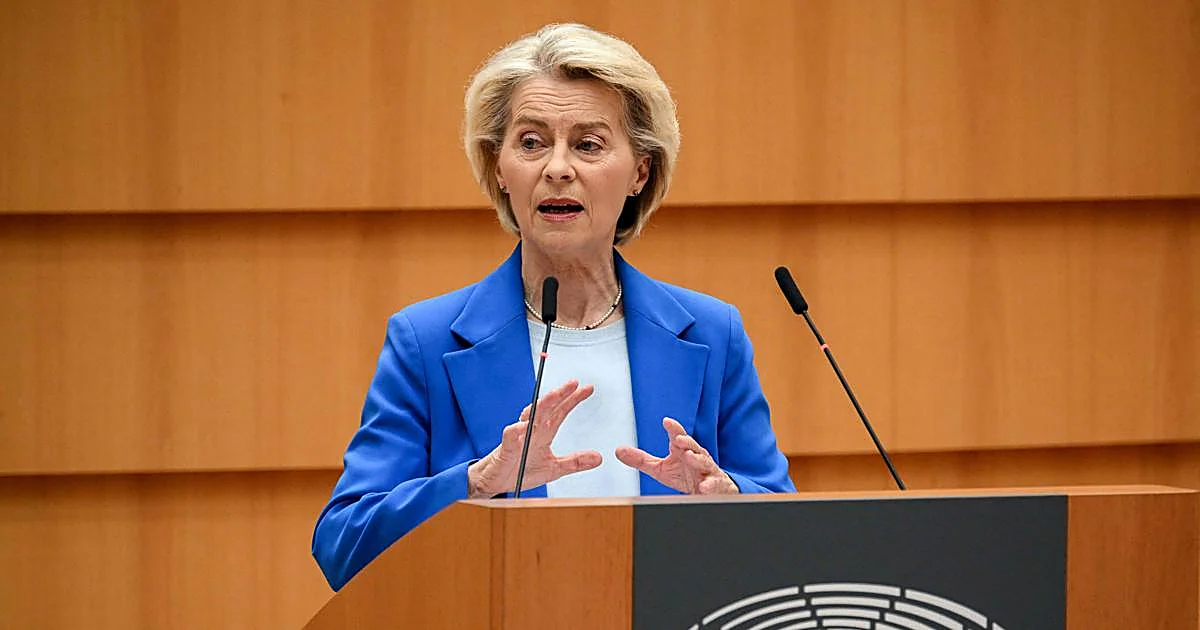
Europe is discovering that delaying the cost of war does not delay its consequences.
Brussels, November 2025.
The European Union is racing to find a financial mechanism capable of sustaining Ukraine at a moment when political divisions, legal constraints and geopolitical fatigue are converging. Ursula von der Leyen, still one of the most influential figures shaping the bloc’s strategic posture, has presented a set of alternative options designed to unlock support for Kyiv after the proposed reparations loan linked to frozen Russian assets stalled. Her initiative underscores the urgency felt across Europe as Ukraine’s reconstruction needs grow and the political consensus behind the original plan weakens.
Sources close to the talks confirm that the most viable alternative under consideration involves issuing a European level loan backed by future revenue generated from the immobilized Russian sovereign assets held across the Union. These assets produce significant annual yields, yet their full confiscation remains legally impossible without triggering challenges under international property norms. The suggested model therefore seeks to avoid direct seizure while still converting asset income into financial leverage for Ukraine’s immediate requirements.
Institutions that monitor the economic landscape of post invasion Ukraine, including leading financial observers in North America, warn that delays in external financing threaten to deepen the country’s fiscal collapse. Intelligence assessments circulating in European policy circles indicate that infrastructure deterioration is proceeding faster than previously estimated, while social services face structural failure without sustained international support. Analysts at major European think tanks argue that if Europe does not deliver a stable funding mechanism soon, Ukraine’s long term defensive capacity and internal cohesion could erode at a pace that will be difficult to reverse.
The debate is also reshaping intra European dynamics. Member states in Central and Eastern Europe push for full confiscation of Russian assets, arguing that Moscow’s invasion represents a fundamental breach of international peace that justifies exceptional legal measures. Western European states, however, insist that crossing that threshold would undermine the credibility of the legal order the Union relies upon to regulate global investment flows. The tension highlights a broader challenge for Europe as it balances punitive intent with geopolitical prudence.
International organizations concerned with global economic stability have weighed in as well. Specialists linked to the International Monetary Fund point out that unpredictable funding structures could slow Ukraine’s reconstruction for years, especially as inflationary pressures and energy volatility compound the country’s vulnerabilities. Meanwhile, security analysts at the North Atlantic Treaty Organization warn that inadequate reconstruction financing increases the risk of prolonged instability in Europe’s eastern flank, a region already exposed to hybrid threats that blur conventional boundaries between warfare, cyber operations and political subversion.
In Asia, policymakers in Tokyo and Seoul interpret Europe’s hesitation as another indicator of the growing fragmentation in Western strategic alignment. Their researchers note that the credibility of democratic coalitions depends heavily on consistency in long term commitments. For nations that rely on Western resolve as a counterweight to regional adversaries, the struggle to finalize a coherent financing mechanism for Ukraine signals a deeper uncertainty about the durability of transatlantic unity.
Washington, for its part, follows the negotiations closely. Senior American advisers acknowledge that domestic political shifts in the United States limit the predictability of its own long term financing for Kyiv. Consequently, the pressure on Brussels to deliver a stable solution has increased. While the United States remains deeply involved in security assistance, officials recognize that European economic support is indispensable for Ukraine’s recovery and for sustaining morale in a conflict that has entered a prolonged and attritional phase.
Against this landscape, von der Leyen’s new proposal functions both as a financial tool and a political message. It signals that Europe is not abandoning Ukraine, even if the method of support must adapt to legal and political constraints. Yet it also exposes the complex machinery behind European decision making, where unanimity is often elusive and where every step carries geopolitical implications far beyond the continent.
The coming weeks will determine whether the Union can craft a mechanism that satisfies legal requirements, reassures markets, maintains internal cohesion and delivers timely assistance to Kyiv. What remains clear is that time is no longer an abstract variable. Each delay tightens the geopolitical cost, and each hesitation reinforces the perception that Europe’s strategic will is being tested not only on the battlefield but within its own institutions.
Phoenix24: resistance is built through clarity.
Phoenix24: la resistencia se construye con claridad.