

 Phoenix 24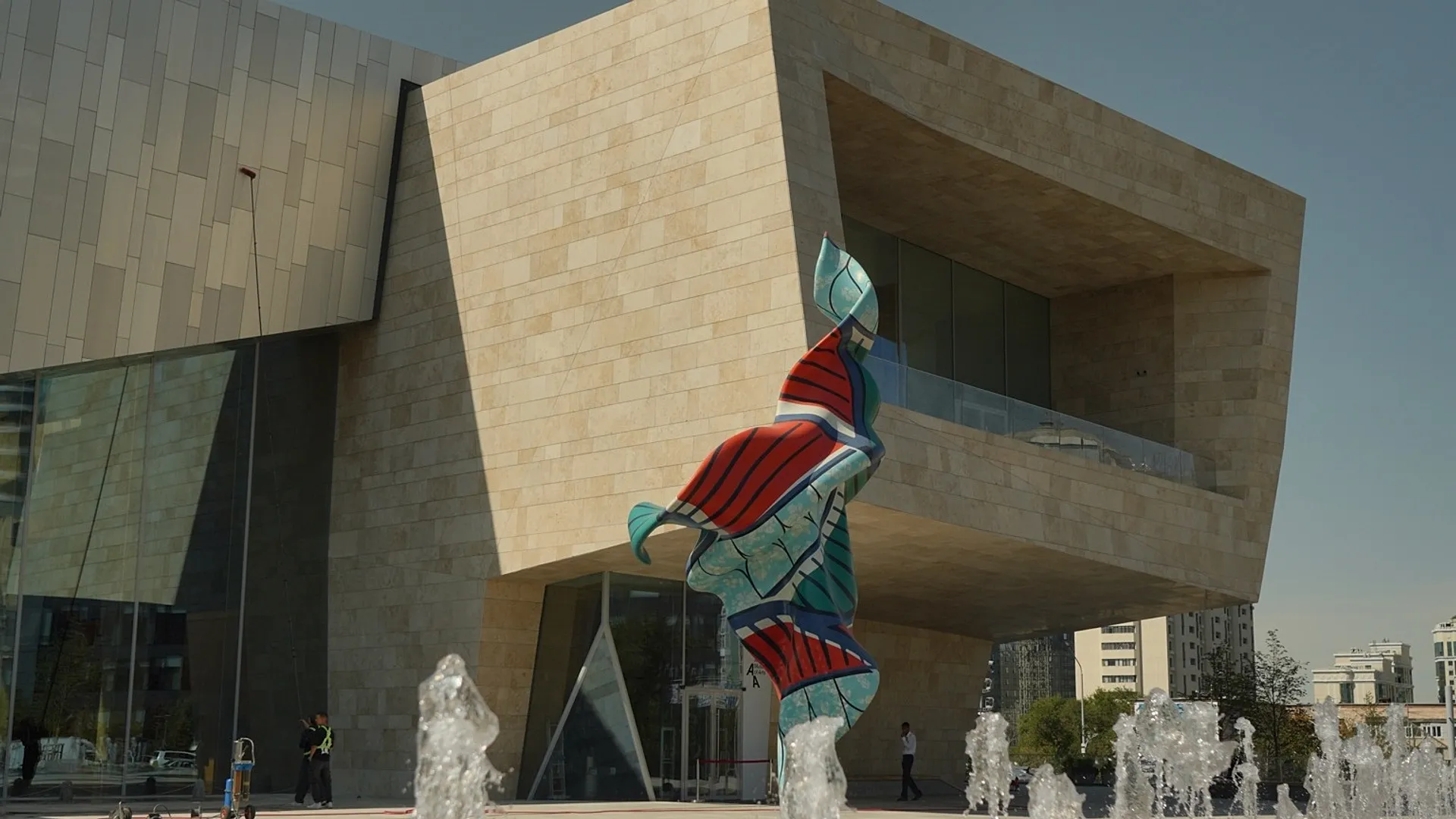
A city once defined by its horizons now builds one of its own.
Almaty, October 2025.
In the shadow of the Tian Shan mountains, Kazakhstan has opened a new architectural and cultural landmark: the Almaty Museum of Art. More than a building, it is a declaration—a signal that Central Asia is ready to tell its own story on the global stage. The museum’s design, its collection, and even its geography embody the country’s attempt to balance modern ambition with ancient memory.
The museum rises at the crossroads of nature and urban geometry. Designed by the British architecture firm Chapman Taylor, the 9,000-square-meter complex fuses limestone and brushed aluminum in two intersecting wings that seem to mirror the dialogue between tradition and transformation. The limestone surfaces anchor the structure to Kazakhstan’s rugged terrain; the metallic forms catch the light of a city that refuses to stand still. At dusk, when the mountain air cools and the façade glows in shifting hues, the building seems less like an object and more like an event—a space that breathes with the rhythm of Almaty itself.
Inside, the museum extends that dialogue between opposites. A central atrium known as “Art Street” cuts through the structure like a river of light, connecting galleries, restoration studios, and education spaces. The curators chose to open with two exhibitions that define its philosophy: a retrospective by Kazakh multimedia artist Almagul Menlibayeva and a collective show titled Guests, exploring migration, hospitality, and the politics of belonging across Central Asia. The themes are not accidental; they articulate a regional identity that has too often been narrated from elsewhere.
For founder and collector Nurlan Smagulov, the museum represents a personal and national milestone. Over the past three decades, he has assembled more than 700 works of modern and contemporary art, many of them by artists from Kazakhstan and neighboring republics. His vision is to situate local creativity within a global conversation rather than a cultural margin. In an interview during the opening, Smagulov described the project as “a gift to the city and a question to the world: what happens when a region long observed begins to observe itself?”
Architects in Berlin and Paris have compared the museum’s design to a geological formation more than a traditional institution. Critics note how its terraces and courtyards erase the barrier between museum and city. Students can sit on its steps sketching the skyline; families stroll through its open plazas without buying a ticket. The integration of public space was deliberate—an antidote to the elitism that often isolates museums from their own communities.
Economically, the project represents an investment of nearly one hundred million dollars between construction, infrastructure, and acquisitions. Yet the government’s role has been primarily supportive rather than directive. Kazakhstan’s Ministry of Culture framed the museum as an “ecosystem for creative industries” and a magnet for cultural tourism, particularly as Almaty positions itself as a hub for art fairs and design conferences in the region.
Reaction across Central Asia has been enthusiastic but also introspective. In Tashkent and Bishkek, local newspapers described the opening as a “gentle provocation,” urging other capitals to reimagine their cultural presence. The New York-based Asia Society praised the initiative as “one of the most significant private cultural undertakings outside the Western hemisphere in recent years.” Still, curators from Prague to Seoul have pointed out that sustainability—both financial and artistic—will determine whether the museum becomes a living institution or a frozen monument.
Beyond the statistics and the symbolism, the experience of walking through the building tells its own story. From the polished stone of its floors to the panoramic glass that frames the mountains, the museum seems to meditate on the act of looking. Each space is designed to shift perspective: a corridor narrows before opening suddenly into a vast gallery, a stairway descends only to curve upward again, as if mimicking the unpredictability of creativity itself. Visitors emerge with the sense that the architecture is not containing the art but conversing with it.
As night falls over Almaty, the museum glows like a lantern in the valley—part fortress, part promise. In a country often associated with its mineral wealth, it offers a different kind of resource: imagination. Whether it becomes a regional catalyst or a solitary masterpiece will depend not on its walls, but on the voices they manage to hold.
Phoenix24: beyond the news, the pattern. / Phoenix24: más allá de la noticia, el patrón.