

 Mario López Ayala, PhD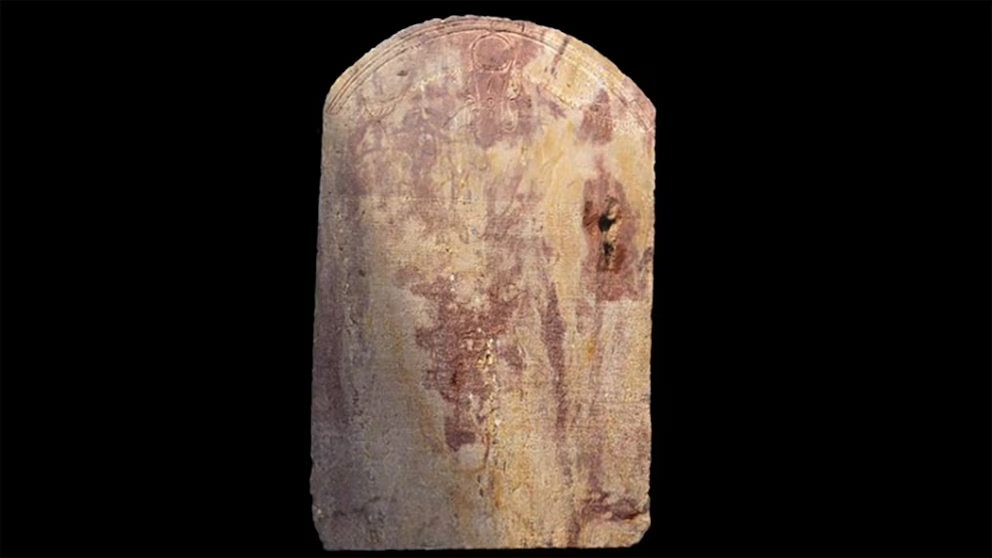
Archaeologists uncover a rare inscription that could reshape our understanding of the Ptolemaic era and the evolution of written language.
Alexandria, October 2025
Egyptian archaeologists have announced the discovery of a carved stone inscription that scholars are calling one of the most significant finds since the Rosetta Stone itself. Unearthed during a joint Egyptian-European excavation near the ancient city of Canopus in the Nile Delta, the artifact is a fragment of the Decree of Canopus, a Ptolemaic-era text dating back to the third century BCE. Experts believe that the new discovery will offer unprecedented insights into the political, religious, and linguistic landscape of ancient Egypt during a period of profound transformation.
The Rosetta Stone, discovered in 1799, became famous for its trilingual inscription, which allowed scholars to decode Egyptian hieroglyphs after centuries of mystery. The newly unearthed fragment, though lesser known, is considered equally important by many specialists because it contains complementary information about the socio-political context of the same era. The text commemorates decrees issued under Ptolemy III Euergetes, a Greek ruler of Egypt whose reign marked a period of remarkable cultural synthesis and imperial ambition.
Preliminary analysis suggests that the fragment includes several sections not present in previously known versions of the decree. These sections appear to elaborate on religious reforms and civic policies introduced by the Ptolemaic administration, including the reorganization of temple hierarchies, the codification of ritual practices, and the expansion of royal patronage to Egyptian priesthoods. Scholars believe this new material could shed light on how Hellenistic rulers sought to legitimize their authority by intertwining Greek governance with Egyptian religious traditions.
Linguists are particularly excited by the inscription’s potential to refine our understanding of the evolution of written language in the Mediterranean world. Like the Rosetta Stone, the newly discovered fragment contains text in hieroglyphic, demotic, and ancient Greek scripts. The presence of parallel translations is crucial because it allows for a more nuanced comparison of vocabulary, syntax, and grammar across linguistic systems. This, in turn, can provide fresh insights into how political concepts, theological terms, and administrative titles were adapted between cultures.
Beyond its linguistic importance, the discovery also has historical significance. The reign of Ptolemy III was characterized by military expansion, scientific patronage, and extensive temple construction. He fostered closer ties between Greek settlers and native Egyptians, blending cultural practices and promoting the worship of both traditional deities and new syncretic forms. The decree celebrates these policies while emphasizing the divine legitimacy of the ruler’s actions. By embedding political authority in religious language, the text illustrates how power was negotiated and consolidated in a multicultural empire.
Archaeologists note that the site where the fragment was found may yield additional artifacts. Excavations have revealed the remains of a temple complex, administrative buildings, and a possible royal residence. Together, these findings suggest that Canopus was more than a provincial town. It was a hub of cultural exchange, bureaucratic governance, and religious innovation, playing a pivotal role in the machinery of the Ptolemaic state.
The discovery also speaks to the broader significance of the Nile Delta as an archaeological landscape. While many of Egypt’s most famous monuments are located in Upper Egypt, sites in the Delta often hold vital clues to understanding the daily operations of the state and its interactions with the Mediterranean world. These regions were home to bustling trade centers, mixed populations, and dynamic cultural interactions, all of which shaped the development of Egypt’s Hellenistic society.
Scholars from several leading institutions, including the University of Oxford and the Bibliotheca Alexandrina, are now collaborating on a comprehensive study of the inscription. Using advanced imaging techniques, they hope to reconstruct damaged portions of the text and analyze the chemical composition of the stone to determine its origin. The research may also help identify whether this fragment was part of a larger monument or one of several copies distributed across the Ptolemaic realm.
The find has already sparked excitement in academic circles and beyond. Historians see it as an opportunity to revisit long-standing assumptions about the relationship between Greek and Egyptian elites during the Hellenistic period. Epigraphers anticipate that the inscription will help refine translations of other contemporary texts. And for the public, the discovery serves as a reminder that Egypt’s sands still conceal treasures capable of transforming our understanding of the ancient world.
In the broader context of world history, the new fragment underscores the enduring importance of cultural translation. Just as the Rosetta Stone unlocked a lost language, this inscription may illuminate how two powerful civilizations communicated, negotiated, and coexisted. It is a testament to the dynamism of the ancient Mediterranean and a reminder that even after centuries of study, Egypt continues to rewrite its own story.
Information that anticipates futures. / Información que anticipa futuros.