

 Phoenix 24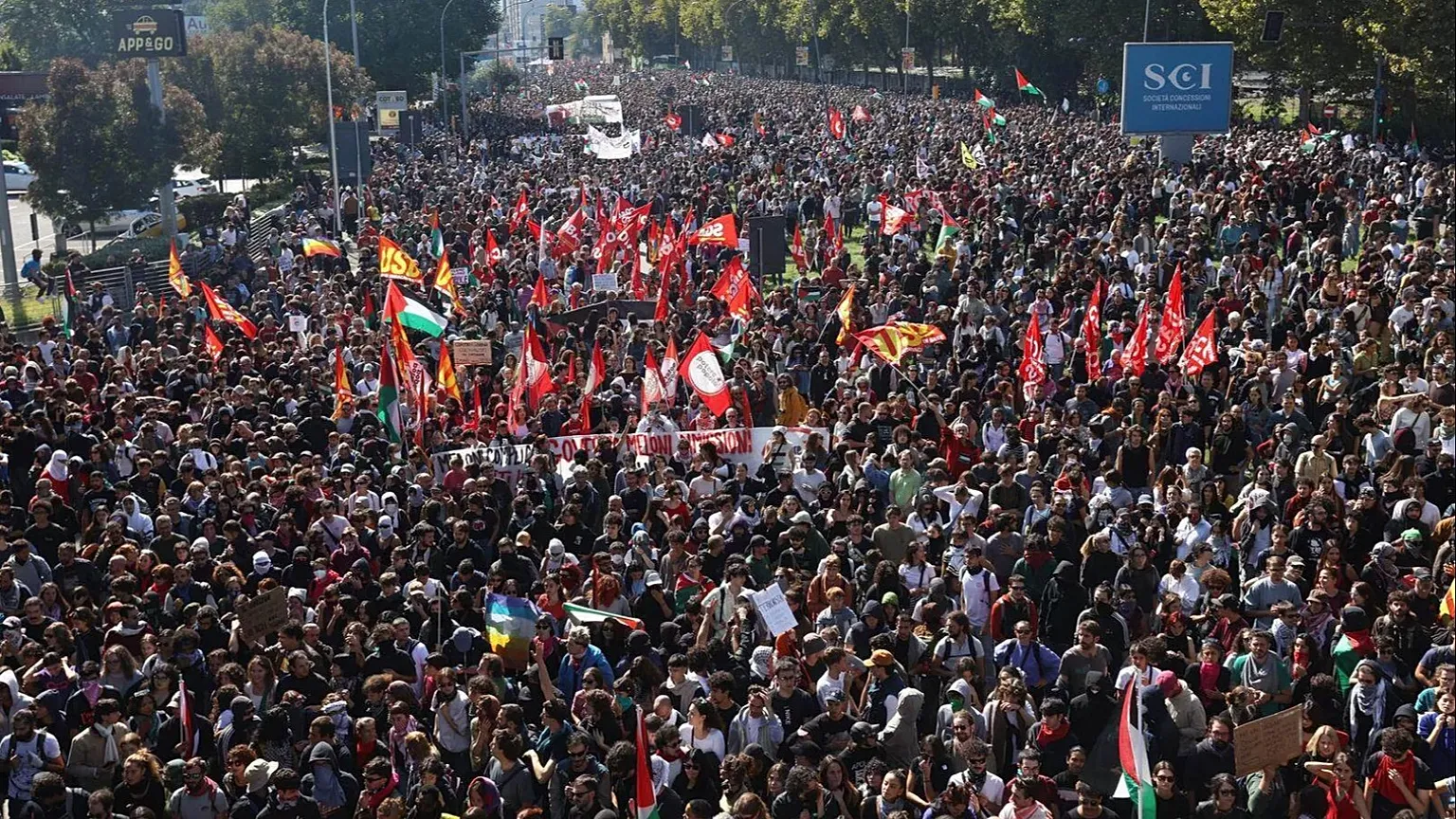
Sometimes, a country’s silence speaks louder than any rally, and Italy’s paralysis is now a message to the world.
Rome, October 2025
Italy awoke to a standstill as tens of thousands of workers, students, and activists filled the streets across the country in a massive national strike, an unprecedented show of solidarity with the international flotilla headed toward Gaza. Organized by major trade unions, civil society networks, and pro-Palestinian coalitions, the mobilization disrupted transportation, education, and public services nationwide, revealing the depth of public anger over what many Italians see as their government’s complicity in a humanitarian disaster.
From Milan to Naples, airports reported cancellations and delays, trains stopped operating, and classrooms remained empty as educators joined the protest. In Rome, a sea of demonstrators filled Piazza San Giovanni waving Palestinian flags, calling for an end to Israel’s blockade, and demanding that Italy withdraw support for policies perceived as enabling the ongoing war. Leaders of the CGIL and USB unions described the strike as both an act of solidarity and a form of political pressure, a direct demand for Prime Minister Giorgia Meloni’s government to adopt a more active stance in favor of a ceasefire and humanitarian access.
The protests were triggered by the imminent arrival of the “Sumud Flotilla,” a civilian convoy of ships carrying medical supplies, food, and water to Gaza, where millions remain under siege. Organizers of the flotilla, which includes vessels from Spain, Turkey, and Norway, argue that the mission is a legitimate humanitarian effort protected by international law. Israeli officials, however, have stated they will intercept the ships before they reach the enclave, citing security concerns and accusing the initiative of assisting Hamas. This looming confrontation has intensified tensions across Europe, where public opinion has increasingly shifted against the continuation of the conflict.
In Italy, the scale of the strike surprised many observers. The country has seen large pro-Palestinian demonstrations before, but rarely on a scale capable of paralyzing essential services. Transportation unions suspended metro, bus, and ferry services in major cities, while public sector employees staged coordinated walkouts. Even private sector workers in logistics and manufacturing joined the movement, forcing several companies to halt production. According to the Interior Ministry, more than 300,000 people participated nationwide, a figure not seen since the anti-austerity protests of the early 2010s.
Political reactions were immediate and deeply divided. Government officials condemned the strike as irresponsible and politically motivated, accusing organizers of exploiting a foreign conflict to destabilize the country. Opposition parties, by contrast, praised the mobilization as a necessary wake-up call to a government they accuse of aligning too closely with Israeli and U.S. policies. Former Prime Minister Giuseppe Conte, now a prominent opposition figure, stated that Italy must choose whether it stands with international law and humanitarian principles or with those who perpetuate collective punishment.
The demonstrations resonated far beyond Italy’s borders. In Paris, Berlin, and Brussels, activists announced plans for parallel actions, while several European trade unions signaled their intention to organize solidarity strikes in the coming days. Human rights organizations such as Amnesty International and Human Rights Watch reiterated calls for the European Union to demand an immediate end to the blockade and to support independent humanitarian initiatives like the flotilla. From Ankara, Turkish officials warned that any Israeli attempt to stop the convoy would constitute a serious violation of maritime law and would further isolate Tel Aviv on the global stage.
The political implications of Italy’s upheaval extend far beyond its national context. Analysts at the European Council on Foreign Relations note that the scope and intensity of the strike reflect a widening gap between European public opinion and government policy on Gaza. While most EU member states continue to voice rhetorical support for a two-state solution, their reluctance to impose sanctions or suspend arms exports has fueled accusations of hypocrisy. The Italian strike, they argue, may signal the beginning of a broader continental shift in which domestic pressure forces governments to recalibrate their approach to the conflict.
As the flotilla sails closer to the blockade zone and Israeli naval forces prepare for a potential interception, the next 72 hours could prove decisive. If the convoy is stopped by force, analysts warn that protests could escalate into sustained civil disobedience campaigns across Europe. If, on the other hand, the ships succeed in delivering their cargo, it could strengthen grassroots diplomacy as a counterweight to traditional statecraft. Either way, Italy’s paralyzed streets have already sent a powerful message: in a war where silence enables suffering, refusal to participate becomes its own form of resistance.
Against propaganda, memory. / Contra la propaganda, memoria.