

 Phoenix 24

Security fears deepen a painful division across Europe.
Narva, Estonia
Estonia is preparing to close all five road border crossings with Russia on December 1, prompting residents and travelers to rush across the frontier before restrictions take effect. The decision, approved by the Estonian government on November 20, follows allegations that Russian military intelligence organized an attempted sabotage operation against a domestic defense manufacturer. While Tallinn presents the measure as necessary to protect national security, families living on both sides of the border face the prospect of prolonged separation, more expensive journeys and growing uncertainty about their ability to maintain personal connections.
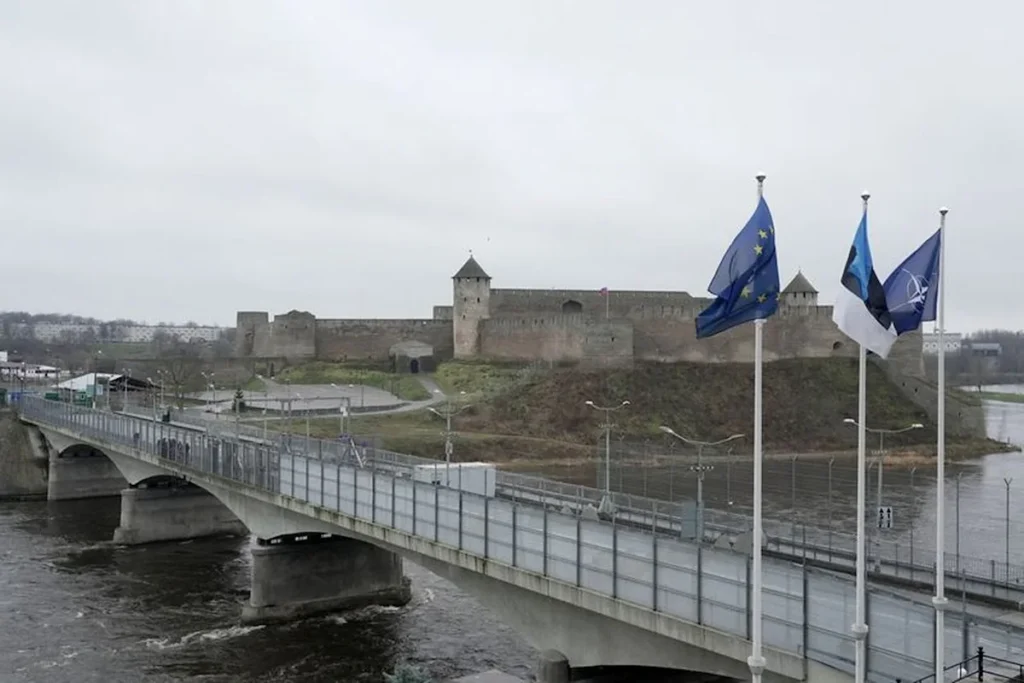
In the Russian border town of Ivangorod, travelers carrying suitcases, backpacks and personal belongings have gathered near the crossing into Estonia. Many are attempting to complete urgent family visits or return to their countries of residence before the deadline. Their situation illustrates the immediate consequences of a security decision affecting communities whose relationships developed long before the current confrontation between Russia and Western governments.
The restrictions will apply to Narva-1, Narva-2, Koidula, Luhamaa and Saatse, covering all five designated road border checkpoints between the two countries. The suspension will initially remain in force for six months, after which Estonian authorities will assess whether security conditions justify extending or modifying the measure. Rail freight operations will continue under existing restrictions and customs controls, meaning the decision does not constitute a complete suspension of every form of cross-border transportation.
The immediate trigger was an attempted arson attack on November 14 against Threod Systems, an Estonian company developing drone technologies, at its premises in Viimsi near Tallinn. Estonia’s Internal Security Service attributed the operation to Russia’s GRU military intelligence agency, reporting that eight Latvian citizens suspected of participating had been detained. Security personnel intervened before the attack caused significant damage, according to the Estonian authorities.
Moscow has rejected the allegations. Kremlin spokesperson Dmitry Peskov dismissed the accusations as unfounded, while Russian Foreign Ministry spokesperson Maria Zakharova criticized the border restrictions and warned of possible diplomatic countermeasures. Her comparison of the decision to the construction of a new Iron Curtain reflects the increasingly confrontational language surrounding security arrangements along Europe’s eastern frontier.
Estonian Prime Minister Kristen Michal has defended the closure as a deliberate response to continuing hostile activities attributed to Russia. Foreign Minister Margus Tsahkna emphasized that the measure extends beyond a single incident, arguing that border movements can be exploited for intelligence recruitment, influence operations, sanctions evasion and other activities threatening European security. Tallinn considers the decision part of its responsibility to protect both Estonia and the wider Schengen area.
The consequences are especially significant in Narva, a predominantly Russian-speaking Estonian city located directly across the river from Ivangorod. Families, businesses and communities have maintained longstanding relationships across this frontier, even as travel restrictions have progressively intensified since Russia’s full-scale invasion of Ukraine in February 2022. The border has remained an important route for people traveling between European countries and Saint Petersburg.
Narva Mayor Jaan Toots has urged the government to consider humanitarian exceptions for residents caring for elderly relatives, attending funerals or confronting urgent family circumstances. The official government guidance, however, requires travelers to use alternative routes after the closure, regardless of citizenship or personal reasons for crossing. Those arrangements could create particularly difficult circumstances for older adults, people with disabilities and households with limited financial resources.
The restrictions also reveal how sharply cross-border mobility has already declined. According to figures cited by Estonian public broadcaster ERR, annual crossings have fallen from more than four million before 2022 to approximately 760,000 in 2026. Roughly 447,000 crossings were recorded at Narva-Ivangorod, underscoring the continuing importance of the route despite years of political tension and increasingly restrictive travel policies.
Alternative journeys through Latvia or other countries with functioning border checkpoints are expected to require additional time and expense. Some travelers may have to rely on air connections involving third countries, creating practical obstacles for people who previously crossed the border on foot. Local businesses, including hotels, restaurants and transportation providers, could also experience reduced activity as visitor movements decline.
The economic effects may extend into regional logistics. Although trade between Estonia and Russia has contracted substantially since the invasion of Ukraine, some transportation companies continue operating routes involving Russia and countries farther east. The government acknowledges that the restrictions could affect freight operations and regional employment, even while estimating that the overall effect on Estonia’s national economy will remain limited.
Estonia’s decision follows a broader European pattern. Finland closed its land border with Russia in December 2023, while Latvia, Lithuania and Poland have implemented increasingly restrictive controls along their eastern borders. These measures reflect security concerns intensified by the war in Ukraine and allegations of hybrid operations targeting European institutions and infrastructure.
For Tallinn, limiting cross-border movement is intended to reduce vulnerabilities associated with an increasingly adversarial relationship. For affected residents, however, the consequences are immediate and personal. A journey that once involved crossing a bridge between neighboring towns may soon require traveling through several countries, placing considerable distance between relatives who live only a short geographical distance apart.
The closure demonstrates how national security decisions can transform established patterns of daily life. Its effectiveness in limiting hostile activities will require assessment over time, while its humanitarian and economic consequences are already becoming visible. As the December deadline approaches, the frontier between Estonia and Russia is becoming more than a geopolitical dividing line: it is increasingly determining whether families can continue meeting across it.
Beyond the Headlines, Accountability Matters.