

 Phoenix 24
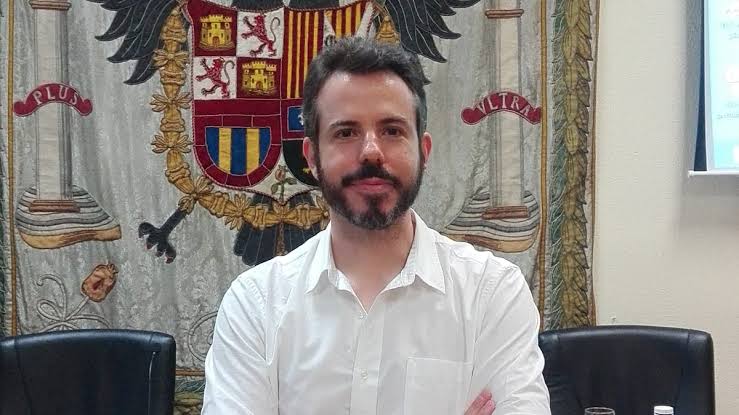
A Spanish novel earns recognition on America’s literary stage.
New York, United States
Spanish novelist Vicente Luis Mora has become the first Spanish author to win a US National Book Award, receiving the prestigious recognition for his novel Centroeuropa in the Translated Literature category. The award, announced during the 77th National Book Awards ceremony in New York on November 18, represents a landmark achievement for contemporary Spanish literature and underscores the growing international recognition of works originally written in Spanish.
The distinction also recognizes British translator Rahul Bery, whose English-language interpretation of the novel introduced Mora’s distinctive narrative to American readers. Published in the United States by Bellevue Literary Press, Centroeuropa was originally released in Spain by Galaxia Gutenberg in 2020. Its success demonstrates how literary translation can extend the international reach of works that initially emerge within national publishing markets.
Set in Prussia during the early nineteenth century, the novel follows Redo Hauptshammer, a widower seeking to rebuild his life after the death of his wife, Odra. Hoping to establish himself as a farmer, he acquires a small property where he intends to bury his wife’s remains and begin cultivating the land. However, his apparently straightforward plans take an unsettling turn when he discovers the frozen body of a soldier beneath the soil.
The discoveries gradually multiply, revealing remains associated with different periods of European conflict. What initially appears to be an isolated encounter with the past develops into an increasingly strange confrontation with history, memory and the persistence of violence. Mora transforms the protagonist’s struggle for an ordinary existence into a literary exploration of how historical events continue to influence individual lives long after their apparent conclusion.
The National Book Award judges praised the novel’s unconventional treatment of historical fiction, identifying literary affinities with Franz Kafka and Nikolai Gogol. Their assessment emphasized the combination of absurdity, emotional vulnerability and historical imagination that shapes the protagonist’s experience. Rather than presenting history as a distant sequence of events, the narrative portrays it as a presence that repeatedly intrudes upon the lives of those seeking to escape its consequences.
The recognition is especially significant because Centroeuropa is Mora’s first novel published in North America. Born in Córdoba in 1970, the Spanish author has developed a multidisciplinary literary career encompassing fiction, poetry, essays and criticism. He previously directed the Instituto Cervantes in Albuquerque, New Mexico, and currently teaches Spanish and Latin American literature at the University of Málaga.
His work has frequently explored the relationship between literary experimentation, contemporary culture and the changing forms of narrative expression. Centroeuropa exemplifies that intellectual approach, combining historical reconstruction with philosophical questions and imaginative storytelling. The novel had already received the Málaga Novel Prize before gaining recognition from the American literary establishment.
The Translated Literature category brought together works from different linguistic and cultural traditions. Mora and Bery prevailed over finalists including Norwegian author Karl Ove Knausgaard, Indonesian novelist Intan Paramaditha, Senegalese writer Mohamed Mbougar Sarr and Syrian author Samar Yazbek. Their selection followed a competitive process involving 159 books submitted by publishers for consideration.
The award recognizes both the original author and the translator, with its $10,000 monetary prize divided equally between them. This shared recognition reflects an important dimension of international publishing: the ability of a literary work to cross linguistic boundaries depends not only on the original writer’s creative achievement but also on the translator’s capacity to preserve its distinctive voice, meaning and artistic complexity.
Mora’s victory follows the success of Argentine writer Gabriela Cabezón Cámara, who received the same distinction in 2025 for the English translation of Las niñas del naranjel. The consecutive recognition of works originally published in Spanish highlights the international possibilities available to Hispanic literary traditions, although success in a major award does not automatically guarantee broader commercial distribution or sustained readership.
For Spanish publishers and literary institutions, the achievement may create opportunities to strengthen international translation programs, establish partnerships with foreign publishing houses and introduce a wider range of contemporary authors to English-speaking audiences. Such developments depend on sustained investment, editorial selection and cultural exchange rather than the prestige of a single award.
The broader significance extends beyond national recognition. Literary translation allows readers to encounter historical experiences, intellectual traditions and cultural perspectives that might otherwise remain inaccessible. In Centroeuropa, a narrative rooted in European history has reached an international audience through themes of grief, memory and the human consequences of conflict.
Mora’s achievement illustrates how literature can transcend geographical and linguistic boundaries without abandoning its cultural origins. His recognition in New York celebrates both the creative strength of Spanish-language writing and the essential contribution of translation to the circulation of ideas across societies.
Behind Every Fact, a Deeper Story.