

 Phoenix 24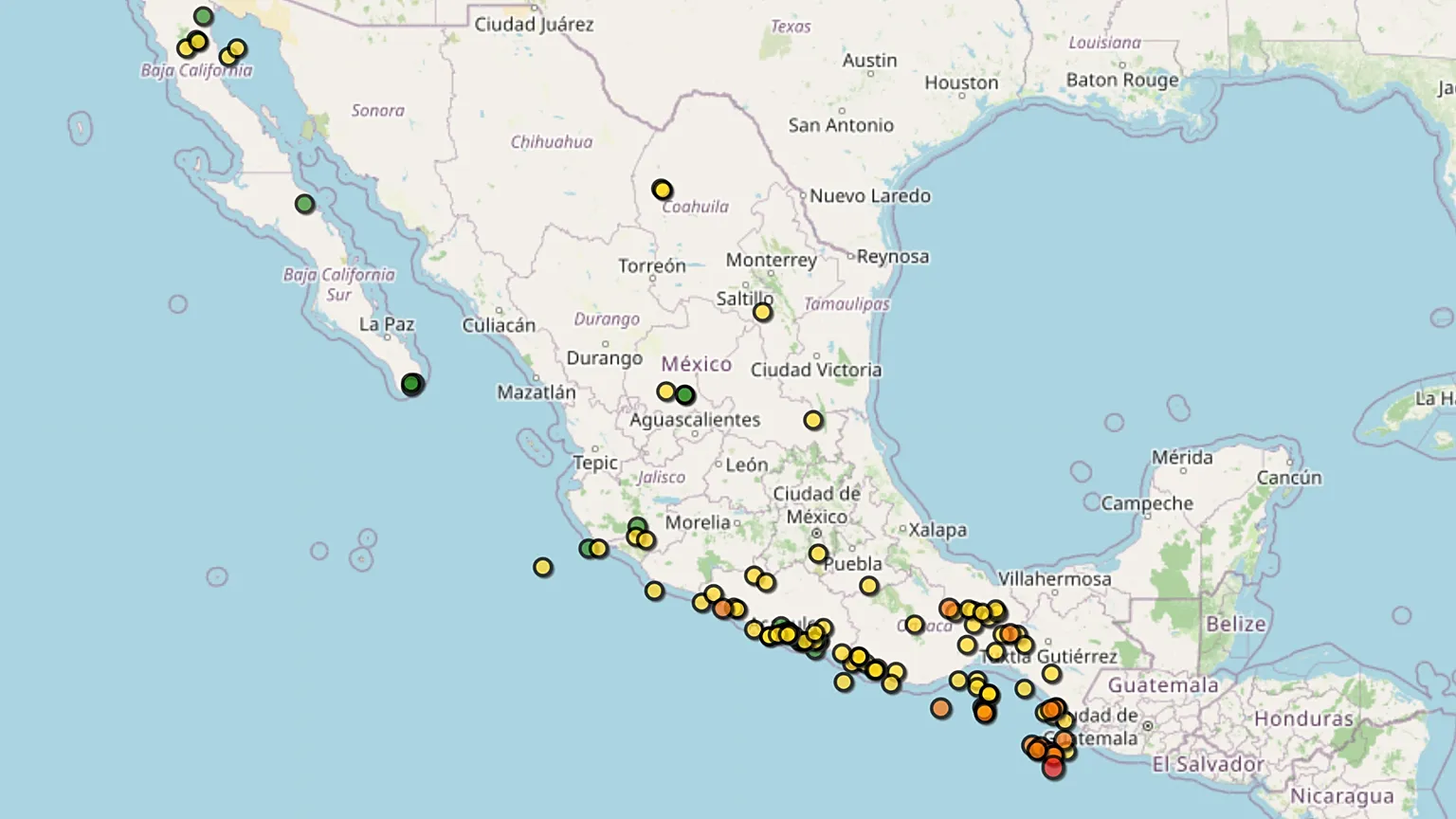
Persistent earthquakes highlight the complexity of seismic activity along Mexico’s Pacific coast.
MEXICO CITY
Mexico has recorded more than 3,000 aftershocks following a powerful magnitude 7.4 earthquake off its southern Pacific coast in July, illustrating how seismic activity can continue for months after a major geological event.
According to figures attributed to Mexico’s National Seismological Service (SSN), operated by the National Autonomous University of Mexico (UNAM), 3,010 aftershocks had been recorded by October 16. The sustained activity has renewed attention to the geological processes governing one of the country’s most earthquake-prone regions.
The original earthquake occurred near the Pacific coast of Chiapas, approximately 135 kilometers from Ciudad Hidalgo, at an estimated depth of 10 kilometers. The region lies along the boundary where the Cocos tectonic plate moves beneath the North American plate.
This geological process, known as subduction, generates significant stress within the Earth’s crust. When accumulated stress is released suddenly, earthquakes can occur, sometimes followed by extensive sequences of smaller seismic events.
Scientists describe an aftershock sequence as a series of earthquakes occurring near the rupture zone of a larger event while the surrounding geological structures adjust to changes in stress.
Although aftershocks generally decrease in frequency over time, they can continue for weeks, months or occasionally longer. Their persistence does not necessarily indicate that a larger earthquake is approaching.
The reported figures demonstrate the gradual evolution of Mexico’s current sequence. Authorities recorded approximately 2,803 aftershocks by October 2, increasing to 2,976 by October 14 and reaching 3,010 two days later.
Most aftershocks are smaller than the original earthquake, although some may be strong enough to be felt by nearby communities. Their potential consequences depend on magnitude, depth, proximity to populated areas and the condition of existing infrastructure.
Mexico’s location along the Pacific Ring of Fire makes seismic activity a persistent national concern. The interaction of several tectonic plates contributes to earthquakes affecting states including Chiapas, Oaxaca, Guerrero and Michoacan.
The consequences extend beyond immediate structural damage. Repeated seismic activity can create uncertainty for residents, particularly in communities where buildings, public infrastructure and emergency services remain vulnerable.
Continuous monitoring allows scientists to document seismic patterns, evaluate the distribution of aftershocks and provide updated information to civil protection authorities.
However, modern seismology cannot reliably predict the exact date, location or magnitude of future earthquakes. A large number of recorded aftershocks should therefore not be interpreted as evidence of an imminent catastrophic event.
For residents, preparedness remains more useful than speculation. Authorities recommend identifying safe areas, reviewing evacuation procedures and following information released through official monitoring and civil protection channels.
The prolonged seismic sequence illustrates an essential distinction between understanding geological hazards and predicting individual events. Scientific observation can improve risk management even when the timing of future earthquakes remains uncertain.
Mexico’s experience reinforces the importance of resilient construction, public education and sustained investment in seismic research across vulnerable regions.
Beyond the Numbers, the Consequences.