

 Phoenix 24
AI is moving from predicting language to predicting biology.
San Francisco, United States
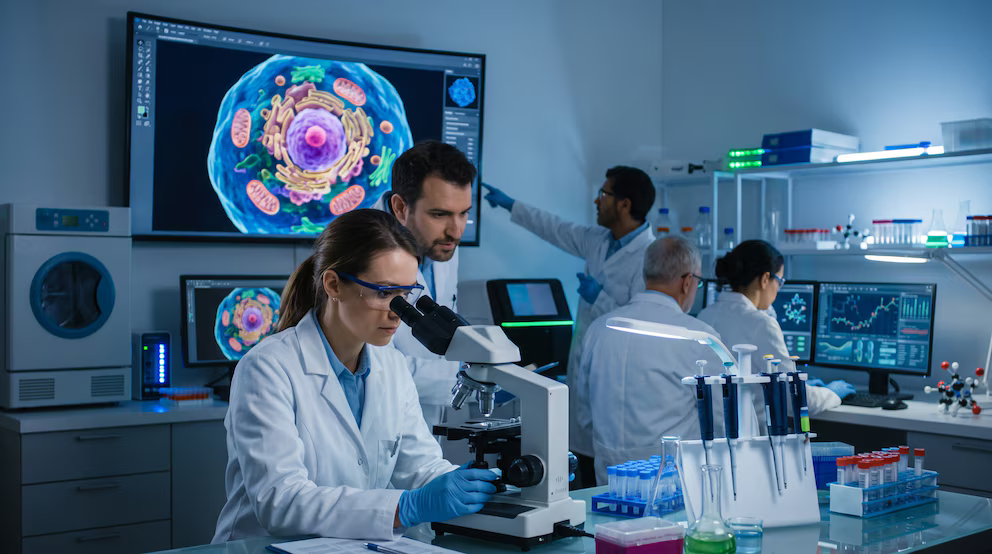
Google DeepMind, Meta and Isomorphic Labs are jointly investing $300 million in Biohub’s effort to create a virtual cell, a digital model capable of predicting how biological cells behave under different conditions. The investment forms part of a broader $1.8 billion Virtual Biology Initiative designed to generate the massive datasets needed to train AI systems for biological research. The ultimate goal is not to replace laboratories overnight, but to allow scientists to test hypotheses digitally before moving the most promising ones into physical experiments. If successful, the project could compress years of biomedical research into much shorter development cycles.
The scientific challenge is enormous because biology does not yet have the equivalent of the vast text datasets that powered large language models. Cells respond to genes, proteins, drugs, environmental conditions and countless molecular interactions that are difficult to capture systematically. Biohub plans to generate large-scale biological measurements and standardize them so AI systems can learn how cellular systems react. The first major datasets are expected within about a year, while more functional predictive models could emerge over the next five years.
The project is backed by an unusually broad coalition. Mark Zuckerberg and Priscilla Chan’s Biohub provided the initial foundation, while the U.S. Department of Energy is contributing more than $500 million over five years for measurement, computing and modeling. Federal biomedical institutions will also contribute data and research infrastructure built through previous public investment. The result is a hybrid model in which government, philanthropy and competing technology companies are financing the same scientific platform.
The pharmaceutical implications are especially significant. A reliable virtual cell could help researchers predict how cells respond to candidate drugs before expensive laboratory and clinical work begins. That could reduce the number of failed experiments, prioritize more promising compounds and potentially accelerate early-stage drug discovery. Isomorphic Labs, already focused on AI-driven drug design, has an obvious strategic interest in that capability.
There is also a competitive dimension. The companies funding the initiative are rivals in artificial intelligence, yet they are cooperating because the biological data required is too expensive and complex for any single organization to generate efficiently. Investors will initially receive privileged access before the datasets are released more broadly, creating an early advantage while preserving the project’s longer-term open-science ambition.
The deeper shift is conceptual. Artificial intelligence is beginning to move beyond describing the world toward simulating living systems themselves. If virtual cells become sufficiently accurate, biology could enter an era in which experiments increasingly begin inside models before they reach the laboratory.
The next great AI frontier may be alive before it is physical.