

 Elise Moreau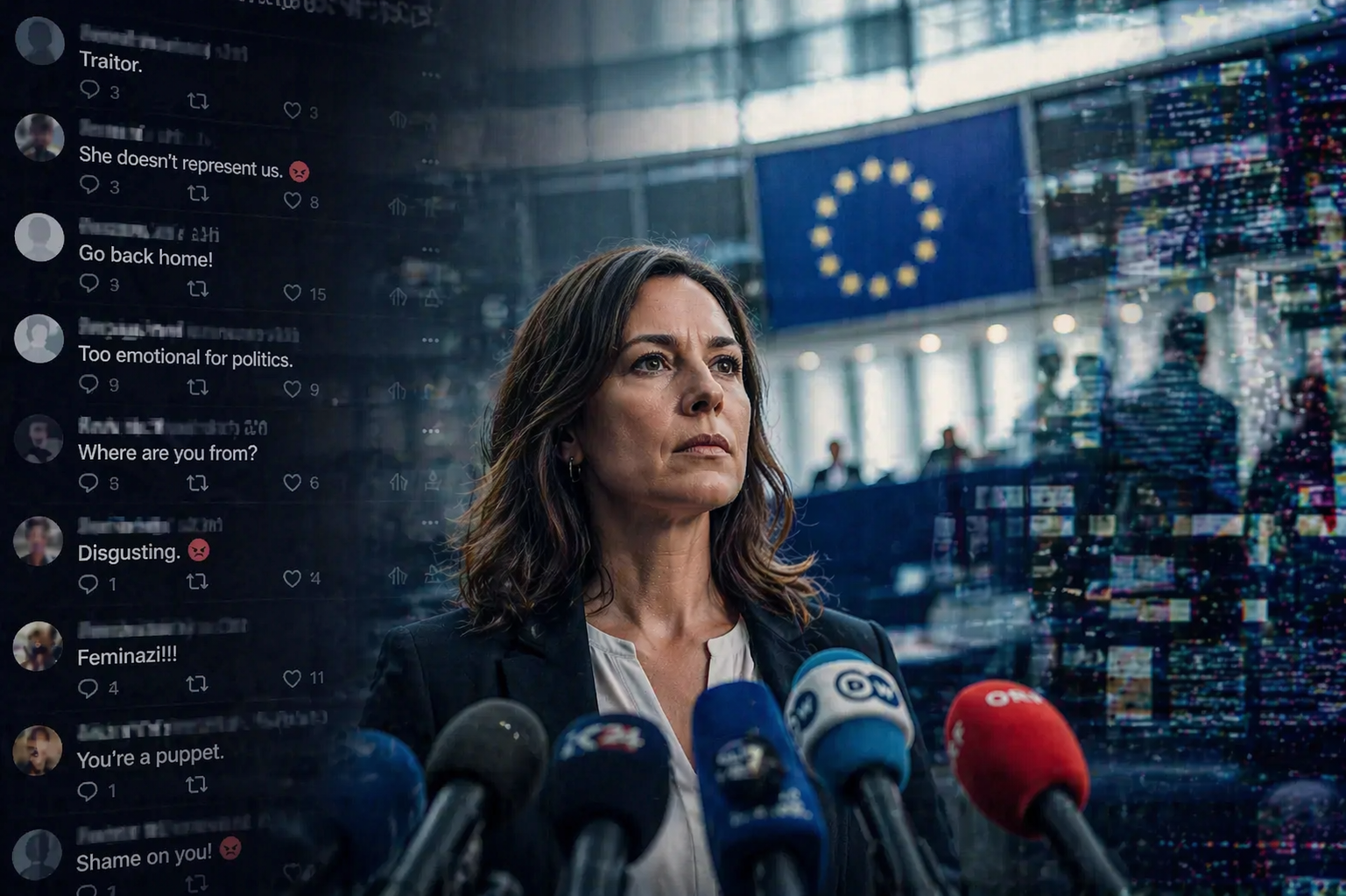
Europe’s democratic fracture now has a gendered pulse.
Brussels, April 2026
Europe keeps describing its democratic crisis in institutional language, as if the problem were still mainly procedural. Electoral resilience. Platform accountability. Rule-of-law pressure. Strategic autonomy. All of that matters, of course, but it also conceals something more intimate and more difficult to quantify. The erosion is no longer happening only at the level of systems. It is happening at the level of atmosphere, at the level of permission, at the level of who is slowly made to feel unbearable in public life.
Women have become central to that process, not incidentally but structurally. Not because they are new to political hostility, but because their visibility now sits at the intersection of several anxieties Europe has not resolved. Migration, digital manipulation, institutional distrust, cultural backlash, demographic insecurity. When these pressures accumulate, they do not distribute themselves evenly. They settle around certain bodies, certain voices, certain figures who come to represent a version of Europe that others increasingly treat as intolerable.
What is striking is how rarely this hostility presents itself honestly. It does not always arrive dressed as misogyny, and almost never announces itself as anti-democratic intent. More often it comes disguised as skepticism, fatigue, irony, or “common sense.” A woman in politics is too emotional until she is too cold. Too visible until she disappears. Too principled until she becomes inconvenient. The attack is often modular, almost administrative. The point is not always to destroy her publicly. Sometimes it is simply to raise the social cost of taking her seriously.
That is one reason disinformation has become so effective. It does not need to persuade everyone. It only needs to destabilize legitimacy at the margins until trust starts leaking from the edges. A manipulated clip, a suggestive half-truth, a repeated insinuation, a campaign of ridicule that travels faster than correction. None of this is new in a technological sense, but the emotional architecture feels different now. The lie no longer works because it is coherent. It works because it finds a public already exhausted enough to metabolize suspicion more easily than complexity.
In that environment, female leadership is treated in a revealingly distorted way. Europe celebrates it ceremonially and punishes it atmospherically. It places women on panels about democracy, rights, and resilience, then leaves them to absorb a volume of symbolic aggression that many institutions still refuse to name with precision. What appears, from a distance, as inclusion can become, at closer range, a much lonelier form of exposure. Representation is not the same thing as protection. In some cases, it is merely a brighter stage on which delegitimization can unfold.
Migration makes this even clearer. Few issues are more efficient in Europe today at converting economic unease into moral panic. The migrant is still one of the continent’s most useful political abstractions, an elastic figure into which governments, parties, and media ecosystems can pour fear, decline, insecurity, or fantasies of national dilution. Yet even here the gendered layer persists. Women who defend rights-based migration policy are framed as naïve, indulgent, detached from reality. Migrant women themselves are either infantilized into silence or instrumentalized as props in someone else’s argument about civilization. Very little of this is accidental. The politics of fear rarely moves without a choreography of selective visibility.
The digital sphere intensifies the pattern because it rewards compression, and compression is hostile to nuance. A human being becomes a symbol. A symbol becomes a target. A target becomes content. Then the cycle repeats until language itself begins to harden. Rights start sounding negotiable. Cruelty begins to sound practical. Empathy is recoded as weakness, and ambiguity as elite evasion. At some point the problem is no longer whether a specific falsehood can be corrected. The problem is that an entire emotional climate has started to favor dehumanization as a reasonable tone of governance.
This is where journalism still has work to do, and perhaps a more difficult kind of work than many newsrooms are prepared to admit. It is not enough to debunk isolated claims if the broader arrangement of contempt remains intact. Facts matter, but patterns matter too. So does cadence. So does framing. So does the refusal to let the language of democratic deterioration become antiseptic. Because once public violence is described too cleanly, it begins to resemble inevitability, and inevitability is one of the most seductive fictions in European politics.
I do not think the crisis is best understood as collapse. Collapse is too theatrical, too clear in its sequencing. What Europe is facing feels more granular than that. A thinning out. A narrowing. A set of repeated permissions through which exclusion becomes easier to articulate and harder to contest without being cast as hysterical, ideological, or unserious. Democracy is not disappearing all at once. It is being made less generous, less breathable, less able to hold contradiction without turning it into threat.
Women in public life are experiencing that narrowing early and intensely, which is why they often function as indicators before they are recognized as subjects. Their treatment reveals where a society is heading before its institutions fully admit it. If a woman cannot speak firmly about migration, rights, violence, or digital manipulation without being turned into an emotional irritant, then the issue is not only sexism, though sexism is certainly there. The issue is that democracy itself is becoming less compatible with voices that refuse its hardening.
Perhaps that is why the current moment feels so difficult to narrate cleanly. The formal structures remain. Elections are held. Rights are invoked. Statements are issued. Panels are convened. But underneath, another grammar is consolidating, one in which exhaustion substitutes for argument and suspicion becomes a mode of belonging. The republic survives on paper while something more fragile erodes in practice: the social willingness to hear another life as fully real.
And that, finally, may be the point that matters most. Behind the data, behind the content moderation debates, behind the migration numbers, behind the electoral maps, there are still voices being trained by the environment to doubt their own right to remain audible. Europe’s crisis is not only institutional. It is sensory, relational, and moral. It lives in tone before it hardens into law. It lives in repetition before it declares itself doctrine. By the time everyone agrees it is serious, much of the damage has already learned how to sound ordinary.
Élise Moreau, French investigative journalist and international correspondent at Phoenix24. Specialist in European affairs, gender equity & digital democracy.