

 Phoenix 24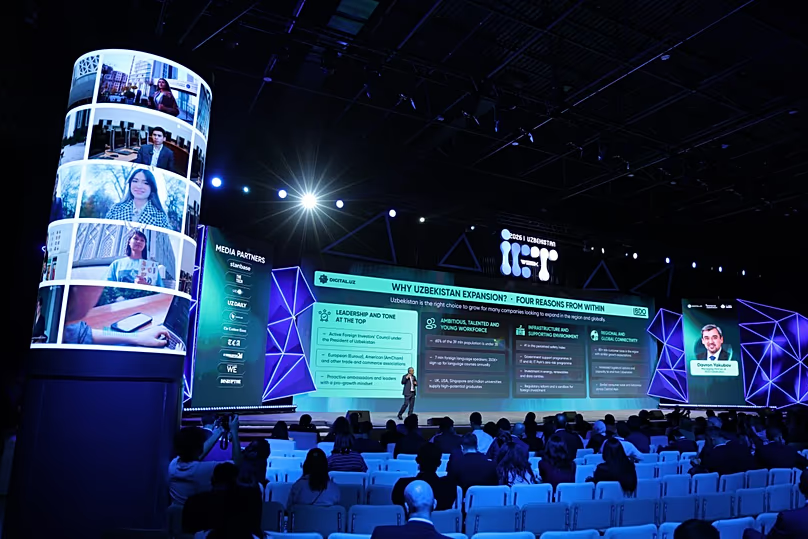
A regulatory experiment could reposition Tashkent on the global technology map.
Tashkent
Uzbekistan is preparing a special business regime designed to attract international technology companies, venture capital and highly skilled professionals as it seeks to transform Tashkent into a gateway for expansion across Central Asia. Enterprise Uzbekistan, created through legislation approved in August, is expected to begin operations in early 2027. The framework combines tax incentives, simplified regulation and international employment rules. Its ambition extends beyond attracting individual startups toward creating an ecosystem capable of competing with established technology hubs.
The fiscal incentives are substantial. Investors operating under the special regime will be exempt from taxes on qualifying dividends and investment income, while companies conducting priority activities will not pay corporate income tax on eligible profits. Sales within the center and exports by participating companies will benefit from a zero percent value added tax rate. Foreign specialists who meet highly qualified employee criteria may also receive exemptions on qualifying salaries and dividends.
Talent mobility forms another pillar of the strategy. Foreign employees of participating companies will be able to obtain visas lasting up to three years without requiring separate work permits. Uzbekistan already permits full foreign ownership, but Enterprise Uzbekistan aims to provide companies with investment instruments and employment standards more familiar to international investors. Reducing administrative friction could become particularly important for firms comparing Tashkent with competing jurisdictions.

The regime will also introduce a regulatory sandbox allowing companies to test technologies under temporarily adapted rules, generally for periods of up to 12 months. Simplified licensing and exemptions from selected requirements could give artificial intelligence developers, financial technology companies and other emerging businesses room to experiment before permanent regulation catches up with their products.
International investors are already paying attention. Venture capital firms have begun establishing operations in Uzbekistan, while authorities hope technology companies will eventually use the country not simply to enter its domestic market but as a base for expansion into neighboring Central Asian economies and the Middle East. The government is also inviting investors and technology companies to participate in shaping the remaining regulations before the launch.
The decisive issue will be credibility over time. Enterprise Uzbekistan is designed to remain in force until 2100, an unusually long horizon intended to reassure investors concerned about regulatory stability. Incentives may attract initial attention, but maintaining investment will depend on predictable rules, competitive infrastructure and the government’s willingness to adapt as technology evolves.
Uzbekistan is therefore competing on more than taxes. It is attempting to build an institutional architecture capable of turning geographic position into technological relevance.
Phoenix24: clarity in the grey zone.