

 Mario López Ayala, PhD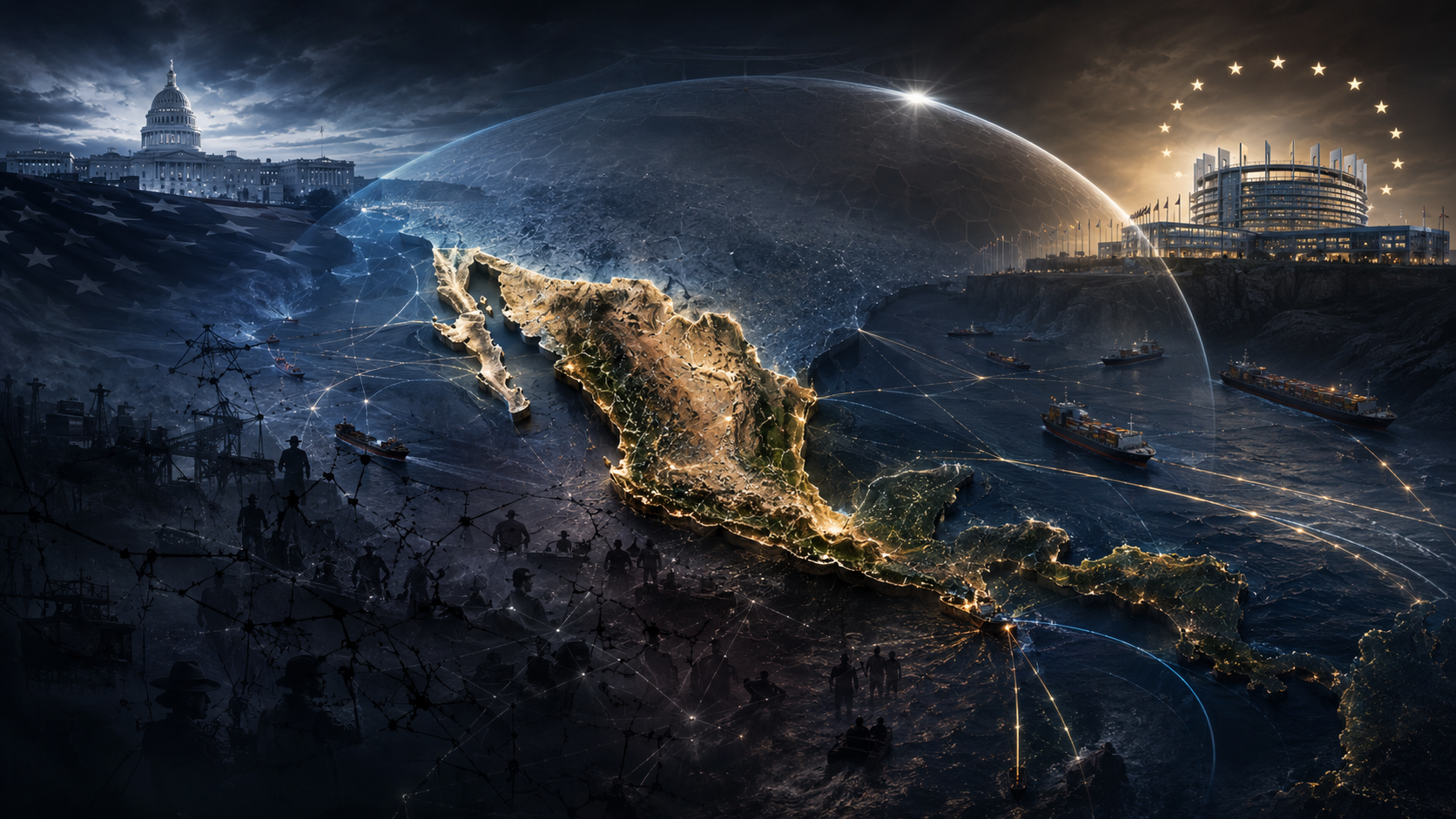
When trade stops travelling alone, sovereignty begins to be measured in security, territory and institutional character.
Mexico once again faces a question that appears commercial, but is not entirely so. The USMCA seems to belong to the language of treaties, rules of origin, dispute panels and review calendars. Yet beneath that technical grammar, something less visible is moving: the way the country manages its relationship with power.
This is not a new discomfort. For decades, Mexico has lived with a mixture of dependence, calculation and caution toward the United States. Proximity has been an advantage, a refuge, a pressure and a condition. Sometimes, all at once.
The problem is not trading with Washington. That would be too simple a reading. The problem begins when a nation organizes its mental horizon around a single exit door. When foreign trade also becomes an emotional structure, every gesture from the dominant partner produces institutional anxiety.
The USMCA is now entering a zone of fragility because certainty has ceased to be its main attribute. A treaty of this magnitude works when it offers a horizon, not only a market. If the legal framework becomes a mechanism of periodic pressure, investors do not read opportunity. They read volatility.
But this moment carries an additional element. Trade no longer travels alone. It travels with insecurity, organized crime, fentanyl, fuel theft, money laundering, vulnerable ports, customs offices under suspicion, illicit financing and allegations of political capture. The economic border has been contaminated by the criminal border.
That displacement changes the meaning of the conversation. The United States no longer views Mexican cartels only as criminal organizations, but as strategic threats. By placing them within the language of terrorism, Washington modifies the mental framework of the bilateral relationship. It is no longer speaking only of judicial cooperation; it is speaking of national security, financial traceability, supply chains and hemispheric vulnerability.
Here appears the Shield of the Americas. Not as a simple anti-drug policy. Nor as a mechanical repetition of the old Rio Treaty. Rather, as a hemispheric security architecture that seeks to organize the continent around cartels, transnational crime, migration, energy, China, borders and territorial control. Its strength is not only in its legal form; it lies in its capacity to impose language, priorities and alignments.
Mexico cannot read that movement as an external matter. Even if it is not fully seated at that table, it remains at the center of the diagnosis. Every signal from Washington regarding cartels, narco-politics, customs, ports, fentanyl or state governments turns Mexican security into a variable of continental negotiation. Under that reading, the USMCA stops being only a trade agreement and becomes part of a larger architecture of geopolitical pressure.
Mexican sovereignty therefore faces an uncomfortable paradox. It must defend itself against any interventionist temptation, but it must also prove that sovereignty exists in the territories where crime imposes rules, schedules, prices, silences and loyalties. Sovereignty is not defended only in press conferences. It is defended on roads, in customs offices, municipalities, prosecutors’ offices, local police forces, ports and public budgets that should not have a criminal owner.
The concept of narco-terrorism, although controversial, produces a psychological effect. It forces the problem to be observed with a different intensity. For years, Mexico managed violence as if it were an internal pathology, terrible but containable. Today that violence appears as a variable of international negotiation.
Accusations, investigations or allegations from the United States against Mexican politicians, especially when they touch figures linked to the governing party or to state governments, open an institutional fracture of high impact. This is not only about proper names. It is about the question that remains suspended after every allegation: how far does the State reach, and where does the gray zone of de facto powers begin?
That gray zone is devastating for trust. Investors do not need a country to be perfect; they need it to be legible. When they do not know whether they are negotiating with an authority, an informal network, a criminal group, a political intermediary or all of them at once, risk stops being operational and becomes structural.
That is why speaking of the USMCA without speaking of insecurity would be like speaking of a factory without looking at the road that connects it, the port that supplies it or the customs office that regulates it. Security is no longer an annex to trade. It is a prior condition. And Washington knows it.
The relationship with the United States will remain fundamental. It is not useful to romanticize alternatives or invent impossible ruptures. The North American market is central to Mexico’s industry, employment and position within the global productive map. But recognizing that centrality is one thing; turning it into a single destiny is another.
That is where Europe appears. Not as salvation. Nor as a substitute. Europe appears as margin, as a second breath, as a reminder that the foreign policy of a serious country is not built on emotional loyalties, but on room for maneuver. At a time when Washington is hardening its hemispheric reading, Brussels can offer a less immediate but more institutional conversation.
The modernized Global Agreement between Mexico and the European Union carries that value. It should not be read merely as a commercial instrument. Its real importance lies in the possibility of opening another agenda: technology, regulation, energy transition, higher education, innovation, artificial intelligence, sustainability, value chains, scientific cooperation, rule of law and institutional standards. Europe does not offer the volume of the United States, but it can offer strategic density.
Europe, however, will also observe what is happening inside Mexico. It is not enough to open diplomatic doors if the country does not control logistical corridors, productive territories, customs offices and financial structures vulnerable to money laundering. Trade diversification requires institutional credibility. And credibility erodes when the border between politics, money and crime becomes too porous.
Mexico has location, talent, industry, borders, resources, treaties and a position that many nations would envy. But it does not always act as if it knows it. At times, it negotiates from a memory of vulnerability, not from a full awareness of its own value. That memory weighs heavily every time a tariff threat, a sanction, a leak or a phrase from Washington reorganizes the national mood.
Mexico has an opportunity, but not a comfortable one. Nearshoring may become a historic platform or a new version of expanded maquila under external surveillance. The difference will depend less on speeches and more on institutional quality: sufficient energy, water, security, functional customs, legal certainty, universities connected to industry, applied artificial intelligence and governable territories.
Washington’s pressure must be read coldly. The United States is not only reviewing a treaty. It is reorganizing its economic security in relation to China, fentanyl, migration, its own internal fractures and a world that no longer obeys the old order. In that reorganization, Mexico is necessary; perhaps that is the point Mexico has not fully assumed.
Being necessary does not mean being invulnerable. Nor does it mean being subordinate. Mexico can be an indispensable partner if it puts its house in order, understands its weight and stops managing its foreign policy as a sequence of reactions. The question is not whether the United States will apply pressure; it will. The question is whether Mexico will have enough internal structure to prevent that pressure from deforming its strategy.
The USMCA, therefore, should not be seen only as a patient in intensive care. It also functions as a symptom. It reveals the vulnerability of a model too heavily concentrated on a single relationship. It also shows that no trade policy can be fully sustained when insecurity erodes territories, institutions and public trust.
The backbone of a new Mexican stage would have to be less spectacular and more serious. Diversification without rupture. North America without submission. Europe without naivety. Industry without improvisation. Sovereignty without shouting. Security without simulation. Diplomacy without a complex.
Washington presses. Europe opens a window. The Shield of the Americas reorganizes the language of continental security. Organized crime occupies spaces that the State does not always recover in time. Mexico observes, calculates, hesitates.
Perhaps the true core of this moment lies there: not in external pressure, but in the internal capacity to decide without drama, without fear and without denying the seriousness of its own fractures. Countries are not defined only by the treaties they sign. They are also defined by the way they defend their territories, clean their institutions, protect their citizens and manage the suspicions the world places upon them.
Mexico can continue explaining itself as a victim of external pressure. Or it can assume, with sobriety, that no geopolitical opportunity matures on institutional ground contaminated by fear, crime and silence.
Mario López Ayala, PhD
Researcher and Director of Phoenix24