

 Phoenix 24
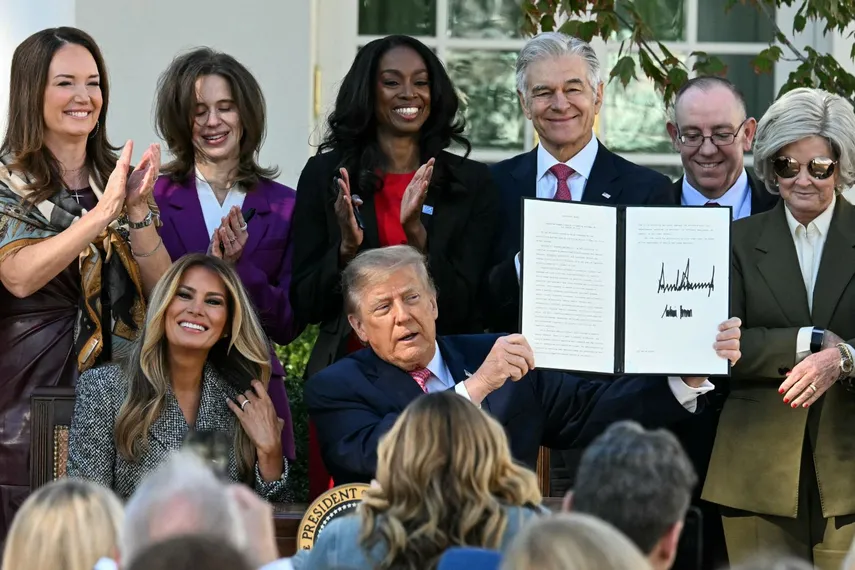
New federal initiative targets medical research gaps and better treatments.
WASHINGTON
President Donald Trump signed an executive order on October 19 establishing a new federal initiative to strengthen women’s health research, improve medical diagnosis and accelerate the development of treatments for conditions that disproportionately affect women. The initiative, championed by First Lady Melania Trump, introduces two coordinating bodies but leaves important questions about financing and implementation unresolved.
The order directs the National Institutes of Health (NIH) to establish a Women’s Health Division within 90 days. The division will work alongside the existing Office of Research on Women’s Health, seeking to strengthen scientific coordination and improve the representation of women in medical research.
A separate White House Women’s Health Task Force will coordinate policies across federal agencies. The group is co-chaired by White House Chief of Staff Susie Wiles and Health and Human Services Secretary Robert F. Kennedy Jr.
The administration identified several research priorities, including cardiovascular disease, cancer, Alzheimer’s disease, autoimmune conditions, chronic pain, infertility, endometriosis, maternal health and menopause.
These conditions present different clinical challenges, but they share an important concern: medical knowledge has not always adequately reflected the biological and healthcare needs of women across their lives.
The initiative also calls for greater consideration of sex-based biological differences in federally supported research and stronger efforts to translate scientific discoveries into clinical practice.
Melania Trump has emphasized five priorities, including advancing research into conditions affecting women, applying artificial intelligence to medical discovery, accelerating access to new treatments and improving affordability.
Artificial intelligence could support the analysis of complex medical datasets and the identification of promising therapeutic approaches. Its effectiveness, however, will depend on research quality, representative data, clinical validation and appropriate regulatory oversight.
The executive order introduces an institutional change rather than an immediate expansion of medical services. It does not specify a new funding allocation, making the scale of future research activity dependent on existing resources and subsequent budget decisions.
The administration also revoked a 2024 executive order and a 2023 presidential memorandum issued under former President Joe Biden, both addressing women’s health research.
That reversal introduces questions about policy continuity. The new initiative shares several objectives with previous federal efforts, although its organizational structure and implementation mechanisms differ.
Supporters of expanded women’s health research argue that longstanding scientific gaps require coordinated action. Critics of the administration have questioned whether the new commitments can deliver meaningful improvements without additional funding, particularly following earlier reductions affecting federal scientific programs.
The effectiveness of the initiative will therefore depend on more than establishing new offices. Research institutions will need clearly defined responsibilities, sufficient personnel and measurable objectives for improving clinical outcomes.
For patients, important benchmarks include earlier diagnosis, access to appropriate treatment and stronger evidence about medical conditions that have historically received inadequate attention.
The order signals renewed federal attention to women’s health, but it does not itself demonstrate that scientific discoveries, affordability or access to care have improved.
Its significance will become clearer as the NIH establishes the new division and federal agencies translate the administration’s priorities into funded research and clinical initiatives.
Where Innovation Meets Responsibility.