

 Phoenix 24
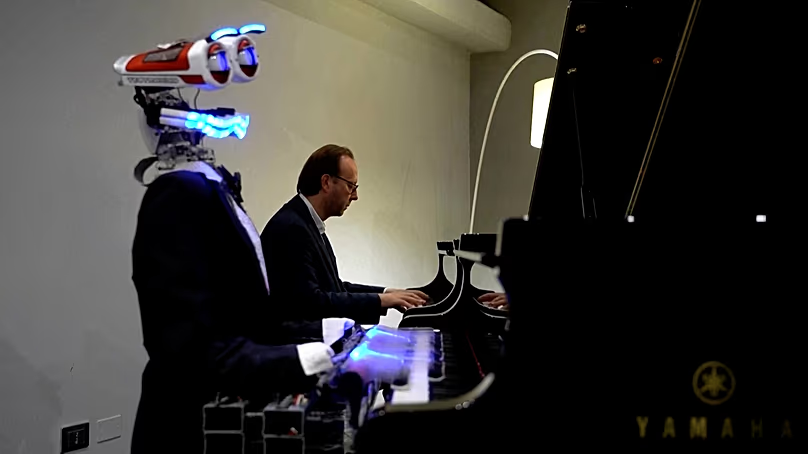
Mechanical perfection confronts the meaning of artistic expression.
Prato, Italy
An Italian robot pianist equipped with 53 mechanical fingers is challenging conventional ideas about musical talent, technical perfection and the role of human emotion in artistic performance. Known as TeoTronico, the machine has attracted international attention through appearances alongside concert pianist Roberto Prosseda, turning classical music into an unexpected encounter between robotics and human interpretation. Their performances raise a question extending beyond the concert hall: can technological precision reproduce the qualities that make artistic expression meaningful?
Developed by Italian electronics engineer Matteo Suzzi, TeoTronico has evolved from an experimental entertainment project into a sophisticated robotic performer capable of reproducing demanding classical compositions. Its mechanical fingers operate through a combination of electromagnetic actuators and other components, allowing the machine to execute musical sequences with remarkable consistency. The robot performs compositions by Mozart, Bach, Beethoven and Chopin using MIDI instructions that determine the notes and their timing. This technical distinction matters because accurate reproduction of programmed music is not equivalent to independently understanding or creating a musical interpretation.
Artificial intelligence adds another dimension to the project. TeoTronico incorporates Google’s Gemini conversational technology, enabling it to answer questions, engage in exchanges with audiences and adopt a deliberately provocative personality. During demonstrations, the robot presents its mechanical advantages as evidence of superiority over human pianists, particularly its ability to execute complex passages without conventional physical limitations. Yet its conversational abilities and its piano-playing mechanism perform different functions, and neither establishes that the machine experiences music emotionally.
Prosseda, who has shared international stages with the robot, approaches their encounters from a different perspective. He argues that musical performance involves communication between artists and audiences, not simply the accurate reproduction of written notes. Variations in phrasing, timing and expressive intention can transform the experience of listening, even when they depart from strictly mechanical consistency. For the Italian pianist, the danger is not necessarily that robots will replace musicians, but that aspiring performers may begin treating machine-like perfection as the ultimate artistic objective.
That concern extends into contemporary music education. Advanced technology can help students analyse rhythm, practise demanding passages and receive increasingly precise feedback on performance. However, an excessive emphasis on measurable accuracy may encourage learners to undervalue interpretation, experimentation and individual expression. The challenge for educators is determining how technological capabilities can strengthen musical development without reducing artistic achievement to technical indicators.
Suzzi believes further advances could eventually enable TeoTronico to improvise, generate compositions or respond musically to signals associated with an audience member’s mood. Such possibilities remain prospective capabilities rather than demonstrated evidence that the robot possesses human-like musical understanding. Systems capable of recognising facial expressions or vocal characteristics might adapt musical output accordingly, but interpreting those signals does not necessarily mean experiencing the emotions they represent. The distinction between computational responsiveness and subjective experience remains scientifically and philosophically unresolved.
The broader significance of TeoTronico lies in what its performances reveal about the relationship between humans and intelligent machines. As artificial intelligence enters creative professions, conventional boundaries between technical execution, authorship and interpretation are becoming increasingly difficult to define. Robots can extend the possibilities of musical performance, but evaluating artistic value also involves cultural context, audience perception and human relationships. A technically flawless performance is not automatically an emotionally compelling one.
TeoTronico demonstrates that technological sophistication can challenge established standards of professional excellence without settling the question of what constitutes genuine artistry. Its 53 fingers can execute musical passages beyond ordinary human physical capabilities, while Prosseda’s performances invite audiences to consider qualities that cannot be captured through accuracy alone. The encounter is therefore less a contest over which performer deserves to win than an examination of how society defines creativity, excellence and human contribution in an increasingly automated world.
Where Innovation Meets Responsibility.