

 Phoenix 24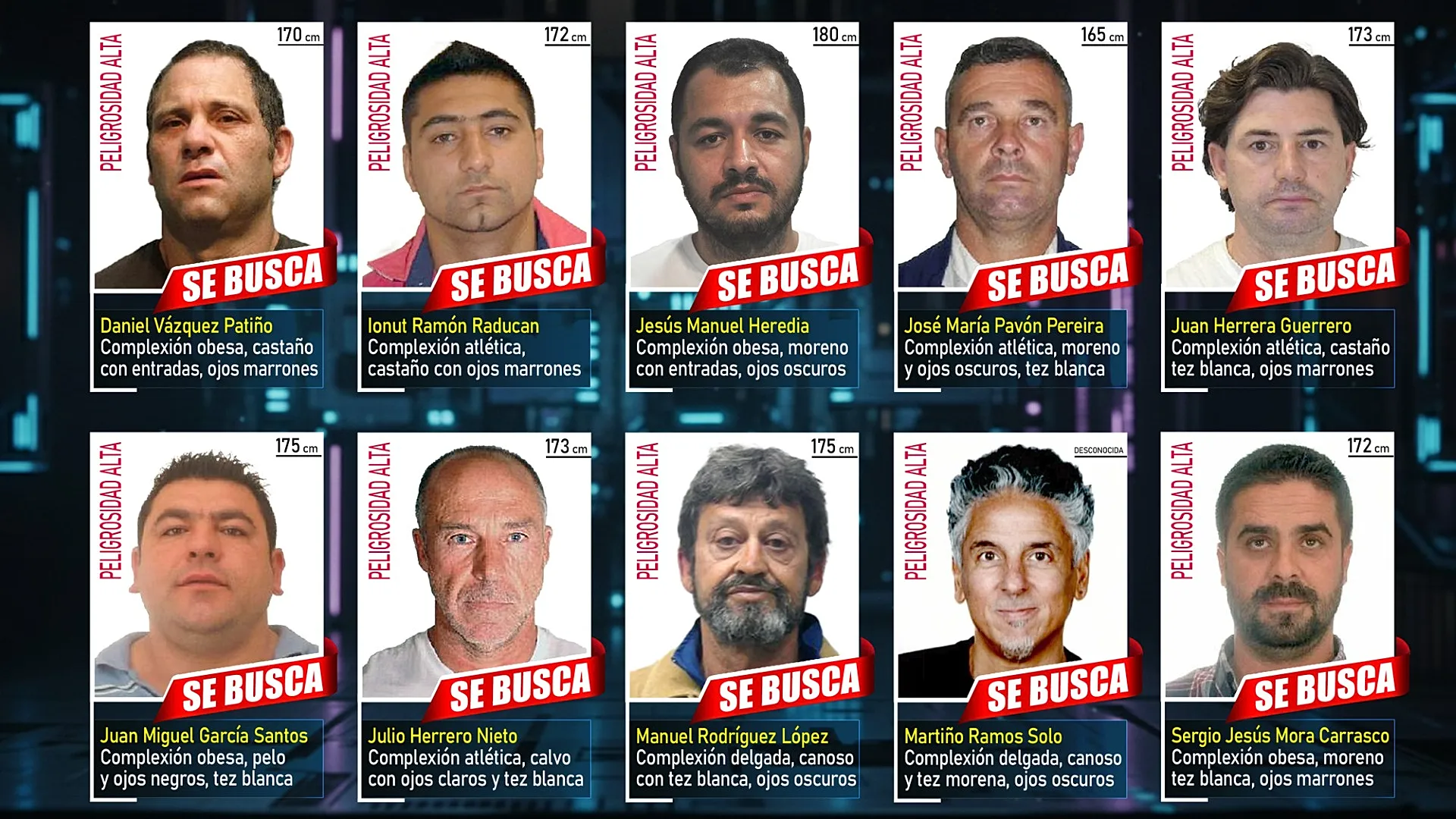
The pressure of a manhunt never disappears; it simply waits for the moment a fugitive makes a mistake.
London, November 2025
Spain’s updated list of its ten most wanted fugitives has become more than an institutional announcement. It is now a mirror of how contemporary criminality adapts, disperses and survives across borders. The recent arrest of a convicted sexual offender found abroad after years of clandestine movement reignited a broader national effort to track high-risk fugitives whose disappearance exposes weak points in the country’s security architecture. Investigators from the National Police concede that the escape route is no longer a desperate improvisation. It has become a planned phase within the operational cycle of violent crime.
The profiles included in the list reflect a grim spectrum: child sexual predators, human traffickers, murder suspects, drug network intermediaries and leaders of forced labor rings. Analysts from a European crime research center underline that these fugitives rarely operate alone. Their ability to remain invisible depends on small but resilient support cells that provide transport, false documents and short-term housing. Europol experts indicate that this model functions as a quiet logistical corridor where each participant minimizes exposure while ensuring continuity. The result is an ecosystem designed not to protect the fugitive permanently, but to extend the window of survival long enough to reconfigure identities and routes.
Spain’s pursuit is embedded within a larger European structure. Officials from the European External Action Service confirm that criminal mobility has evolved into unconventional patterns. Some fugitives navigate secondary routes through the Balkans, avoiding corridors with established checkpoints. Others move by small boats across fragmented areas of the central Mediterranean where surveillance intensity varies. The International Organization for Migration has reported similar overlaps between irregular migration flows and criminal escape routes, adding complexity to the identification process. These intersections force Spain to rely heavily on networks such as ENFAST, which coordinates alerts in multiple time zones and shares operational details with partners who monitor land borders, ports and airports.
Criminal interdependence with Latin America introduces an additional layer of difficulty. According to studies from an American organized crime observatory, certain Latin American networks offer fugitives logistical support in exchange for expertise, intelligence or access to illicit markets in Europe. This cooperation is most visible in cases involving cocaine trafficking and human exploitation. A researcher from the Peterson Institute who specializes in illicit economic systems explains that these exchanges are structured like commercial agreements, where risk is distributed and assets are diversified. The partnerships are not symbolic; they materially extend the lifespan of fugitives by giving them access to external safe routes.
Inside Spain, the National Police has implemented enhanced citizen-alert mechanisms and refined internal screening processes to filter large volumes of information. Hundreds of fugitives were located in the past year through public reports that were later cross-checked with biometric comparison tools and predictive models of appearance change. An expert from a Spanish security research institute warns that although these technologies improve precision, they must be used with caution to avoid misidentification or challenges to due process in court. The balance between technological speed and legal safeguards remains delicate, particularly when dealing with crimes involving minors or exploitation.
The social impact of publishing fugitive lists is another challenge. A criminologist involved in national risk perception studies indicates that repeated exposure to wanted images can generate desensitization, reducing the urgency of public cooperation. Authorities must therefore design communication strategies that retain attention without resorting to sensationalism. This is especially relevant in cases connected to crimes that provoke fear at a societal level, such as child sexual violence or trafficking of vulnerable women. A miscalibrated approach can either overwhelm the audience or trivialize the threat.
Not all support structures behind fugitives belong to organized crime. European researchers have documented cases in which individuals on the run survive by blending into informal labor markets, seasonal work circuits or migrant neighborhoods where documentation is seldom examined closely. These environments offer anonymity not through deliberate protection, but through the absence of institutional scrutiny. This diffuse form of sheltering is one of the main factors that complicates long-term tracking, even for experienced investigative units.
Spain’s updated list is therefore not a simple enumeration of dangerous individuals. It is a snapshot of a broader and more sophisticated system that relies on overlapping geographies, temporary identities and flexible logistics. The real task is not only to locate each fugitive, but to dismantle the scaffolding that allows them to remain operational outside the reach of the state. European cooperation, interregional data exchange and human intelligence now form the backbone of Spain’s strategy, but the future of these efforts will depend on the country’s ability to react to criminal innovation rather than merely respond to it.
At its core, this manhunt raises a deeper question about institutional resilience. The strength of a state is not measured only by how it captures criminals, but by how it prevents the infrastructure of escape from becoming a viable lifestyle for repeat offenders. Spain’s most wanted list is a reminder that as long as that infrastructure remains intact, the cycle of disappearance and pursuit will continue to reproduce itself.
Phoenix24: clarity in the grey zone. / Phoenix24: clarity in the grey zone.