

 Phoenix 24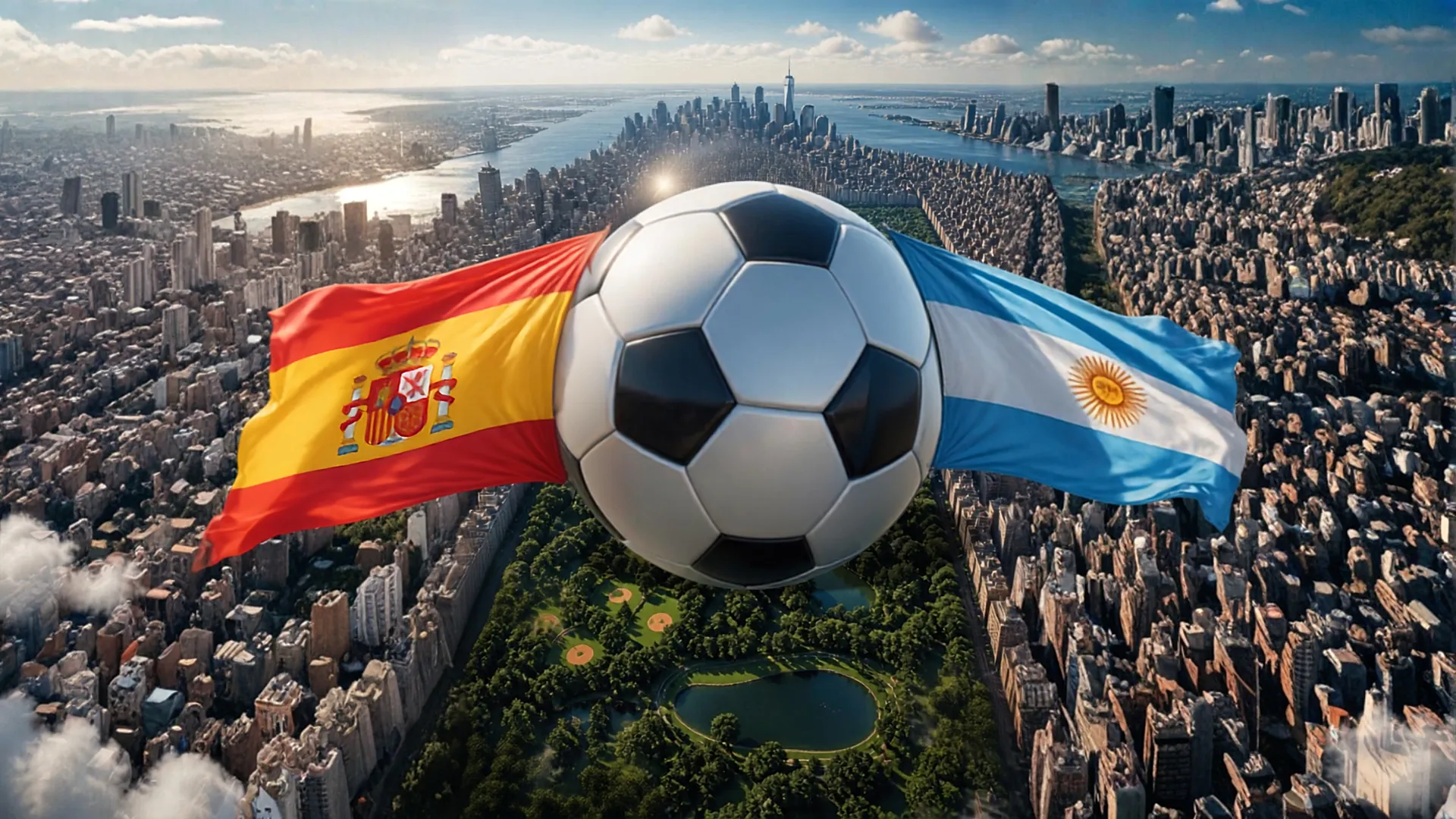
Possession, precision and legacy collide in New York.
New York | July 2026
Spain and Argentina will contest the 2026 World Cup final this Sunday in a match that brings together the reigning European champion and the defending world and South American champion. The decisive encounter will begin at 3:00 p.m. in New York, 9:00 p.m. in Madrid and 4:00 p.m. in Buenos Aires. More than 80,000 spectators are expected at the New York New Jersey Stadium for the final match of the first 48-team World Cup.
Euronews describes the confrontation as a clash between two football cultures that understand control in fundamentally different ways. Spain seeks to dominate through possession, structured movement and the disciplined management of space. Argentina prefers emotional acceleration, individual improvisation and the capacity to survive matches that appear to be escaping its control.
The final will also bring together two generations represented by Lionel Messi and Lamine Yamal. Messi arrives at another defining moment in a career already marked by international and club success, while Yamal represents the future of Spanish football and one of the tournament’s most disruptive attacking talents. Their presence gives the match a symbolic dimension extending beyond the tactical battle.
Argentina enters the final as the tournament’s most productive attacking team, having scored 19 goals. Lionel Scaloni’s side has combined experience, physical intensity and decisive individual actions, particularly during moments when the structure of a match begins to break apart. The defending champion has repeatedly demonstrated that it does not need complete control to create decisive opportunities.
Its semifinal against England provided the clearest example. Argentina remained behind until the closing stages before Enzo Fernández equalized in the 85th minute. Lautaro Martínez then completed the comeback during stoppage time after a decisive intervention from Messi, sending the South American side into another World Cup final.
Spain followed a contrasting route. Luis de la Fuente’s team defeated France 2-0 in the semifinal through controlled possession, coordinated pressure and clinical finishing. Mikel Oyarzabal converted a penalty before Pedro Porro extended the advantage early in the second half, allowing Spain to manage the remainder of the contest without surrendering its tactical identity.
The numbers reinforce that contrast. Argentina reaches the final with the strongest attack, while Spain arrives with the tournament’s best defensive record after conceding only one goal. The match therefore presents the classic confrontation between an expansive offensive force and a system designed to deny opponents space, rhythm and clear opportunities.
Spain is expected to preserve the structure that carried it through the knockout rounds. Unai Simón would start in goal behind a defensive line involving Porro, Pau Cubarsí, Aymeric Laporte and Marc Cucurella. Rodri and Fabián Ruiz would control the central areas, while Dani Olmo, Álex Baena and Yamal would operate around Oyarzabal.
Yamal’s physical condition remains one of Spain’s principal uncertainties. The young winger missed a training session after receiving treatment to his left thigh following a blow during the semifinal against France. The concern has been described as precautionary rather than serious, but his availability and physical freedom could significantly influence Spain’s ability to destabilize Argentina from wide positions.
Scaloni is also expected to maintain the foundation of his established lineup. Emiliano Martínez would remain in goal, with Cristian Romero, Lisandro Martínez and Nicolás Tagliafico forming part of the defensive structure. Rodrigo De Paul, Leandro Paredes, Enzo Fernández and Alexis Mac Allister would provide intensity and distribution through midfield.
Messi and Julián Álvarez are expected to lead Argentina’s attack. Their relationship combines the captain’s capacity to identify spaces with Álvarez’s continuous movement behind defensive lines. Lautaro Martínez remains another decisive option after his semifinal contribution, giving Scaloni the possibility of changing the attacking structure if Argentina requires greater presence inside the penalty area.
Rodri may become the central figure in Spain’s attempt to control Messi. The Manchester City midfielder will need to regulate possession while preventing Argentina from attacking the spaces created when Spain advances its fullbacks. His positional judgment could determine whether the European champion controls the rhythm or allows the match to become emotionally unpredictable.
Argentina, meanwhile, will attempt to disrupt Spain before its passing sequences become established. De Paul and Enzo Fernández can apply pressure aggressively, while Mac Allister offers the technical capacity to escape Spain’s first defensive line. The South American side may accept periods without possession if it can recover the ball in positions that expose Spain’s defensive transitions.
History adds another layer to the final. It will be the first World Cup championship match between two Spanish-speaking countries since Uruguay defeated Argentina in the inaugural tournament in 1930. Spain and Argentina have met only once previously at a World Cup, when Argentina won 2-1 during the 1966 edition.
Argentina is seeking its fourth world title after victories in 1978, 1986 and 2022. Another triumph would make it the first nation in decades to retain the World Cup and would extend Messi’s extraordinary international legacy. It would also confirm Scaloni’s team as one of the most successful national sides of the modern era.
Spain is pursuing its second championship, 16 years after the generation led by Andrés Iniesta, Xavi Hernández and Iker Casillas conquered the 2010 tournament in South Africa. Victory would connect that historic team with a new generation capable of combining positional discipline with greater attacking speed and individual creativity.
Slovenian referee Slavko Vinčić will direct the final. His experience includes major European club finals, and his management of physical contact and tactical fouls may become important in a match involving intense midfield pressure. Both teams possess players capable of changing the emotional temperature of the contest, making officiating consistency especially relevant.
The final represents more than a confrontation between famous players. It is a collision between two systems of belief: Spain’s conviction that order can control uncertainty and Argentina’s confidence that character can transform adversity. One team seeks to calculate the rhythm; the other thrives when the rhythm becomes impossible to calculate.
After 103 matches across Canada, Mexico and the United States, the expanded World Cup will conclude with a final carrying historical, tactical and generational significance. Spain wants to recover the crown through precision. Argentina wants to preserve it through resilience and attacking instinct.
Only one philosophy will leave New York carrying the fourth or second star it has pursued across an unforgettable tournament.
Phoenix24 | One final, two identities, a world watching. Una final, dos identidades, un mundo observando.