

 Phoenix 24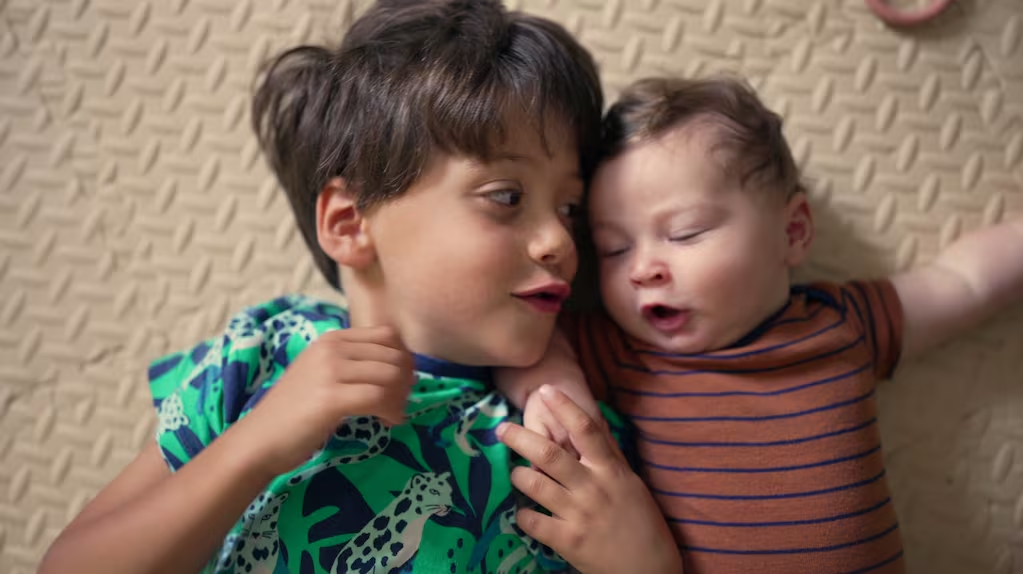
Some of the most important learning happens quietly at home.
Mexico City, April 2026. The growing interest in what children learn by helping care for younger siblings reveals something larger than a parenting anecdote. It points to a developmental truth that remains deeply relevant in an age obsessed with artificial intelligence: daily family interaction can become a training ground for emotional skills that no screen can fully automate. What this conversation highlights is not simply that children become more helpful. It is that they begin to build capacities linked to empathy, emotional regulation, and conflict navigation.

That matters because these abilities often emerge through repetition rather than formal instruction. A child who helps care for a younger sibling must observe moods, anticipate needs, adapt communication, and respond to frustration in real time. Those are not minor domestic gestures. They are early exercises in reading emotion and managing social complexity. In developmental terms, the household becomes a practical laboratory for interpersonal intelligence.
The current fascination with AI adds a revealing layer to this issue. When technology driven analysis points toward empathy and emotional intelligence as key outcomes of sibling care, it indirectly confirms the limits of purely technical models of development. Data systems may detect patterns, but the skills themselves are still formed through lived human contact. That is why the story has broader significance. It reminds us that the foundations of emotional competence are often built not through specialized programs, but through ordinary acts of relational responsibility.

There is also a cognitive dimension beneath the emotional one. Children who care for younger siblings are often pushed to interpret changing situations, solve small problems, and regulate their own impulses while attending to someone else’s needs. This can strengthen patience, flexibility, and decision making in ways that later extend into school, friendships, and group settings. In other words, sibling care is not only about kindness. It can also sharpen adaptive intelligence.
Still, the issue requires balance. There is a clear difference between age appropriate participation and excessive responsibility. Emotional growth tends to emerge when care is framed as collaboration inside a healthy family environment, not when a child is overburdened or forced into substitute parenting. That distinction is crucial. What builds empathy is not pressure alone, but guided involvement within a stable and supportive structure.

This is where the broader social meaning appears. Modern societies increasingly celebrate measurable achievement while underestimating the silent formation of relational abilities inside the home. Yet many of the qualities now most valued in education, leadership, teamwork, and even human centered technology depend on the same emotional competencies developed in intimate settings. The family remains one of the earliest places where a child learns how to read another person without reducing them to information.
That is why the real importance of this story extends beyond children helping children. It speaks to a larger tension in contemporary culture. As artificial intelligence becomes more sophisticated at simulating interaction, the human skills that matter most may be those formed through care, patience, and emotional presence. A child learning to comfort, mediate, or adapt within the family is developing something more durable than convenience. They are building a form of social intelligence that will remain valuable precisely because it cannot be fully mechanized.
The deeper lesson is simple but not trivial. Sibling care, when balanced and age appropriate, can function as a quiet school of emotional maturity. It teaches that understanding another person is not an abstract virtue, but a practiced act. In a world increasingly organized around speed, interfaces, and automated response, that may be one of the most important forms of development a child can carry into the future.
Detrás de cada dato, hay una intención. Detrás de cada silencio, una estructura.
Behind every data point, there is an intention. Behind every silence, a structure.