

 Phoenix 24
Reputation collapses faster than evidence.
New Orleans, February 2026.
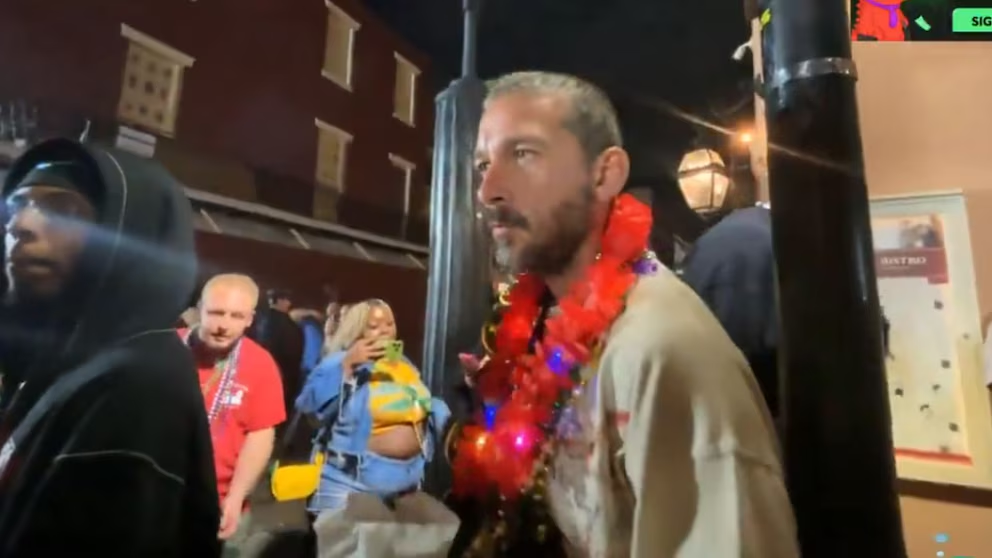
The episode, as described through police reporting and accounts circulated in international media, is not simply celebrity gossip. It is a compact example of how the contemporary public sphere can turn a street altercation into a global narrative file. Shia LaBeouf was arrested in New Orleans after a fight during Mardi Gras, and the controversy escalated beyond the physical confrontation because of a second claim: that he allegedly shouted homophobic slurs while clashing with multiple people outside a bar.
On the legal track, the case sits in a familiar lane. Coverage has described charges consistent with simple assault, the kind of allegation that is processed routinely in local systems. But the reputational track operates on different rules and at a much higher speed. Allegations of homophobic language carry a symbolic charge that is interpreted as social risk, not as “just words.” The public narrative stops asking only who hit whom and starts asking what kind of aggression this was, what climate it created, and what it might normalize.

What makes the story volatile is the nature of the evidence feeding it. Reports have pointed to police documents that attribute repeated homophobic insults to the incident. Alongside that are witness and victim claims describing a chaotic scene, with shouting, pushing, and punches, unfolding in a high density festival environment shaped by alcohol, crowd pressure, and the stimulation of a city in celebration. In that setting, legal truth tends to move slowly, while media truth hardens early, often around a handful of phrases that function as moral proof even before they become procedural proof.
That tension is structural: the difference between allegation and conviction. Serious journalism leans on conditional language because the cost of a factual error is high. Audiences, however, often operate through heuristics. A police report is treated as certainty. An emotionally vivid account is treated as pattern. A figure with prior controversy is treated as repetition. None of these leaps require malice. They require speed, and speed penalizes nuance.
The hate dimension adds another layer because it does not stay inside the scene. Whether a case is formally treated as a hate incident depends on jurisdictional standards and specific proof, and it rarely resolves within the first media cycle. What does resolve quickly is cultural polarization. For some, the story confirms a model of aggressive masculinity and performative entitlement. For others, it becomes a new chapter in the argument about “cancel culture” and excessive sensitivity. Either way, the fight stops being a fight and becomes a symbol, and symbols are managed with little patience.

There is also a broader industry context that makes this kind of incident unusually consequential. Entertainment brands learned long ago that “off camera behavior” is part of the product. The boundary between personal conduct and professional identity has eroded, and a late night arrest in a tourist district can circulate with the same force as a film premiere. In that frame, alleged slurs are interpreted as indicators of values, even when the incident itself is confused and noisy. The contemporary logic is unforgiving: audiences do not only consume work. They consume coherence. When they perceive incoherence, they react as if there has been a breach of trust.
From a social psychology perspective, the pattern is recognizable. Morally charged events activate group identity. Those who feel targeted by the alleged language mobilize around sanction because punishment reaffirms norms. Those who fear precedent mobilize around defense because defense reaffirms autonomy against what they perceive as social surveillance. The episode becomes less about one individual’s behavior and more about how a polarized audience uses the incident to confirm what it already believes about culture, power, and belonging.
Even the urban governance layer matters here. Mardi Gras is not a neutral stage. It is a mass event where policing, private security, alcohol consumption, and crowd management intersect under pressure. Arrests in that context are often fast containment moves, followed by a slower phase where the narrative depends on records, cameras, reports, and testimony that rarely line up cleanly. The dominant storyline is not always the most accurate one. It is often the most reproducible one.
None of this substitutes for due process, and it should not be mistaken for a verdict. The more durable observation for a global audience is this: the system no longer punishes only the punch. It punishes the interpretation of the punch. In an era of imperfect traceability, interpretation tends to anchor on what sounds definitive, not on what is most verifiable. Whatever the legal outcome, the case already functions as a reminder of the moment we are in: reputations are now decided in the narrow corridor between official reporting and viral narrative, and that corridor is where errors multiply, but also where public culture gets written.
Phoenix24: claridad en la zona gris. / Phoenix24: clarity in the grey zone.