

 Phoenix 24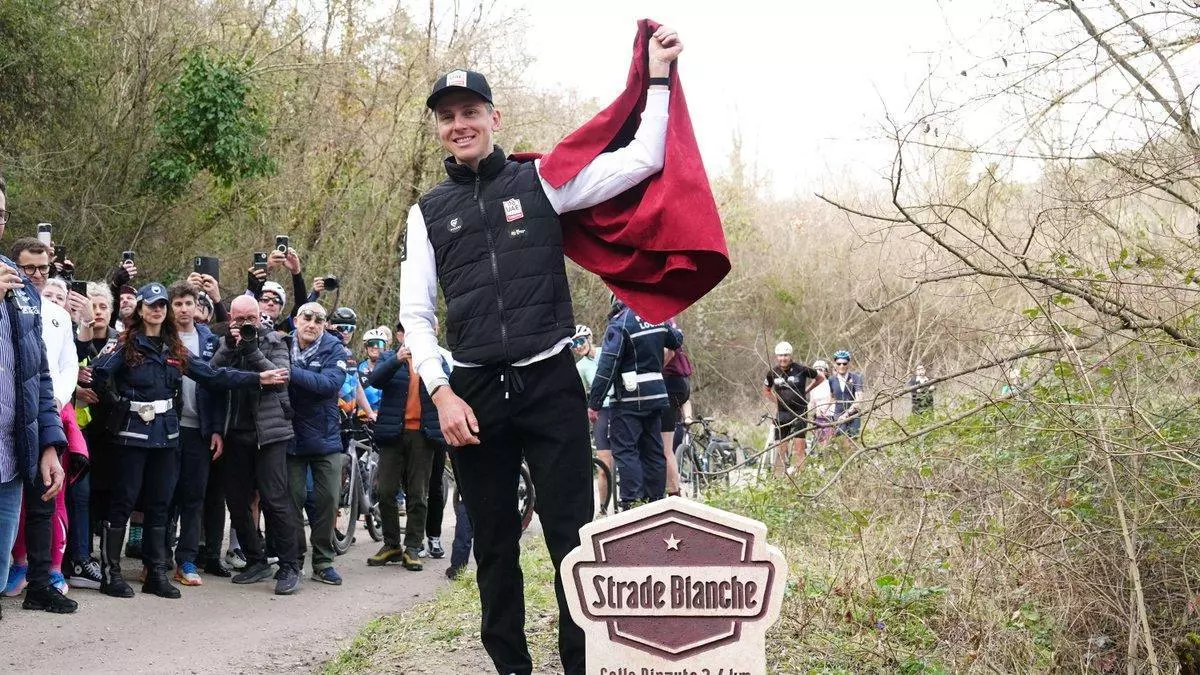
The season begins where control gets tested.
Siena, March 2026
Tadej Pogačar will begin his 2026 season at Strade Bianche, and the choice of stage is not sentimental. It is structural. This race does not allow a champion to drift into form in anonymity, because Tuscany’s white roads compress every weakness into a visible mistake. Pogačar arrives as the defending winner, a three-time champion of the event, and the rider who has turned this modern classic into a recurring demonstration of how quickly he can separate the field when the surface stops forgiving. His return is also his first race since Il Lombardia last October, a long gap by elite standards that makes the debut meaningful even before the first attack is launched. The comeback is not only about legs. It is about re-entering the psychological tempo of competition after months of training, recovery, and quiet accumulation.
Strade Bianche is designed to punish anyone who confuses fitness with readiness. It is a one-day race that behaves like a miniature stage race: repeated stress, repeated decision points, and repeated opportunities for chaos. The 2026 edition marks the twentieth running, with roughly 200 kilometers of racing and a heavy dose of gravel sectors that fracture the peloton into survival groups long before the finish. The final kilometers into Siena, culminating in the climb toward Piazza del Campo, are not merely photogenic. They are a final sorting mechanism. Riders who arrive at that ramp with debt in their legs do not get a second chance, and riders who arrive with control can turn a small gap into an unanswerable verdict. That is why the race is such an efficient referendum on form.
For Pogačar, the debut lands inside an unusually loaded narrative. He is not returning as a contender among contenders. He is returning as the reference point. When a rider dominates a race in consecutive editions, the conversation shifts from who can win to who can change the script. That is what makes his season opening so charged. It forces rivals to declare intentions early, because letting him settle into rhythm is often the same as letting him decide the moment of separation. In this edition, he will face a familiar cluster of threats, riders capable of surviving the gravel, responding to accelerations, and turning the final approach into a tactical contest rather than a solo recital. Names like Tom Pidcock and Wout van Aert sit naturally in that category, and the broader field includes riders whose strength is not only power but refusal to panic when the race breaks in unpredictable ways. The presence of a fast-rising talent like Paul Seixas adds a different kind of tension: the curiosity of whether a new variable can disturb an established hierarchy, even if only by forcing an extra decision from the favorite.
UAE Team Emirates-XRG arrives with a support roster that signals intent rather than caution. Pogačar will not be isolated by design. The team has brought a group built to control the race’s middle phase and reduce the number of chaotic scenarios where luck decides positioning. That matters because Strade Bianche is often won by the strongest rider, but it is frequently lost by the strongest rider who is badly placed at the wrong moment. Pogačar’s support includes riders suited to the demands of gravel, transitions, and the fatigue that accumulates as the race repeatedly changes surface and speed. Even the team’s internal story matters: UAE has already collected early-season wins through other leaders, and that collective momentum changes how a squad behaves. A team that has already tasted victory tends to race with more clarity and less desperation. That is an advantage in a race that punishes emotional decision-making.
The course itself is part of the debate this year because small changes can shift how opponents imagine their chances. Reports around the 2026 route indicate it has been trimmed slightly, with some gravel reduction compared to the prior edition. On paper, fewer gravel sectors should favor more conventional road strength and make the race marginally less selective. In practice, that assumption often fails with Pogačar, because his advantage is not only in pure gravel handling. It is in his ability to accelerate repeatedly, sustain pressure, and convert a moment of disorder into a permanent separation. If the course is slightly less chaotic, it can also become easier for the strongest team to manage. The more orderly a race becomes, the more likely it is that the most complete leader and the most organized team can turn strength into control.
There is also a symbolic detail that reveals how far Pogačar’s dominance has reached. One of the race’s gravel sectors, Colle Pinzuto, has been named in his honor. That kind of recognition is rare in a sport that normally reserves memorials for retirement, tragedy, or decades of historical distance. Naming a sector after an active rider is a statement about impact in the present tense. It also adds pressure, because it turns the day into a ceremony whether the rider wants it or not. If he wins, the story becomes inevitability. If he loses, the story becomes vulnerability. Either way, the myth grows.
The deeper strategic question is what this debut signals about Pogačar’s season architecture. Strade Bianche is not a random first race. It is consistent with a selective approach that prioritizes the Monuments and the Tour de France, with appearances chosen to maximize competitive sharpness rather than accumulate early-season mileage. That approach carries a risk: fewer races mean fewer opportunities to absorb mistakes in public before the biggest objectives arrive. But it also carries a benefit: each appearance becomes an event, and the team can build preparation cycles around high-impact days rather than constant travel. In modern cycling, where fatigue management and peak timing are increasingly scientific, that strategy can be a form of control.
For the sport, this debut is also a calibration moment. When a dominant rider returns, the peloton reveals its psychology. Does it race collectively to contain him, or does it race competitively to beat each other and accept that containment is someone else’s problem. Strade Bianche often exposes that choice early, on a gravel sector where a small split becomes a large gap because cooperation collapses. If rivals want to beat Pogačar, they need not only legs but coordination, and coordination is the rarest resource in a field full of private ambitions.
Pogačar has framed his return with a simple desire: a good start, the feeling of racing again after watching from the couch. That modest language is part of the ritual, but the reality is heavier. His season begins in a place designed to test control, and control is what defines his dominance. If he wins again, it will not only be another classic in the palmarès. It will be the opening proof that the hierarchy remains intact. If he does not, it will not mean decline. It will mean the peloton has finally found a way to complicate the script. Either outcome matters, because Strade Bianche is not merely a race. It is the first public answer to the year’s most persistent question: can anyone force Pogačar to race on their terms.
Every silence speaks. / Cada silencio habla.