

 Phoenix 24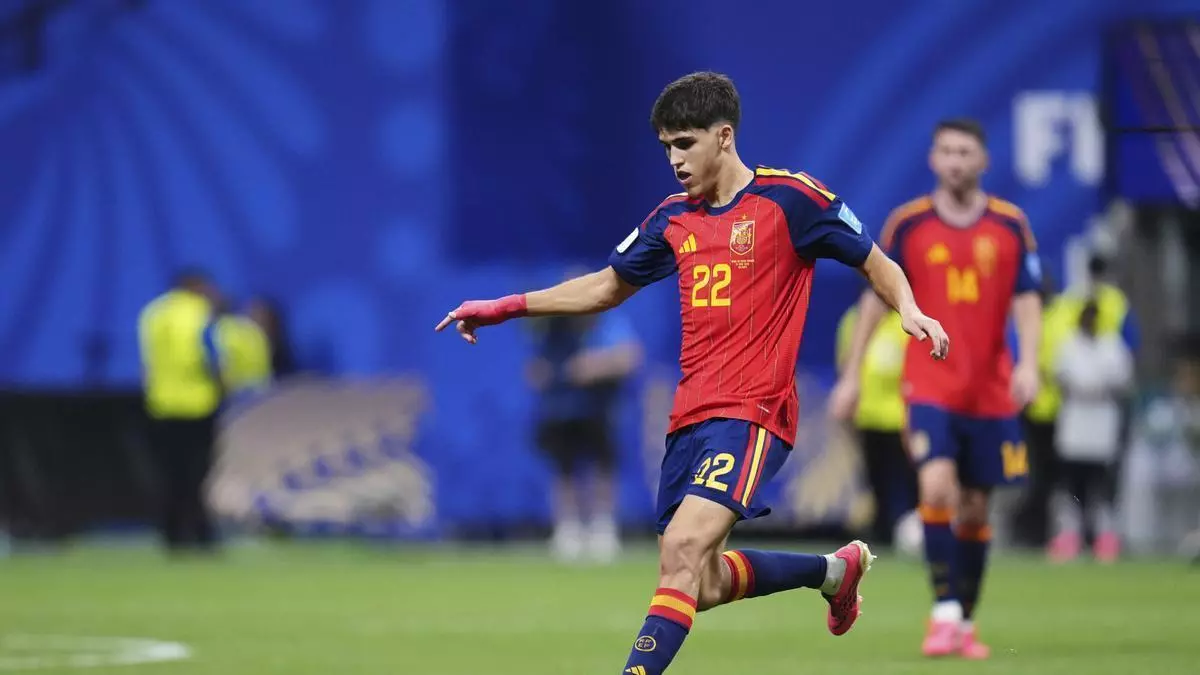
The teenage defender is turning distribution into quiet authority.
ATLANTA, United States | June 2026
Pau Cubarsí is emerging as one of Spain’s most reliable performers at the 2026 World Cup, not through spectacular tackles or dramatic goals, but through an extraordinary level of passing precision. The 19-year-old central defender completed 98 of 99 passes during Spain’s 4-0 victory over Saudi Arabia. That performance followed an equally impressive tournament debut against Cape Verde, when he completed 107 of 109 attempts. Across his first two World Cup matches, only three of his 208 passes failed to reach a teammate.
The numbers explain why Cubarsí has become indispensable to Luis de la Fuente’s system. Spain wants to control possession, move opponents from side to side and build attacks patiently from the back. That approach requires defenders who can remain calm under pressure and identify the correct passing lane without slowing the game. Cubarsí combines technical accuracy with the judgment needed to decide when to circulate the ball and when to break defensive lines.
Against Saudi Arabia, his distribution was nearly flawless. He completed all four of his attempted long passes while repeatedly helping Spain advance into midfield. His performance was not limited to safe exchanges with goalkeeper Unai Simón or defensive partner Aymeric Laporte. Cubarsí also delivered passes through pressure and into areas where Spain’s midfielders could immediately attack the next line.
Spain’s 4-0 victory provided the ideal context for his qualities. After a disappointing scoreless draw against Cape Verde, the national team needed a convincing response in its second Group H match. Lamine Yamal opened the scoring in the tenth minute before Mikel Oyarzabal added two goals in quick succession. An own goal by Hassan Al Tambakti completed the result early in the second half.
The attacking players received most of the attention, but Cubarsí’s control from the back helped create the conditions for Spain’s dominance. Saudi Arabia struggled to disrupt the rhythm because the defender rarely surrendered possession. When one passing route closed, he changed the angle and found another. His confidence allowed Spain’s midfielders and fullbacks to position themselves higher without fearing an unnecessary turnover.
That composure is particularly remarkable because Cubarsí is playing in his first senior World Cup. Many young defenders become conservative when appearing on football’s largest stage, choosing the safest option and avoiding responsibility. Cubarsí has done the opposite. He continues demanding the ball and participating in the construction of attacks as though the tournament were an extension of his regular club football.
His maturity has been one of the defining characteristics of his rapid rise. Cubarsí made his first-team debut for Barcelona in January 2024 and soon demonstrated that his age did not prevent him from understanding complex tactical situations. Within months, he was competing in the Champions League and appearing for Spain’s senior national team. His progress transformed him from an academy prospect into an established international defender.
The journey was not entirely uninterrupted. Luis de la Fuente included him in Spain’s preliminary squad before Euro 2024 but ultimately left him out of the final selection. Cubarsí later joined the Olympic team and won the gold medal in Paris. That experience helped him continue developing without treating the European Championship omission as a permanent setback.
Two years later, there is little debate about his importance to Spain. Cubarsí has formed a balanced partnership with Laporte, whose experience complements the younger defender’s speed of thought and distribution. Laporte provides physical authority and positional guidance, while Cubarsí gives the team a dependable first pass. Their understanding has helped Spain maintain consecutive clean sheets during the opening phase.
Passing statistics can sometimes be misleading because central defenders often complete short, low-risk exchanges. Cubarsí’s value lies in the combination of accuracy and intention. He does not simply protect his completion percentage. He uses the ball to manipulate pressure, accelerate possession and connect Spain’s defense with its most creative players.
His ability to receive while facing his own goal is equally important. Opponents frequently attempt to press Spain high, hoping to force mistakes near the penalty area. Cubarsí responds by controlling the ball cleanly, scanning before possession arrives and selecting his next action quickly. Those details reduce the time available for forwards to close him down.
The defender also contributes through anticipation rather than excessive physical confrontation. He reads passing lanes early and often recovers possession before a duel becomes necessary. This style allows him to defend aggressively without constantly leaving his position. It also helps Spain regain the ball quickly and resume its controlled attacking structure.
His development reflects the football education traditionally associated with Barcelona’s academy. Central defenders are expected to understand possession as deeply as midfielders. They must recognize space, break pressure and accept responsibility for initiating attacks. Cubarsí appears comfortable with those demands because they have shaped his game from an early age.
Spain’s next challenge against Uruguay will test him differently. The South American team can combine physical intensity with direct attacking transitions. Cubarsí may have less time on the ball and more defensive work than he experienced against Saudi Arabia. His passing accuracy will matter, but his positioning and ability to manage space behind Spain’s advanced line will be equally significant.
The tournament will eventually place greater pressure on every mistake. Knockout matches can be decided by one poor pass, one late reaction or one moment of hesitation. Cubarsí’s early performances suggest that he is prepared to accept that responsibility. His calmness does not eliminate risk, but it gives Spain a defender capable of managing it intelligently.
At 19, Cubarsí is already playing with the authority of a much more experienced international. His World Cup has begun with two clean sheets and a passing record close to perfection. The statistics are impressive, but the deeper significance lies in what they reveal about Spain’s structure. Every successful attack begins more easily when the first decision is precise.
Precision becomes leadership when every pass gives the team control. / La precisión se convierte en liderazgo cuando cada pase le da control al equipo.