

 Phoenix 24
The ending separates a false conviction from a hidden crime.
BOSTON, United States | June 2026
Netflix’s I Will Find You ends by revealing that David Burroughs was imprisoned for a crime built on fabricated evidence, while the true disappearance of his son Matthew was connected to a wealthy family and a false belief about paternity. The mystery begins with David serving a life sentence for allegedly murdering his three-year-old son. A bloodstained baseball bat, a neighbor’s testimony and David’s history of night terrors were used to support the conviction. The final episodes dismantle each of those assumptions and expose two separate conspiracies operating around the same tragedy.
The turning point comes when journalist Rachel Mills visits David in prison with a photograph taken at an amusement park. A boy in the background appears to have the same birthmark on his cheek as Matthew. The image creates the possibility that David’s son was never murdered and gives him a reason to escape. With help from prison director Philip Mackenzie and his son, police sergeant Adam Mackenzie, David begins searching for the child while federal agents pursue him.

Rachel’s investigation first returns to Hilde Winslow, the neighbor whose testimony helped send David to prison. Hilde had claimed that she saw him burying the murder weapon, but she later admits that the statement was false. Local criminal figure Nicky Fisher forced her to lie as part of a revenge campaign against David’s father, Lenny, a former police officer. Fisher blamed Lenny for the death of his own son in prison and wanted to destroy his family.
This revelation proves that the evidence against David was manipulated, but Fisher was not responsible for Matthew’s disappearance. His role was limited to framing David after the crime had already taken place. The distinction is essential because the series initially encourages viewers to believe that the fabricated evidence and the kidnapping must have come from the same person. Instead, David became the victim of two unrelated acts of revenge and obsession.
The real architect of Matthew’s disappearance is Hayden Payne, a wealthy philanthropist and Rachel’s former boyfriend. Hayden believed that he was Matthew’s biological father because of a confusion involving a fertility clinic. David’s former wife, Cheryl, attended Berg Reproductive under Rachel’s name, and Hayden later provided genetic material believing Rachel was the patient. When he saw Matthew years later at a family gathering, he assumed the child had been conceived through that process.
Hayden never knew that his mother, Gertrude Payne, had secretly ordered a paternity test. The result showed that he was not Matthew’s father, but she concealed that information from him. His conviction therefore remained intact and became the emotional justification for the kidnapping. Hayden saw himself not as a criminal taking another family’s child, but as a father reclaiming someone he believed belonged to him.
To make Matthew appear dead, Hayden constructed an elaborate substitution. The body found in the child’s bed belonged to Martin Bischoff, a Swiss boy suffering from metachromatic leukodystrophy who lived in an orphanage operated by the Payne family. Hayden transported Martin to Boston, killed him and manipulated the DNA evidence so that authorities would identify the body as Matthew. The act transformed his obsession into murder and allowed the kidnapping to remain hidden for years.
The false identification explains why David stopped fighting with full intensity after his conviction. He believed his son was dead, and proving his own innocence could not restore the life he thought had been lost. The amusement-park photograph changes that emotional logic because it gives him something more urgent than freedom. His escape is driven by the need to correct the failure he feels as a father and protect Matthew while there is still time.
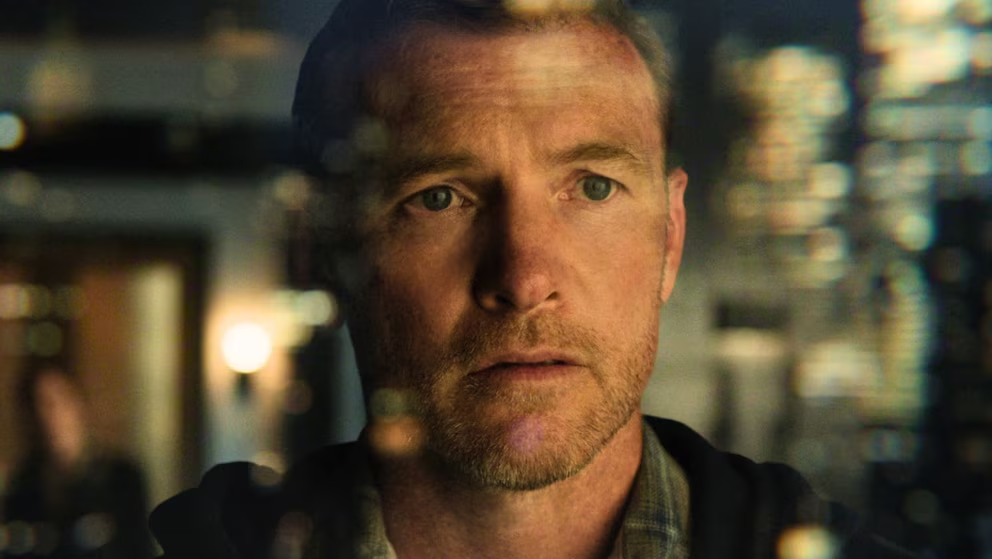
FBI agents Sarah Greer and Max Williams spend much of the series tracking David under the assumption that he has become dangerous. Greer gradually begins to recognize inconsistencies in the original case and doubts the official version of events. Her change of perspective becomes decisive during the final confrontation at the Payne mansion. When Hayden points a weapon at Rachel, Greer shoots and kills him.
Hayden’s death ends the immediate threat, but the series avoids presenting it as a simple victory. David has recovered the truth, yet years of his life were taken from him and Matthew grew up under another identity. The family must now rebuild relationships shaped by grief, guilt and deception. The ending emphasizes recovery rather than suggesting that one revelation can erase the consequences of the crime.
Eight months later, David’s conviction is formally overturned. Rachel publishes a book documenting the case, while Cheryl has a daughter with her current husband, Ronald Dreasen. Adam loses his position in the police force and opens a private detective agency. These developments show how each character moves forward after becoming involved in the search.
The final family reunion takes place at Lenny’s funeral after his death from colon cancer. The setting brings the surviving characters together through another loss rather than through a public celebration. David and Rachel hold hands while looking at the family they fought to reunite. His voice-over acknowledges that the road ahead will not be easy, but that worthwhile things rarely are.
The restrained final gesture is important because the series does not resolve the relationship between David and Rachel through a dramatic romantic declaration. Their connection remains open, grounded in shared suffering, loyalty and the experience of finding Matthew. The conclusion allows tenderness to replace spectacle. After a story dominated by accusations, pursuit and violence, the final image values the quiet restoration of trust.

I Will Find You ultimately builds its ending around the distinction between innocence and recovery. David proves that he did not murder his son, but freedom alone is not the complete resolution he needs. The deeper victory is discovering that Matthew survived and exposing the network of lies that erased his identity. The mystery closes by showing that the truth can correct a conviction, while healing the people damaged by it requires far more time.
The truth does not erase the past, but it changes the future. / La verdad no borra el pasado, pero cambia el futuro.